Introduction
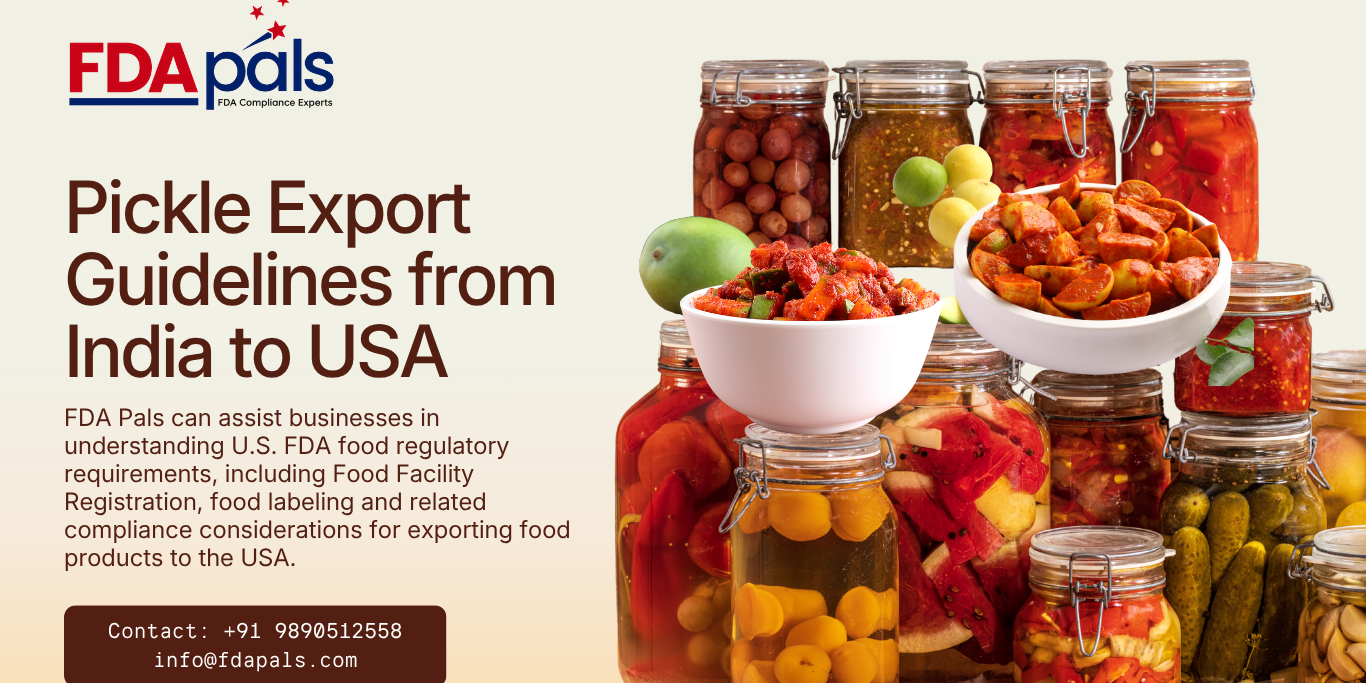
Indian pickles are popular in international markets because of their distinctive flavors, traditional preparation methods, and wide variety of ingredients. Mango pickle, lime pickle, mixed vegetable pickle, chili pickle, and other regional varieties are increasingly finding opportunities among Indian-origin consumers as well as consumers interested in international foods.
However, exporting pickles from India to the United States is not simply a matter of preparing the product, putting it into jars, and shipping it overseas. Exporters need to consider Indian food regulations, U.S. FDA requirements, food safety controls, product classification, labeling, facility registration, import procedures and documentation.
The exact requirements can vary depending on the formulation, processing method, packaging, shelf stability and intended market. In particular, some commercially processed shelf-stable pickles may fall within FDA requirements applicable to acidified foods, making process filing and scheduled-process considerations important.
This guide explains the key pickle export guideline that Indian manufacturers and exporters should understand before exporting pickle products to the USA.
Why Is Compliance Important When Exporting Pickles to the USA?
Food products imported into the United States must comply with applicable U.S. food safety and labeling requirements. FDA states that imported foods must be safe, sanitary and properly labeled, and imported food can be inspected at U.S. ports of entry.
FDA does not generally pre-approve individual food products, labels or shipments before importation. Instead, compliance is assessed under the applicable regulatory requirements, including facility registration, food safety requirements, labeling and import procedures.
For an Indian pickle exporter, non-compliance can result in shipment delays, detention, refusal or other regulatory action.
Therefore, compliance should be considered before the first commercial shipment, not after the product has already reached the U.S. port.
1. Obtain the Required Registrations and Licenses in India
Before exporting pickles, the manufacturer or exporter should establish the required Indian business and food regulatory framework.
✅ FSSAI License
Pickles are regulated food products in India. FSSAI’s food product standards include requirements for pickles, including provisions concerning ingredients, preservation and microbiological requirements.
The food business operator should therefore have the appropriate FSSAI license for its activities.
FSSAI’s FoSCoS system provides eligibility and licensing information for food businesses, including exporters.
✅ Importer Exporter Code (IEC)
An Indian business exporting goods generally needs an Importer Exporter Code (IEC) issued through the Directorate General of Foreign Trade (DGFT).
Exporters should also determine whether any applicable registration or membership requirements apply to their products and business model.
APEDA provides export guidance covering steps such as establishing an organization, obtaining PAN and IEC and other export-related requirements.
2. Understand the FDA Food Facility Registration Requirement
If a facility manufactures, processes, packs or holds food intended for consumption in the United States, it may be required to register with FDA before beginning those activities, unless an exemption applies.
This is particularly important for Indian pickle manufacturers exporting to the USA.
What does FDA Food Facility Registration mean?
FDA food facility registration allows FDA to identify facilities involved in the U.S. food supply chain. Registration does not mean that FDA has approved the pickle product or certified the facility as compliant.
Foreign facilities subject to registration also need to provide the information required by FDA, including the applicable U.S. agent information.
Food facility registrations are subject to biennial renewal. FDA’s 2026 renewal period runs from October 1 through December 31, 2026.
Therefore, exporters should not treat FDA registration as a one-time activity.
3. Determine Whether Your Pickle Is an Acidified Food
This is one of the most important considerations when exporting shelf-stable pickles to the USA.
Many commercially packaged pickles use acidification as a method of controlling microbial growth and achieving shelf stability. Depending on the product and processing method, an exported pickle may fall within FDA’s regulatory framework for acidified foods.
FDA’s acidified food requirements under 21 CFR Part 114 can include establishment registration and process filing requirements for commercial processors.
FDA states that a commercial processor that manufactures, processes or packs acidified foods must register its establishment and provide information concerning the scheduled processes for its acidified foods.
Why is process filing important?
The scheduled process is linked to factors such as:
- Product formulation
- Acidity
- Processing method
- Container type and size
- Thermal processing conditions
- Critical processing factors
- Storage conditions
Therefore, an exporter should not assume that simply having an FDA Food Facility Registration automatically completes the FDA requirements for a shelf-stable pickle.
Food Facility Registration and acidified food process filing are separate regulatory considerations.
The applicability should be evaluated based on the actual product and manufacturing process.
4. Maintain Strong Food Safety Controls
Pickles contain ingredients such as vegetables, fruits, spices, oil, salt, vinegar, acids and other ingredients. Depending on the recipe and processing method, different hazards may need to be evaluated.
Potential food safety concerns may include:
- Microbial contamination
- Yeast and mold
- Pathogenic microorganisms
- Contaminated raw materials
- Pesticide residues
- Heavy metals
- Allergen-related risks
- Chemical contamination
- Foreign matter
- Incorrect processing conditions
A manufacturer should conduct an appropriate hazard analysis and implement preventive controls and sanitation practices applicable to its operation.
The U.S. regulatory framework places strong emphasis on preventive food safety controls, and FSVP requires U.S. importers to verify that foreign suppliers produce food in a manner that meets applicable U.S. food safety requirements.
5. Follow U.S. Pickle Labeling Requirements
Correct labeling is one of the most common compliance considerations for food exporters.
The label should be reviewed against applicable U.S. FDA food labeling requirements before printing commercial packaging.
Depending on the product, the label may need information such as:
- Statement of identity/product name
- Net quantity of contents
- Ingredient statement
- Allergen declaration, when applicable
- Nutrition Facts
- Name and place of business of the manufacturer, packer or distributor
- Country-of-origin information where applicable
- Appropriate lot or production identification
- Other required statements depending on the product
FDA’s Food Labeling Guide explains the federal requirements applicable to food labeling and notes that FDA does not pre-approve individual food labels.
✅ Ingredient declaration
Ingredients should generally be declared in accordance with applicable U.S. labeling requirements and in descending order of predominance by weight, subject to applicable regulatory provisions.
For example, a pickle containing mango, edible oil, salt, spices, vinegar and other ingredients needs to be reviewed based on its actual formulation.
✅ Allergen labeling
If a pickle contains a major food allergen, the applicable U.S. allergen declaration requirements must be evaluated.
This becomes especially important for products containing ingredients such as certain nuts or other allergenic ingredients.
Do not assume that an ingredient that is traditionally used in an Indian pickle is automatically exempt from U.S. allergen requirements.
6. Nutrition Facts Label for Pickles
Nutrition labeling should also be evaluated before the product enters the U.S. market.
The Nutrition Facts declaration depends on factors such as:
- Serving size
- Serving size regulations
- Product formulation
- Nutrient composition
- Applicable exemptions
Exporters should use the current FDA requirements rather than simply copying an Indian nutrition panel onto the U.S. package.
FDA notes that its Food Labeling Guide’s nutrition chapter is currently under revision and recommends referring to current FDA nutrition-labeling resources for the latest requirements.
A professional label review can help identify problems before packaging is printed in large quantities.
7. Packaging Requirements for Pickle Export
Packaging plays an important role in maintaining product safety and quality during international transportation.
For pickles, exporters should evaluate:
- Food-contact suitability of packaging
- Container compatibility with acidic or oily products
- Closure integrity
- Leakage prevention
- Tamper-evident features where appropriate
- Shelf-life stability
- Resistance to transportation conditions
- Proper secondary packaging
- Export carton strength
Glass jars are commonly used for pickles, but the suitability of the specific container and closure system should be evaluated for the product and processing conditions.
Packaging should also be suitable for the intended storage and transportation environment.
APEDA provides export-related guidance and packaging resources for Indian exporters.
8. FSVP Requirements for the U.S. Importer
The Indian manufacturer is not generally the party responsible for establishing the U.S. importer’s FSVP, but the exporter needs to understand it because it can directly affect the export relationship.
The Foreign Supplier Verification Program (FSVP) requires covered U.S. food importers to perform risk-based activities to verify that their foreign suppliers are producing food according to applicable U.S. food safety requirements and that the food is not adulterated or misbranded with respect to allergen labeling.
An FSVP may involve:
- Hazard analysis
- Supplier evaluation
- Food safety documentation
- Verification activities
- Corrective actions
- Recordkeeping
- Importer identification
The U.S. importer may therefore request documentation from the Indian pickle manufacturer.
Maintaining organized food safety and compliance records can make the supplier verification process significantly easier.
9. Prior Notice for Pickle Shipments
Food shipments entering the United States generally require Prior Notice to FDA before arrival, unless an applicable exemption applies.
Prior Notice provides FDA with information about incoming food shipments and allows FDA to evaluate import information before the food reaches the U.S. port.
Prior Notice can be submitted through the FDA Prior Notice System Interface or through the applicable CBP interface.
The timing requirements depend on the transportation method. For example, FDA’s guidance specifies different minimum timeframes for shipments arriving by road, rail, air and water.
Exporters should coordinate with their U.S. importer, customs broker or other responsible party to ensure Prior Notice is correctly handled.
10. Prepare Export Documentation
The documentation required for a pickle shipment can vary depending on the transaction, buyer and destination requirements.
Common export documents may include:
- Commercial invoice
- Packing list
- Bill of lading or airway bill
- Certificate of origin, where required
- Shipping bill
- Product specifications
- Certificate of analysis, where required
- Health or other certificates, where applicable
- Insurance documentation
- Other buyer- or destination-specific documents
APEDA identifies documents such as commercial invoices, bills of lading, certificates of origin, inspection certificates and export packing lists among commonly used export documentation.
The exporter should confirm the exact documentation requirements before shipment rather than relying on a generic checklist.
11. Conduct Product Testing Before Export
Testing requirements depend on the product, formulation, processing method, customer specifications and destination regulations.
Depending on the pickle, exporters may evaluate parameters such as:
- Microbiological safety
- Acidity/pH
- Preservative levels
- Heavy metals
- Pesticide residues
- Chemical contaminants
- Nutritional composition
- Other product-specific parameters
For shelf-stable acidified products, process controls and scheduled-process considerations can be particularly important.
Testing should be performed using suitable methods and laboratories, with records maintained as part of the company’s food safety documentation.
12. Common Mistakes to Avoid When Exporting Pickles to the USA
Indian pickle exporters should avoid assuming that domestic compliance automatically means U.S. compliance.
Some common mistakes include:
👉Treating FDA registration as product approval
FDA food facility registration does not mean FDA has approved the pickle product.
👉Ignoring acidified food requirements
A shelf-stable acidified pickle may require additional FDA compliance steps beyond ordinary food facility registration.
👉Using an Indian label without U.S. review
U.S. food labeling requirements should be evaluated separately.
👉Not coordinating with the U.S. importer
The U.S. importer may have FSVP responsibilities and may need documentation from the Indian supplier.
👉Ignoring Prior Notice
Food shipments generally require FDA Prior Notice before arrival unless an exemption applies.
👉Printing large quantities of packaging before compliance review
A labeling error discovered after thousands of labels have been printed can become an expensive problem.
Pickles Export Guidelines: Practical Compliance Checklist
Before exporting pickles from India to the USA, consider the following:
- Confirm the appropriate FSSAI licensing requirements.
- Obtain IEC and complete applicable Indian export formalities.
- Determine the product classification and applicable U.S. FDA requirements.
- Check whether the product falls under acidified food requirements.
- Complete FDA Food Facility Registration where required.
- Evaluate acidified food establishment registration and process filing where applicable.
- Review the formulation and ingredients.
- Conduct appropriate hazard analysis and food safety controls.
- Review the U.S. product label.
- Verify Nutrition Facts requirements.
- Check allergen declaration requirements.
- Verify packaging suitability.
- Establish appropriate shelf-life controls.
- Maintain product testing and quality records.
- Coordinate FSVP requirements with the U.S. importer.
- Ensure Prior Notice is submitted correctly.
- Prepare commercial and export documentation.
- Confirm buyer-specific requirements before shipment.
🎯 Conclusion
Exporting Indian pickles to the United States offers significant business opportunities, but success depends on more than product quality and market demand.
A compliant export strategy should consider FSSAI requirements in India, IEC and export documentation, FDA Food Facility Registration, acidified food requirements where applicable, U.S. labeling, food safety controls, FSVP coordination, Prior Notice and shipment documentation.
Most importantly, exporters should evaluate the product and manufacturing process before launching exports, particularly when the pickle is commercially processed and shelf-stable.
Regulatory requirements can vary according to the formulation, processing method, packaging and intended market. Therefore, exporters should obtain a product-specific regulatory assessment rather than relying only on a general checklist.
Frequently Asked Questions (FAQs)
1. Can I export pickles from India to the USA?
Yes. Indian pickles can be exported to the USA, provided the product, manufacturing facility, labeling, processing and import shipment comply with applicable Indian and U.S. requirements.
2. Is FDA Food Facility Registration required for pickle manufacturers?
A facility that manufactures, processes, packs or holds food intended for consumption in the United States generally must register with FDA unless an applicable exemption applies.
3. Do all pickles require acidified food process filing?
Not necessarily. Applicability depends on the product formulation, processing method and regulatory classification. Commercial processors of acidified foods are subject to specific FDA establishment registration and process filing requirements.
4. Does FDA approve pickle labels before export?
FDA generally does not pre-approve individual food labels. The responsibility is on the food business to ensure that the label complies with applicable U.S. requirements.
5. Is FSVP required for imported Indian pickles?
FSVP generally applies to covered U.S. importers of food. The importer must perform risk-based activities to verify that the foreign supplier and food meet applicable FDA requirements.
6. Is Prior Notice required for pickle exports to the USA?
Generally, yes. FDA requires Prior Notice for covered food shipments imported or offered for import into the United States, unless an applicable exemption applies.
7. What documents are needed to export pickles from India?
Documents can vary by shipment and buyer. Common documents include commercial invoices, packing lists, shipping documents, certificates of origin where required and other customs, food safety or buyer-specific documents.
8. Can I use the same Indian pickle label in the USA?
Not automatically. The label should be reviewed against applicable U.S. FDA requirements, including product identity, ingredients, Nutrition Facts and allergen declarations where applicable.
9. What are the most important FDA requirements for pickle exporters?
Key considerations can include FDA Food Facility Registration, applicable food safety requirements, U.S. labeling, acidified food requirements where applicable, Prior Notice and coordination with the U.S. importer regarding FSVP.