
Introduction
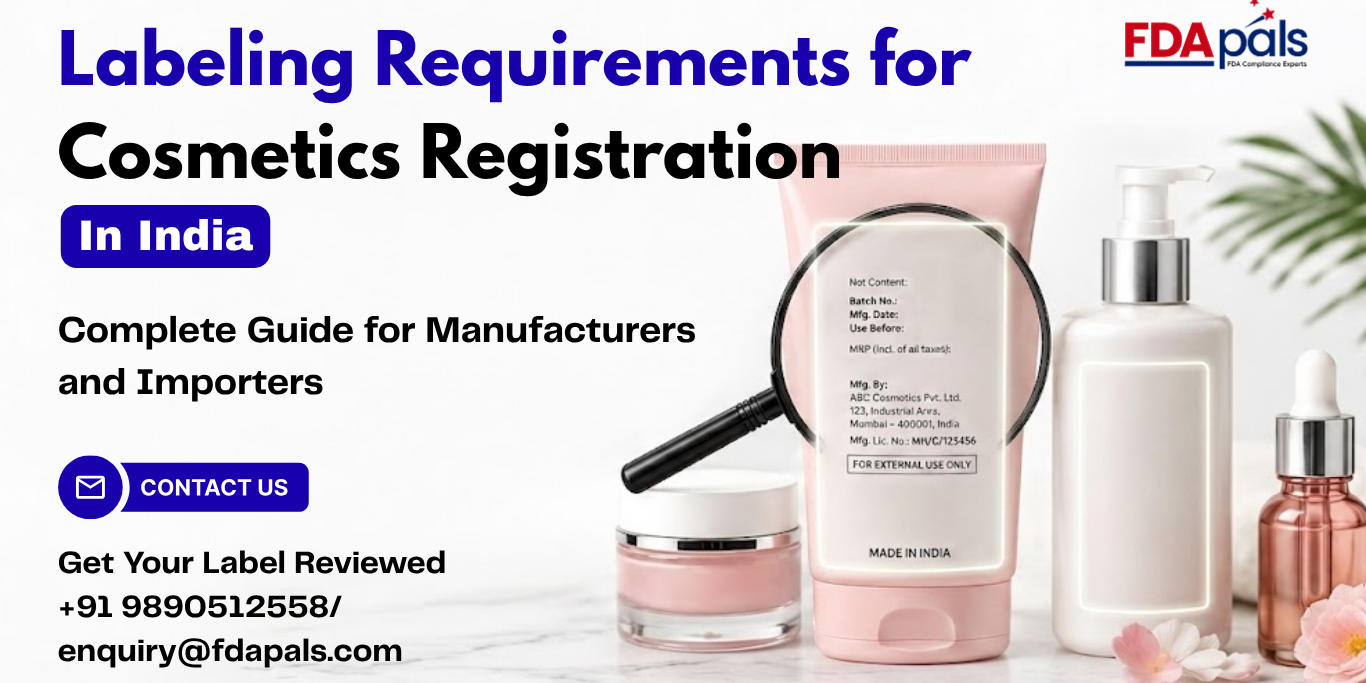
Entering the Indian cosmetics market requires more than simply having a good-quality product and attractive packaging. Cosmetic labeling compliance is an important part of regulatory compliance in India, particularly for businesses importing cosmetics or manufacturing products for sale in the Indian market.
The Central Drugs Standard Control Organization (CDSCO) regulates cosmetics in India under the Drugs and Cosmetics Act, 1940 and the Cosmetics Rules, 2020. The Cosmetics Rules, 2020 contain specific provisions relating to the labeling, packing, standards, sale, and distribution of cosmetics.
Under the rules, cosmetics must be appropriately labeled and packed before they are sold or distributed in India. For imported cosmetics, additional information relating to the importer and registration must also be provided on the product label.
For manufacturers, brand owners, and importers, understanding these requirements before finalizing packaging can help avoid regulatory issues, relabeling requirements, and delays in bringing products to the Indian market.
In this guide, we explain the labeling requirements for cosmetics registration in India, including the information generally required on cosmetic labels, imported cosmetic requirements, ingredient declarations, batch details, expiry information, and common compliance mistakes.
What Are the Labeling Requirements for Cosmetics in India?
The principal requirements are provided under Chapter VI of the Cosmetics Rules, 2020, which deals with labeling, packing, and standards for the sale or distribution of cosmetics.
Rule 34 specifies the manner in which cosmetics should be labeled. Depending on the product and packaging, information may need to appear on the inner label, outer label, or both.
The cosmetic label requirements are intended to provide consumers and regulatory authorities with essential information about the product, its manufacturer, contents, batch identification, expiry information, and safe use.
CDSCO also states that imported cosmetics must be registered before import into India and that products must comply with applicable standards and regulatory requirements.
Mandatory Information on Cosmetic Labels
One of the first steps for cosmetic regulatory compliance is ensuring that the required information is correctly incorporated into the product packaging.
1. Name of the Cosmetic
The name of the cosmetic should be clearly stated on the label.
The product name should accurately identify the cosmetic and should not create a false or misleading impression regarding its nature, composition, or intended use.
For example, if a product is marketed as a facial moisturizer, the product description and claims should be consistent with its intended cosmetic purpose.
2. Name and Address of the Manufacturer
The label should provide the name of the manufacturer and the complete address of the manufacturing premises, as applicable under the rules.
This information is important for traceability and regulatory identification.
For imported products, the relevant manufacturer information from the country of origin should be appropriately reflected along with the India-specific information required under the Cosmetics Rules.
3. Batch or Lot Number
Cosmetic products generally require a distinctive batch number or lot number.
The batch identification allows a particular batch to be traced back to its manufacturing records.
The Cosmetics Rules specify permitted ways of identifying the batch, including terms such as “Batch No.”, “Lot No.” or similar prescribed designations.
There are certain exemptions for small packs. For soaps, the month and year of manufacture may be provided instead of a batch number, subject to the applicable provisions.
4. Manufacturing Licence Number
The applicable manufacturing licence number is required to be displayed on the label in the prescribed manner.
The rules provide specific provisions concerning manufacturing licence numbers and also contain a provision for certain imported cosmetics where such a licence number is not mandatory in the country of origin.
Therefore, importers should not simply copy the labeling format used in another country without checking the Indian requirements.
5. Net Contents
The outer label should declare the net contents of the cosmetic.
The method of declaration depends on the physical form of the product:
- Solids – generally by weight
- Liquids – generally by fluid measure
- Semi-solids – by applicable weight or measure
- Products divided into individual units – numerical count may also be relevant
The Cosmetics Rules provide certain exemptions for very small packages and specified products.
6. Use Before or Expiry Information
Cosmetic packaging should contain the applicable use-before, expiry, or equivalent date information in accordance with the Cosmetics Rules.
The date format and presentation should be clear and should not be misleading.
Cosmetic Importers should pay particular attention to expiry requirements because CDSCO specifically states that cosmetics cannot be imported where the “use before” or “use by” date shown on the label is less than six months from the date of import.
7. Directions for Safe Use
Where a cosmetic presents a hazard or requires particular precautions, the label should provide appropriate directions for safe use.
Depending on the product, this may include instructions concerning:
- How the product should be applied
- Frequency of use
- Areas where the product should not be used
- Required precautions
- Specific warnings
- Other safety-related instructions
The purpose is to ensure that consumers can use the product appropriately and safely.
8. Warning and Caution Statements
Where applicable, cosmetic labels must include warnings, cautions, or special directions that consumers need to follow.
This is particularly important for products that may have specific risks if misused.
For example, products containing ingredients requiring specific precautions should provide appropriate information on the packaging.
9. Ingredient Declaration
Ingredient labeling is another important component of cosmetic compliance.
Under Rule 34, ingredients present in concentrations of more than 1% are generally listed in descending order of weight or volume at the time they are added to the formulation. Ingredients present at concentrations of 1% or less may then be listed in any order.
The ingredient declaration should be preceded by the word “INGREDIENTS.”
The rules provide exemptions for certain small packages, including specified liquid and solid/semi-solid packs.
Manufacturers and importers should therefore review the formulation and proposed ingredient list carefully before finalizing the packaging artwork.
Labeling Requirements for Imported Cosmetics in India
Imported cosmetics have additional regulatory considerations.
CDSCO states that cosmetics imported into India must be registered under the applicable provisions of the Cosmetics Rules, 2020 before import. The product, pack size, variants, and manufacturing premises are relevant to the registration process.
For imported cosmetics marketed in India, the Import Registration Certificate number must be mentioned on the label of the unit pack, together with the applicable importer information.
The Cosmetics Rules also require imported cosmetics to carry the registration certificate number and the name and address of the registration certificate holder for marketing the product in India.
Can India-Specific Information Be Added After Import?
Yes, in applicable circumstances.
CDSCO’s guidance explains that India-specific labeling requirements, such as the name and address of the importer and the Import Registration Certificate number, may be incorporated after landing in India at a customs/bonded warehouse or another place approved by the competent authority, before the product is released into the Indian market.
The Cosmetics Rules similarly provide for India-specific labeling to be stickered on the unit pack at bonded warehouses where applicable.
However, businesses should not assume that every labeling problem can simply be corrected through post-import stickers. The overall packaging and labeling should be reviewed for compliance before shipment.
Cosmetic Ingredient Labeling: What Manufacturers Should Check
Before submitting a cosmetic registration application or finalizing packaging artwork, manufacturers and importers should compare the ingredient declaration against the actual formulation.
Important points include:
- Use the correct ingredient names.
- Verify the concentration/order requirements.
- Check whether restricted or regulated ingredients are involved.
- Review applicable Indian standards.
- Ensure that the label corresponds to the product formulation submitted for registration.
- Check whether product-specific warnings are required.
- Avoid unsupported or misleading claims.
For products covered by applicable Indian Standards, the Cosmetics Rules require compliance with the relevant labeling requirements specified in the applicable BIS standards.
Cosmetic Claims and Labeling Compliance
A cosmetic label is not only about displaying technical information. Marketing claims are also important.
Under Rule 36 of the Cosmetics Rules, 2020, a cosmetic should not purport or claim to convey an idea that is false or misleading to the intended user.
Therefore, manufacturers should carefully evaluate statements such as:
- “100% safe”
- “Guaranteed results”
- “Permanent treatment”
- “Cures skin disease”
- “No side effects”
- “Clinically proven”
Such claims should not be used casually. Depending on the wording and intended purpose, a claim may potentially change how the product is viewed from a regulatory perspective.
A good cosmetic label should be clear, accurate, consistent with the product’s intended cosmetic purpose, and supported by appropriate documentation.
Common Cosmetic Labeling Mistakes
Even when the product itself is compliant, labeling errors can create unnecessary regulatory problems.
Some common issues include:
👉Incorrect manufacturer information
Using an incomplete or outdated manufacturing address can create inconsistencies between the product label and regulatory documents.
👉Missing importer details
Imported cosmetics require India-specific information where applicable. Missing importer information can become a compliance issue.
👉Incorrect registration information
The Import Registration Certificate number should be correctly reflected on the unit pack where required.
👉Inconsistent ingredient lists
The ingredient declaration on the packaging should correspond with the formulation and submitted regulatory documentation.
👉Missing batch information
Batch or lot identification is important for product traceability.
👉Incorrect expiry information
The use-before or expiry information should be clear and compliant with applicable requirements.
👉Unsupported claims
Claims that are exaggerated, misleading, or inconsistent with the cosmetic nature of the product may create regulatory concerns.
👉Finalizing artwork too early
One of the most common practical mistakes is printing thousands of labels before completing regulatory review.
A better approach is to complete a regulatory label review before mass printing.
Cosmetic Labeling Checklist Before Registration
Before submitting a cosmetic registration application or launching an imported cosmetic in India, businesses can review the following:
- Product name is correct
- Manufacturer name is correct
- Complete manufacturing address is provided where required
- Importer information is included where applicable
- Batch/Lot number requirements are addressed
- Manufacturing licence information is addressed
- Net contents are correctly declared
- Use-before/expiry information is correctly presented
- Ingredient declaration is reviewed
- Required warnings and precautions are included
- Directions for safe use are included where applicable
- Relevant BIS requirements have been checked
- Product claims have been reviewed
- Import Registration Certificate information is correctly reflected for imported products
- Label information is consistent with registration documents
- Final artwork has been reviewed before printing
Why Label Review Should Be Done Before Cosmetic Registration
Cosmetic registration is not simply a documentation exercise.
The information submitted during registration should be consistent with the actual product being marketed. Differences between the formulation, product name, manufacturer details, pack size, variants, and labeling can create questions during regulatory review.
For importers, this becomes even more important because the product must comply with Indian requirements before it is legally marketed in the country.
CDSCO’s official cosmetics page states that imported cosmetics must be registered and must comply with applicable quality, safety, and regulatory requirements.
A regulatory label review can therefore help identify potential problems before the product reaches customs or the Indian market.
How FDA Pals Can Help With Cosmetic Registration and Label Compliance
Understanding cosmetic labeling requirements can be challenging, particularly for foreign manufacturers entering the Indian market for the first time.
FDA Pals assists businesses with regulatory requirements related to cosmetic registration and compliance in India.
Our support can include:
- Cosmetic registration guidance
- Documentation review
- Product and variant assessment
- Label compliance review
- Ingredient and formulation documentation review
- Imported cosmetic registration support
- India-specific labeling guidance
- Regulatory documentation assistance
- CDSCO-related compliance support
Whether you are an Indian manufacturer, foreign cosmetic manufacturer, brand owner, distributor, or importer, reviewing your product label before commercialization can help you avoid preventable compliance issues.
Frequently Asked Questions
1. Is cosmetic labeling mandatory in India?
Yes. Cosmetics sold or distributed in India must comply with the applicable labeling and packing requirements under the Cosmetics Rules, 2020.
2. What information should be included on a cosmetic label?
Depending on the product and applicable provisions, information can include the product name, manufacturer details, batch number, manufacturing licence information, net contents, expiry/use-before information, ingredients, warnings, directions for safe use, and other required particulars.
3. Do imported cosmetics require additional labeling?
Yes. Imported cosmetics have additional India-specific requirements. The applicable Import Registration Certificate number and importer/registration certificate holder information must be addressed on the label as required under the Cosmetics Rules.
4. Can India-specific information be added after the product arrives in India?
In applicable cases, India-specific information can be incorporated at a customs/bonded warehouse or another approved location before release into the market.
5. Is an Ingredient list required on cosmetic packaging?
Yes, subject to the applicable provisions and exemptions for certain small packages. Ingredients above 1% are generally listed in descending order, followed by ingredients at 1% or less in any order.
6. Is the expiry date required on cosmetic products?
Applicable use-before, expiry, or equivalent date information must be provided according to the Cosmetics Rules. Importers should also check the specific six-month requirement applicable at the time of import.
7. Can cosmetic labels contain marketing claims?
Cosmetic claims must not be false or misleading. Businesses should review claims carefully before printing packaging or marketing materials.
8. Do cosmetic products need to comply with BIS standards?
Where applicable, cosmetics covered by the relevant Indian Standards must comply with the applicable requirements, including relevant labeling provisions.
9. Can FDA Pals help with cosmetic registration in India?
Yes. FDA Pals can assist businesses with cosmetic registration documentation, regulatory guidance, label compliance review, and related registration requirements.
10. When should cosmetic labels be reviewed?
Ideally, labels should be reviewed before final artwork approval and mass printing, and certainly before import or commercial launch in India.
Conclusion
Labeling Requirements for Cosmetics Registration in India should be treated as an important part of the overall regulatory compliance process rather than simply a packaging requirement.
The Cosmetics Rules, 2020 establish specific requirements concerning product identification, manufacturer details, batch information, net contents, expiry information, ingredients, warnings, and other particulars. Imported cosmetics have additional India-specific requirements relating to registration and importer information.
For businesses planning to manufacture, import, or market cosmetics in India, completing a regulatory review of the label before commercialization can help reduce avoidable compliance problems.