India has a long history of cultivating and processing herbs, botanicals, spices and traditional plant-based products. With growing international demand for botanical ingredients, herbal powders, organic products and plant-based wellness products, the export of herbal products from India to the USA has become an important opportunity for Indian manufacturers, processors and exporters.
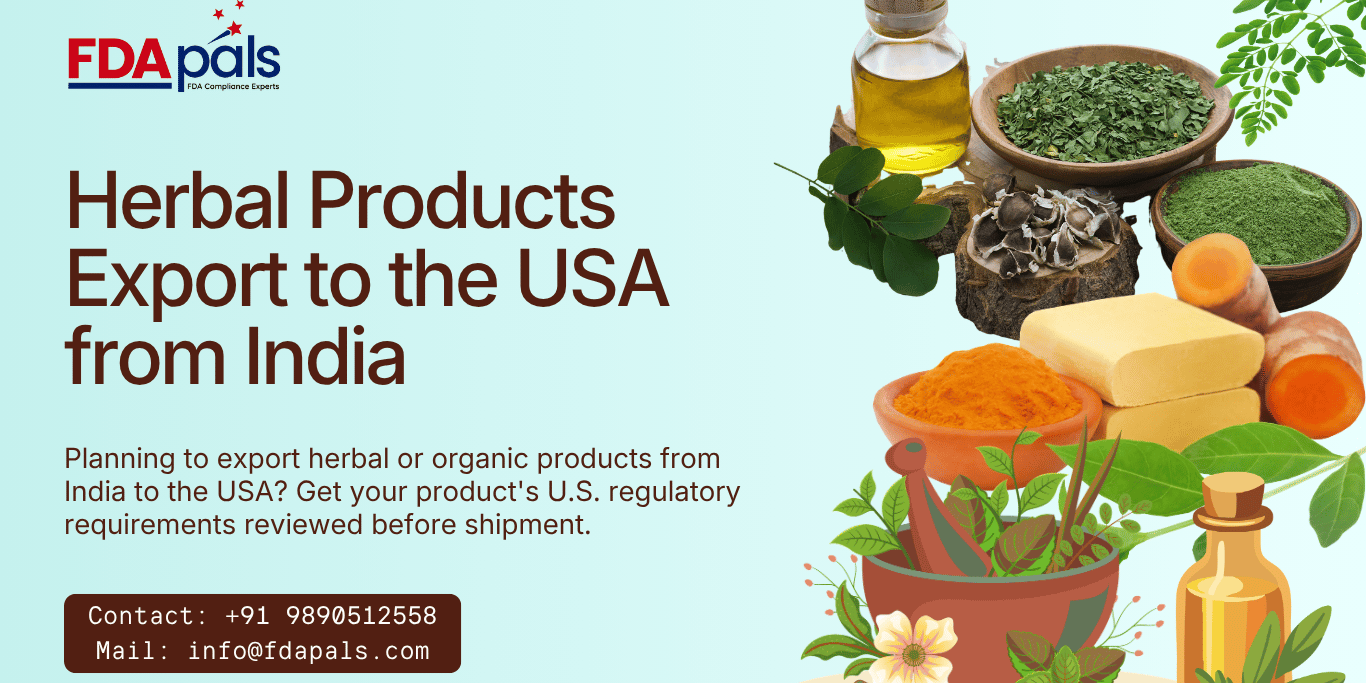
Products such as moringa powder, turmeric powder, ashwagandha, tulsi, amla, triphala, herbal teas, botanical extracts and other plant-based ingredients are exported from India in different forms and for different intended uses.
However, exporting a herbal product to the United States is not simply a matter of shipping the product. The exporter must first determine how the product will be classified under U.S. regulations and then meet the applicable requirements for manufacturing, safety, labeling, claims, facility registration and importation.
This guide explains the key considerations for herbal products export to USA from India, including commonly exported products, FDA requirements, documentation, labeling and the export process.
What Herbal Products Can Be Exported from India to the USA?
India produces a wide range of herbs, botanicals, spices and plant-based products that may be exported to the U.S. market.
Depending on the product and its intended use, commonly exported categories include:
1. Moringa Products
Moringa is one of India’s important botanical products and may be exported in forms such as:
- Moringa leaf powder
- Moringa capsules
- Moringa extracts
- Dried moringa leaves
- Moringa tea
- Moringa-based dietary supplement products
APEDA’s market intelligence report identifies increasing exports of moringa and other medicinal plant products from India.
2. Ashwagandha
Ashwagandha is another significant Indian botanical product available in several forms, including:
- Ashwagandha root
- Ashwagandha powder
- Ashwagandha extract
- Ashwagandha capsules
- Tablets
- Botanical ingredients
APEDA reports that Indian ashwagandha exports increased substantially between FY2020 and FY2024, with the product being marketed in multiple forms including extracts, powder, tea-bag-cut material and tablets.
Important: exporters should pay particular attention to the intended use and formulation of ashwagandha products. FDA’s current import-alert material identifies concerns involving conventional food products containing ashwagandha, including certain ashwagandha teas.
Therefore, an exporter should not assume that an ashwagandha product can be exported simply because the same product is legally marketed in India.
3. Turmeric Products
India is one of the world’s major sources of turmeric, and exporters may supply:
- Turmeric powder
- Turmeric fingers
- Turmeric extract
- Curcumin ingredients
- Turmeric-based food products
- Turmeric-containing dietary supplements
The regulatory requirements can differ depending on whether turmeric is supplied as a conventional food, ingredient or dietary supplement.
4. Tulsi Products
Tulsi, also known as holy basil, can be supplied in different forms, including:
- Tulsi leaves
- Tulsi powder
- Tulsi extract
- Tulsi tea
- Herbal blends
- Dietary supplement products
APEDA’s data identifies tulsi as one of the medicinal plant products exported from India.
5. Amla Products
Indian exporters may supply:
- Dried amla
- Amla powder
- Amla extract
- Amla capsules
- Amla-based food products
6. Triphala
Triphala is another traditional botanical formulation that may be marketed in forms such as:
- Triphala powder
- Triphala capsules
- Triphala extracts
- Tablets
7. Herbal Teas
Indian exporters also supply various herbal and botanical tea products, such as:
- Tulsi tea
- Ginger tea
- Turmeric tea
- Lemongrass tea
- Hibiscus tea
- Chamomile blends
- Mint herbal tea
- Other botanical tea blends
However, the formulation and intended use are important. A product presented as a conventional food or tea may be subject to different requirements than a product marketed as a dietary supplement.
8. Other Botanical Products
Other products and ingredients that may be considered for export include:
- Neem
- Brahmi
- Giloy
- Shatavari
- Arjuna
- Fenugreek
- Ginger
- Licorice
- Psyllium
- Botanical extracts
- Dried herbs
- Herbal ingredients
- Plant-based powders
APEDA’s export database includes numerous medicinal and botanical products, including ashwagandha, giloy, neem extracts and other plants and plant parts.
Why Is the USA an Important Market for Indian Herbal Products?
The United States is an important destination for Indian organic and medicinal plant products.
For example, APEDA’s organic export data recorded exports to the USA across categories including medicinal plant products, spices and condiments, tea, processed food and essential oils.
APEDA’s more recent market intelligence also reports growth in Indian medicinal plant product exports to the United States, with U.S.-bound medicinal plant product volumes increasing from 1,230 MT in FY2020 to 2,209 MT in FY2024.
This creates opportunities for Indian companies supplying:
- Bulk botanical ingredients
- Organic herbs
- Herbal powders
- Plant extracts
- Herbal teas
- Dietary supplement ingredients
- Finished dietary supplements
- Conventional food products containing herbs
Are Herbal Products Regulated by the U.S. FDA?
Yes, many herbal products entering the United States fall under FDA jurisdiction.
However, there is no single FDA category called “herbal products.”
This is one of the most important points for Indian exporters.
Depending on the product and how it is marketed, an herbal product could be regulated as:
- Conventional food
- Dietary supplement
- Food ingredient
- Drug
- Cosmetic
- Another FDA-regulated product category
FDA explains that Ayurvedic products are not specifically defined as a category under U.S. law. Their regulatory status depends on factors such as intended use and claims.
Therefore, product classification should be determined before starting the export process.
FDA Requirements for Herbal Products Export to USA from India
The applicable FDA requirements depend on the product category.
1. FDA Food Facility Registration
If the Indian facility manufactures, processes, packs or holds food for consumption in the United States, the facility may be required to register with FDA, subject to applicable exemptions. FDA’s current registration guidance covers domestic and foreign food facilities.
This can be relevant for manufacturers and processors of certain herbal powders, teas, food ingredients and other conventional food products.
2. Dietary Supplement Requirements
If the herbal product is marketed as a dietary supplement, additional requirements may apply.
Dietary supplements can include products containing herbs or other botanicals and can be sold in forms such as capsules, tablets, powders and liquids.
Dietary supplement manufacturers are subject to applicable FDA requirements, including dietary supplement Current Good Manufacturing Practice requirements under 21 CFR Part 111.
FDA also emphasizes that dietary supplements are not FDA-approved before marketing in the same manner as drugs.
3. Product Labeling
Correct labeling is a critical part of exporting herbal products to the USA.
FDA-regulated products imported into the United States must meet applicable U.S. requirements, including labeling requirements. FDA states that imported products must comply with the same applicable laws and regulations as domestic products.
Depending on the product category, labeling may include information such as:
- Product identity
- Ingredient declaration
- Net quantity
- Manufacturer, packer or distributor information
- Nutrition information where applicable
- Supplement Facts for Dietary Supplements
- Allergen information where applicable
- Directions for use
- Required warnings
- Other mandatory statements
For dietary supplements, FDA provides specific labeling guidance.
4. Be Careful With Health and Disease Claims
One of the biggest regulatory risks for Indian herbal and Ayurvedic exporters is the use of medicinal claims.
For example, statements such as:
- “Treats diabetes”
- “Cures arthritis”
- “Prevents cancer”
- “Treats high blood pressure”
- “Cures infertility”
can create significant regulatory concerns.
FDA explains that herbal and Ayurvedic products marketed in the United States with claims to prevent, treat, diagnose or cure diseases can fall into the drug regulatory pathway.
Therefore, Indian exporters should review their:
- Product website
- Packaging
- Product labels
- Brochures
- Amazon listings
- Social media
- Advertisements
- Product descriptions
before exporting the product.
5. Good Manufacturing Practices and Product Safety
Quality and contamination control are particularly important for herbal products.
Botanical products can potentially be affected by:
- Heavy metals
- Microbial contamination
- Pesticide residues
- Adulteration
- Foreign matter
- Incorrect botanical identification
- Other contaminants
FDA has specifically highlighted concerns involving heavy metals in certain Ayurvedic products and has also worked with Indian industry on good agricultural and manufacturing practices for herbs and botanicals.
For food products, applicable facilities may be subject to CGMP and preventive-control requirements under 21 CFR Part 117. Dietary supplements have additional CGMP requirements under 21 CFR Part 111.
6. Foreign Supplier Verification Program (FSVP)
FSVP is primarily an obligation for the U.S. importer rather than a simple “FDA registration” for the Indian exporter.
Under FDA’s FSVP regulations, U.S. importers generally have responsibilities to verify that imported food meets applicable U.S. safety requirements and is not adulterated or, where applicable, misbranded.
Indian exporters should therefore be prepared to provide their U.S. importer with appropriate information and documentation needed for the importer’s verification activities.
7. FDA Prior Notice for Imported Food
Certain imported food shipments require FDA Prior Notice before arrival in the United States.
The importer/exporter should coordinate the shipment documentation and entry process with the U.S. importer, customs broker and other responsible parties.
FDA can examine imported products at entry, and products that appear to violate applicable requirements may be refused admission.
Documents Required for Exporting Herbal Products from India to USA
The exact documents depend on the product, manufacturing arrangement and U.S. regulatory classification.
Common documentation may include:
- Commercial invoice
- Packing list
- Certificate of Analysis (COA)
- Product specification
- Ingredient specification
- Manufacturing details
- Product formulation
- Label artwork
- Certificate of Origin
- Organic certification, where applicable
- Batch/lot information
- Microbiological testing reports
- Heavy metal testing reports
- Pesticide residue testing, where applicable
- Stability information, where applicable
- FDA facility registration information, where applicable
- Importer/FSVP information
- Shipping and customs documents
A product-specific regulatory assessment should be conducted before finalizing the documentation.
Organic Herbal Products Export from India to USA
If a product is marketed as organic, the exporter should not simply place the word “organic” on the label without determining the applicable organic certification and labeling requirements.
India has an established National Programme for Organic Production (NPOP), administered through APEDA. APEDA reports that India’s certified organic production includes medicinal/herbal and aromatic plants, spices, tea and other agricultural categories, with organic products exported to the United States and other markets.
For an exporter, organic certification can therefore be an important part of the commercial and regulatory strategy, but the requirements for using an organic claim in the U.S. should be assessed separately.
Step-by-Step Process to Export Herbal Products to USA from India
A practical export process can be structured as follows:
Step 1: Identify the Product
Determine exactly what you are exporting.
For example:
Moringa leaf powder → ingredient/food/supplement?
Ashwagandha capsules → dietary supplement?
Turmeric powder → conventional food/ingredient?
Herbal tea → conventional food or supplement?
Step 2: Determine the U.S. Regulatory Classification
Review:
- Ingredients
- Composition
- Intended use
- Dosage form
- Packaging
- Labeling
- Marketing claims
This step is critical because regulatory requirements can change significantly depending on classification.
Step 3: Review FDA Requirements
Determine the applicable requirements relating to:
- Facility registration
- CGMP
- Product safety
- Labeling
- Claims
- Ingredients
- Import requirements
- Prior Notice
- FSVP
- Other applicable FDA requirements
Step 4: Review the Label
The U.S. label should be reviewed before commercial production and shipment.
Avoid simply using an Indian-market label for the U.S. market.
Step 5: Prepare Testing and Quality Documentation
Depending on the product, testing may address:
- Identity
- Purity
- Potency/strength
- Microbial limits
- Heavy metals
- Pesticide residues
- Other contaminants
Step 6: Coordinate With the U.S. Importer
The Indian exporter should coordinate with the U.S. importer regarding:
- FSVP
- Customs entry
- FDA requirements
- Product documentation
- Shipping documentation
- Import procedures
Step 7: Ship the Product
Once the applicable regulatory and commercial requirements have been addressed, the product can proceed through the export and U.S. import process.
FDA-regulated imports can be reviewed at entry, so accurate documentation and compliance are important.
Common Mistakes When Exporting Herbal Products to USA
Indian exporters should avoid the following common mistakes:
1. Assuming Indian approval is enough
Compliance in India does not automatically establish compliance with U.S. FDA requirements.
2. Treating every herbal product as a dietary supplement
An herbal product can fall under different U.S. regulatory categories depending on its intended use and presentation.
3. Using disease claims
Medical claims can create significant regulatory problems.
4. Ignoring product-specific ingredients
Certain ingredients may require additional regulatory assessment.
5. Using an incorrect label
U.S. labeling requirements can differ significantly from Indian labeling requirements.
6. Ignoring contamination risks
Herbal products should have appropriate quality controls and testing based on the product and risks.
7. Assuming FDA registration means FDA approval
For dietary supplements, FDA registration or compliance steps should not be represented as FDA product approval. FDA explicitly states that it does not approve dietary supplements or their manufacturers/distributors in the same manner as drugs.
Why Choose a Regulatory Consultant for Herbal Product Export to USA?
The U.S. regulatory pathway for herbal products can become complicated when a company is dealing with multiple products or product formats.
A regulatory consultant can help an Indian exporter evaluate:
- Product classification
- FDA requirements
- Facility registration
- Ingredient compliance
- Label review
- Claims review
- Documentation
- Import requirements
- U.S. importer coordination
- Dietary supplement requirements
- Food compliance requirements
This can help businesses identify regulatory issues before the product is shipped to the United States.
Export Herbal Products to USA With the Right Regulatory Strategy
India has a diverse range of herbs, botanicals, spices and plant-based products with established international export activity. Products such as moringa, ashwagandha, turmeric, tulsi, amla, triphala, herbal teas and botanical extracts can represent commercial opportunities for Indian businesses.
However, successfully exporting herbal products to the USA requires more than identifying a buyer and arranging shipment.
The exporter should first understand the product’s U.S. regulatory classification, ingredients, intended use, labeling, claims, manufacturing requirements and import obligations.
A product that is marketed as a conventional food in India may not necessarily follow the same regulatory pathway in the United States. Similarly, an Ayurvedic product cannot automatically be marketed in the U.S. as a medicine simply because it is traditionally used for a particular health condition. FDA has specifically highlighted these differences for Indian herbal and Ayurvedic products.
Planning the regulatory pathway before export can help Indian manufacturers and exporters reduce compliance risks and prepare their products for the U.S. market.
Conclusion
The USA offers significant opportunities for Indian herbal and organic product exporters, but regulatory compliance should be considered before entering the market.
Whether you manufacture moringa powder, ashwagandha, turmeric powder, tulsi, amla, triphala, herbal tea, botanical extracts or other herbal products, the first step is to determine the appropriate U.S. regulatory pathway.
Understanding FDA requirements, product classification, labeling, claims, manufacturing controls, testing and import responsibilities can help Indian businesses prepare their products for the U.S. market.
Frequently Asked Questions
Q. 1) Can I export herbal products from India to the USA?
Yes, Indian businesses can export various herbal, botanical, food and dietary supplement products to the U.S., provided the products meet applicable U.S. requirements.
Q. 2) Is FDA registration required to export herbal products to the USA?
It depends on the product category and facility activities. Certain food facilities are required to register with FDA, while dietary supplements and other FDA-regulated products have their own requirements.
Q. 3) Can I export moringa powder from India to the USA?
Moringa products can be exported to the U.S., but the applicable requirements depend on how the product is classified and marketed.
Q. 4) Can I export ashwagandha to the USA?
Ashwagandha products require careful regulatory assessment. The formulation, intended use, labeling and claims matter. FDA’s current import-alert information specifically identifies concerns involving conventional foods and teas containing ashwagandha.
Q. 5) Can I export turmeric powder to the USA?
Turmeric powder may be exported as a food or ingredient when applicable U.S. requirements are met. The specific regulatory requirements depend on its intended use, formulation, labeling and claims.
Q. 6) Can I export herbal tea from India to the USA?
Herbal teas may be exported, but the product formulation and labeling must comply with applicable U.S. requirements. Some botanical ingredients may raise additional regulatory issues, so each formulation should be assessed individually.
Q. 7) Does FDA approve herbal products before export?
Not generally. FDA requirements depend on the product category. Dietary supplements, for example, are not FDA-approved before marketing in the same way drugs are.
Q. 8) What documents are required to export herbal products to the USA?
Documents vary by product, but may include product specifications, COA, ingredient information, label artwork, testing reports, facility information, commercial documents and information needed by the U.S. importer for applicable import requirements.
Planning to export herbal or organic products from India to the USA? Get your product’s U.S. regulatory requirements reviewed before shipment.