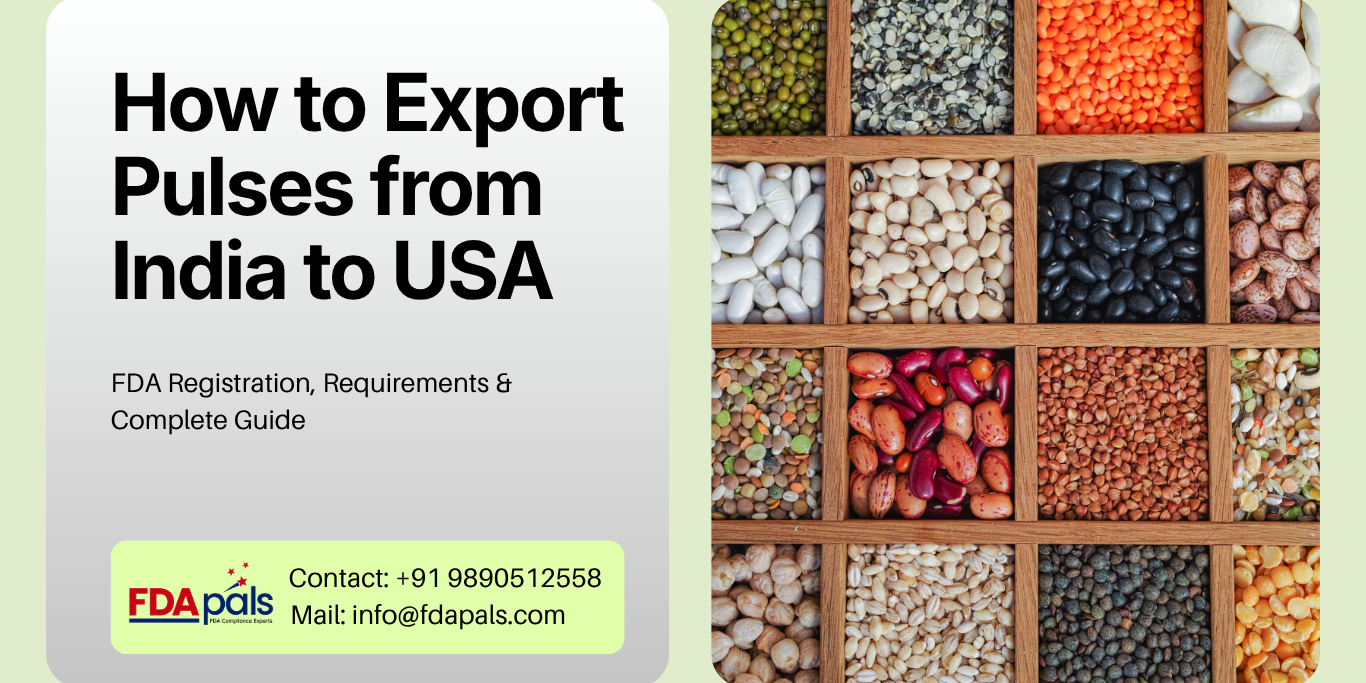
The United States is an important destination for Indian food exporters, including businesses dealing in pulses, lentils, beans, chickpeas, peas and other edible legumes. With growing demand for Indian food products in the U.S., exporters have significant opportunities to expand their businesses into the American market.
However, exporting pulses from India to the USA requires more than arranging shipping and customs documentation. Food businesses must understand and comply with applicable U.S. Food and Drug Administration (FDA) requirements before their products enter the American market.
This guide explains the major regulatory considerations for pulses export to USA from India, including FDA registration, U.S. FDA Agent requirements, food facility compliance, labeling, documentation and import procedures.
What Are Pulses?
Pulses are edible dried seeds of leguminous plants. Common pulses exported from India include:
- Chickpeas (Chana)
- Lentils (Masoor Dal)
- Pigeon Peas (Toor Dal)
- Mung Beans (Moong Dal)
- Black Gram (Urad Dal)
- Kidney Beans (Rajma)
- Black-eyed Peas
- Dried Peas
- Split Peas
- Other dried legumes and pulses
These products may be exported as whole, split, dried, cleaned, processed or packaged food products, depending on the nature of the business and product.
Why Export Pulses from India to the USA?
India has a strong agricultural and food-processing sector and is well known for producing a wide range of pulses and legumes.
Indian exporters can target U.S. markets through:
- Indian grocery stores
- Supermarkets
- Food distributors
- Restaurants
- Food manufacturers
- Wholesale importers
- Ethnic food markets
- Online grocery businesses
However, exporters must ensure that their facilities, products, packaging and documentation comply with applicable U.S. requirements.
FDA Requirements for Pulses Export to USA
One of the most important regulatory considerations for an Indian pulse exporter is U.S. FDA food facility registration.
If a facility is involved in manufacturing, processing, packing or holding food for consumption in the United States, it may be required to register with the FDA under the applicable U.S. food facility registration requirements.
For example, an Indian company involved in processing and packing pulses intended for the U.S. market should evaluate whether its facility requires FDA registration.
Important:
FDA registration is not the same as FDA product approval.
For most conventional food products, including pulses, the FDA does not generally issue a pre-market approval certificate simply because a food facility has been registered.
Instead, registration is one part of the broader U.S. food regulatory compliance framework.
Step 1: Determine Whether Your Facility Requires FDA Registration
Before exporting pulses, the business should determine whether its activities fall within the scope of facilities required to register with the U.S. FDA.
This can depend on activities such as:
- Manufacturing
- Processing
- Packing
- Repacking
- Holding food
- Nature of the food product
- Facility operations
An exporter should assess its specific business model rather than assuming that every company involved in trading food products has identical requirements.
Step 2: Complete U.S. FDA Food Facility Registration
Where applicable, the facility registration should be completed with the U.S. FDA.
The registration generally involves providing information such as:
- Facility name
- Facility address
- Contact details
- Food-related activities
- Product categories
- Owner/operator information
- Emergency contact information
- U.S. Agent details where applicable
The information submitted should be accurate and consistent with the facility’s actual operations.
Step 3: Appoint a U.S. FDA Agent
Foreign food facilities that are required to register with the FDA generally need a U.S. Agent.
A U.S. FDA Agent acts as the communication link between the foreign facility and the FDA for regulatory communications.
For Indian pulse exporters, having an experienced U.S. FDA Agent can help with:
- FDA communications
- Regulatory correspondence
- Registration-related assistance
- Communication with FDA
- Maintaining updated registration information
- Supporting the foreign facility during regulatory matters
FDApals provides U.S. FDA Agent services for foreign food facilities exporting products to the United States.
Step 4: Understand U.S. Food Labeling Requirements
Proper labeling is another important consideration when exporting packaged pulses to the USA.
Depending on the product and packaging, the label may need to contain information such as:
- Product name
- Net quantity
- Ingredient information, where applicable
- Name and address of manufacturer, packer or distributor
- Nutrition information, where applicable
- Allergen information, where applicable
- Country-of-origin information where required
- Other applicable labeling declarations
For example, a packaged product such as Toor Dal, Masoor Dal or Chana Dal may require appropriate labeling before being marketed in the United States.
Exporters should review their specific product label against applicable U.S. requirements rather than simply using the label used for the Indian market.
Step 5: Check FSMA Requirements
The Food Safety Modernization Act (FSMA) significantly changed the U.S. approach to food safety by emphasizing prevention rather than relying primarily on responses after contamination occurs.
Depending on the facility and product, applicable requirements may include preventive controls and other food safety obligations.
Foreign food facilities exporting food to the United States should determine which FSMA requirements apply to their operations.
Compliance requirements can vary depending on the nature and size of the facility, the activities performed and the food involved.
Step 6: Prior Notice for Food Shipments
Food shipments entering the United States may require FDA Prior Notice before the shipment arrives.
Prior Notice provides the FDA with information about an incoming food shipment and helps facilitate the agency’s food import screening process.
The applicable information and submission timeline can depend on the transportation method and other shipment details.
Exporters should ensure that Prior Notice requirements are properly addressed before dispatching shipments to the USA.
Step 7: Check Product and Food Safety Requirements
Pulses intended for the U.S. market should meet applicable food safety and regulatory requirements.
Exporters should pay attention to factors such as:
- Product quality
- Contamination risks
- Pesticide residues
- Microbiological safety, where applicable
- Foreign material
- Storage conditions
- Packaging
- Sanitation
- Traceability
- Food safety controls
Depending on the product and supply chain, additional U.S. regulatory requirements may apply.
Documents Required for Pulses Export to USA
The exact documentation can vary depending on the exporter, product, shipment and applicable regulations. Common export and compliance documents may include:
| Document | Purpose |
|---|---|
| Commercial Invoice | Provides transaction and shipment details |
| Packing List | Contains package and quantity information |
| Bill of Lading / Airway Bill | Transportation document |
| Certificate of Origin | Establishes product origin where required |
| Product Specification | Provides product characteristics |
| Certificate of Analysis (COA) | Provides relevant test results where applicable |
| FDA Facility Registration Details | Identifies registered food facility where applicable |
| U.S. FDA Agent Details | Identifies the U.S. Agent for a foreign facility |
| Prior Notice Information | Supports FDA import notification |
| Food Safety Documentation | Demonstrates applicable safety controls |
| Label Artwork | Helps verify U.S. labeling compliance |
The final document list should be determined according to the product, facility and shipment requirements.
Can Indian Pulse Traders Export to the USA Without a Manufacturing Facility?
This depends on the business structure and activities being performed.
For example, a trading company may purchase pulses from another facility and export them to the United States, while another company may clean, process, repack or label the product before export.
These different activities can create different regulatory responsibilities.
Therefore, exporters should identify who manufactures, processes, packs, labels and holds the food before determining which FDA requirements apply.
FDA Registration vs. Importer Requirements
One common misconception among exporters is that completing FDA food facility registration means the shipment is automatically approved for entry into the USA.
This is not correct.
FDA compliance can involve multiple elements, including:
Facility Registration → U.S. Agent → Food Safety Compliance → Labeling → Prior Notice → Import Review
FDA registration is therefore only one component of the overall compliance process.
Common Mistakes Made by Pulse Exporters
Indian exporters entering the U.S. market should avoid common compliance mistakes such as:
1. Treating FDA Registration as Product Approval
FDA facility registration does not mean that every product manufactured by the facility has received FDA approval.
2. Using an Incorrect Facility Address
Registration information should accurately reflect the facility involved in food manufacturing, processing, packing or holding.
3. Ignoring U.S. Labeling Requirements
A label that complies with Indian requirements may not automatically satisfy U.S. requirements.
4. Forgetting Prior Notice
Food shipments may require Prior Notice before entering the United States.
5. Not Updating Registration Information
Changes to facility details or other registration information may require updates.
6. Assuming All Food Products Have Identical Requirements
Different foods and business models can have different regulatory obligations.
How FDApals Can Help with Pulses Export to USA
FDApals assists Indian food businesses with regulatory requirements associated with exporting food products to the United States.
Our services can include:
- U.S. FDA Food Facility Registration
- U.S. FDA Agent Services
- FDA registration support for food facilities
- Regulatory compliance guidance
- Documentation assistance
- Food labeling compliance guidance
- FDA-related regulatory communication support
- Registration updates and renewal assistance
Whether you are exporting dal, lentils, chickpeas, beans, peas or other pulse products, our team can help you understand the applicable U.S. regulatory requirements.
Ready to Export Pulses to the USA?
Before shipping your products, make sure your facility and food products are properly assessed for applicable U.S. regulatory requirements.
Contact FDApals for assistance with U.S. FDA Food Facility Registration and FDA Agent Services.
FDApals
📞 +91 9890512558
📧 info@fdapals.com
FAQs – Pulses Export to USA
Q. 1) Is FDA registration mandatory for exporting pulses to the USA?
If the foreign facility falls within the scope of facilities required to register under U.S. food facility registration rules, FDA registration is required. The applicability should be determined based on the facility’s activities and product.
Q. 2) Do pulses need FDA approval before export?
Generally, conventional food products such as pulses are not subject to a general FDA pre-market approval process. However, they must comply with applicable U.S. food safety, labeling and import requirements.
Q. 3) Do Indian pulse exporters need a U.S. FDA Agent?
A foreign food facility that is required to register with the FDA generally needs a U.S. Agent in the United States.
Q. 4) Can I export dal from India to the USA?
Yes, Indian businesses can export products such as dal and other pulses to the U.S., provided applicable import, food safety, labeling and other regulatory requirements are met.
Q. 5) Is Prior Notice required for pulses?
Food shipments entering the United States may be subject to FDA Prior Notice requirements. Exporters should ensure that the appropriate information is submitted within the applicable timeframe.
Q. 6) How long does FDA food facility registration take?
The timing can vary depending on the information required and the registration process. It is important to provide accurate facility information to avoid delays or complications.