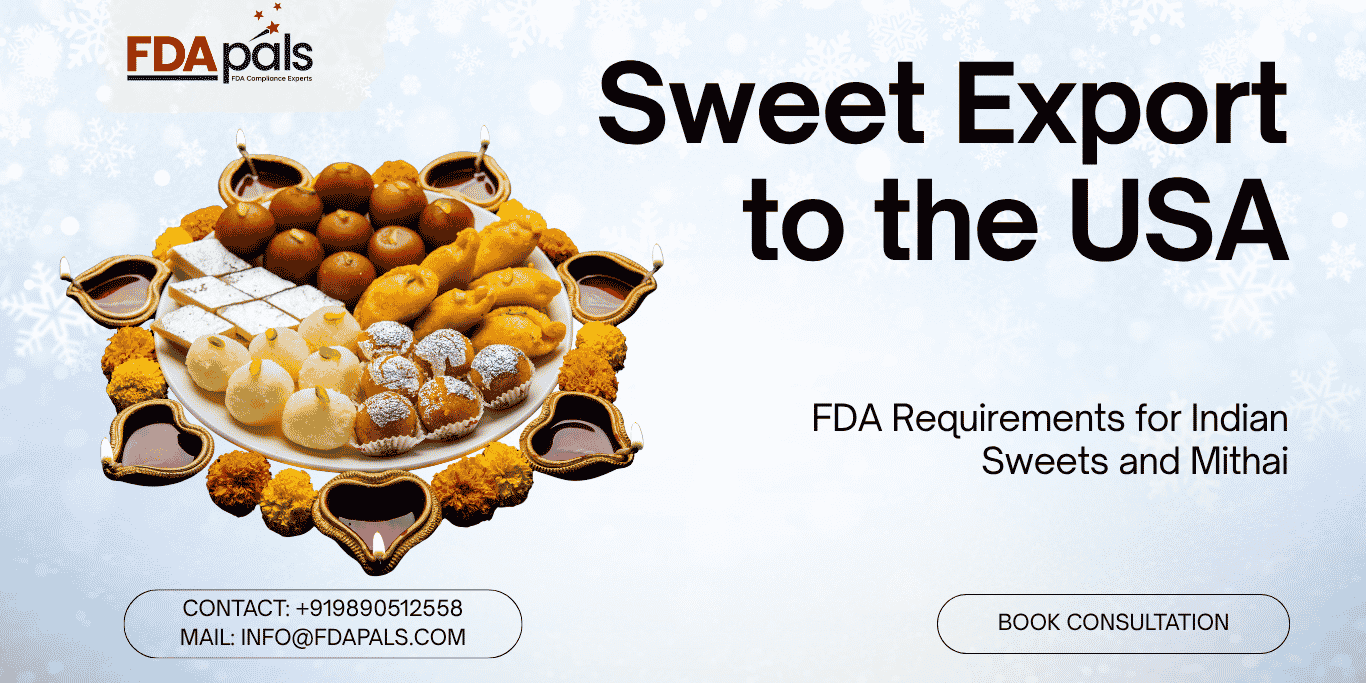
Indian sweets are no longer limited to local sweet shops and festivals in India. From Soan Papdi and Kaju Katli to Gulab Jamun, Rasgulla, Barfi and Laddus, Indian mithai has become increasingly popular among the Indian diaspora and consumers interested in Indian food across the USA.
For Indian sweet manufacturers and exporters, this creates an excellent business opportunity.
But there is an important question to consider before sending your first shipment:
Can you simply manufacture the sweets in India, pack them, and ship them to the USA?
Not exactly.
When food products enter the United States, they need to meet applicable US food safety and regulatory requirements. Depending on the product, facility, ingredients, packaging, and supply chain, exporters may need to address requirements related to FDA Food Facility Registration, food labeling, ingredients, allergens, Prior Notice, FSVP, and food safety controls.
This guide explains the major considerations for businesses planning to export Indian sweets to the USA.
What Indian Sweets Can Be Exported to the USA?
A wide variety of Indian sweets and sweet products may be considered for export to the US market, depending on their formulation, processing, packaging, shelf life, and applicable requirements.
Some popular examples include:
- Soan Papdi
- Gulab Jamun Mix
- Rasgulla
- Barfi
- Kaju Katli
- Besan Laddus
- Motichoor Laddus
- Boondi Laddus
- Coconut Laddus
- Dry-fruit sweets
- Diwali sweet boxes
- Other packaged Indian mithai
However, it is important to understand that not every sweet has the same compliance requirements.
For example, a dry packaged sweet containing nuts may have different considerations from a milk-based sweet with a shorter shelf life. Similarly, a dry Gulab Jamun mix is different from ready-to-eat Gulab Jamun.
Therefore, exporters should evaluate the actual product rather than assuming that one compliance approach will work for every sweet.
Why Is FDA Compliance Important for Sweet Exporters?
If you are exporting food to the USA, compliance should be considered before the shipment leaves India, not after it reaches the US border.
A shipment can face problems if the product, facility, labeling, documentation, or import information does not meet applicable requirements.
This is why Indian exporters should first understand:
What is my product?
Who manufactures it?
Where is it manufactured?
Who is importing it into the USA?
What does the product label say?
What FDA requirements apply to this particular product?
Answering these questions early can help reduce avoidable compliance problems later.
FDA Requirements for Sweet Export to USA
1. FDA Food Facility Registration
One of the first requirements businesses should evaluate is FDA Food Facility Registration.
If your Indian facility manufactures, processes, packs, or holds food for consumption in the United States, the facility may be required to register with the US FDA, subject to applicable exemptions.
This registration is associated with the food facility. It should not be confused with approval of an individual sweet or product.
For example, if an Indian manufacturing facility produces Soan Papdi or packaged Laddus for export to the USA, the business should determine whether the facility falls within the FDA food facility registration requirements.
2. Food Labeling Requirements
The packaging is another important part of US food compliance.
A product that is legally sold in India may still require changes to its label before being marketed in the USA.
Depending on the product, labeling may involve information such as:
- Product name or identity
- Net quantity
- Ingredient list
- Allergen declaration
- Nutrition information, where applicable
- Name and address information
- Other information required under applicable US labeling rules
For example, Kaju Katli contains cashews, while many traditional Indian sweets contain milk, wheat, almonds or other ingredients that may be relevant to allergen labeling.
Therefore, exporters should review the product formulation and label before printing large quantities of packaging.
3. Ingredient and Allergen Compliance
This is particularly important for Indian sweets because many traditional recipes contain nuts, dairy and other ingredients.
A sweet may contain:
- Milk
- Wheat
- Cashew
- Almond
- Pistachio
- Other tree nuts
- Coconut
- Sesame
- Food additives
- Colors
- Flavors
The exporter should know exactly what goes into the product and ensure that applicable ingredients and allergens are properly represented on the US-market label.
For example, simply writing “Kaju Katli” on the package may not be enough to address all applicable US labeling requirements.
4. Prior Notice for Imported Food
Imported food shipments generally require Prior Notice to be submitted to the FDA before the food arrives in the United States, subject to applicable requirements and exemptions.
Prior Notice provides information about an incoming food shipment and allows the FDA to receive advance information about food entering the country.
Exporters and their US import partners should make sure the required information is submitted correctly and within the applicable timeframe.
5. FSVP Requirements
Another important area is the Foreign Supplier Verification Program (FSVP).
If an Indian company is supplying food to a US importer, the US importer may have responsibilities under FSVP.
In simple terms, FSVP is designed to ensure that covered foreign suppliers are producing food in a manner that provides the required level of assurance that the food meets applicable US food safety requirements and is not adulterated under applicable provisions.
This means Indian exporters should communicate with their US importer and understand how FSVP responsibilities apply to their particular supply arrangement.
FDA Food Facility Registration and FSVP are not the same thing.
This distinction is important because businesses sometimes assume that registering their facility with FDA completes all their US food compliance obligations.
6. Food Safety and Manufacturing Practices
The manufacturing process also matters.
Sweets may contain dairy, nuts, flour, sugar, oils, spices, colors and other ingredients. The facility should maintain appropriate food safety and manufacturing controls applicable to its operations and products.
Depending on the circumstances, businesses may need to consider requirements related to:
- Sanitation
- Preventive controls
- Good manufacturing practices
- Allergen controls
- Contamination prevention
- Storage
- Transportation
- Product traceability
The objective is not simply to get the product through customs. The product should be manufactured, packed, stored and transported in a way that supports food safety.
7. Packaging and Shelf Life
Shelf life is particularly important when exporting Indian sweets.
Consider the difference between:
Soan Papdi → generally a dry product
Kaju Katli → may contain nuts and has its own storage considerations.
Rasgulla → often sold in syrup and packaged in a way designed for longer storage.
Milk-based Barfi → may have different storage and shelf-life considerations.
Therefore, exporters should consider:
- Product stability
- Shelf life
- Packaging
- Storage conditions
- Transportation
- Temperature requirements, where applicable
- Protection from contamination
- Packaging integrity
The goal is to ensure that the product remains safe and suitable for consumption throughout its intended shelf life.
Documents and Information for Sweet Export to USA
There is no single universal document list that applies identically to every sweet product.
The requirements can depend on the product, manufacturer, importer and supply chain.
However, exporters may need information such as:
- Manufacturer details
- Facility information
- Product details
- Ingredient list
- Product formulation
- Allergen information
- Nutrition information
- Product label
- Packaging details
- Shelf-life information
- FDA registration information, where applicable
- US importer information
- Shipment information
- Prior Notice information
- Other regulatory or commercial documents
A product-specific review is therefore preferable to using a generic checklist.
Common Mistakes Indian Sweet Exporters Should Avoid
1. Assuming Indian labels can be used without review
US food labeling requirements may differ from Indian requirements.
2. Ignoring allergens
Many Indian sweets contain milk, wheat, cashews, almonds, pistachios and other ingredients that require careful consideration.
3. Thinking FDA registration means product approval
FDA Food Facility Registration is not the same as FDA approval of your sweet product.
4. Forgetting about the US importer
The US importer may have separate responsibilities, including applicable FSVP requirements.
5. Checking compliance only after receiving an export order
Regulatory requirements should ideally be reviewed before production and shipment.
6. Treating every sweet product in the same way
A dry sweet, dairy-based sweet, canned sweet and dry sweet mix can have different compliance considerations.
How FDApals Can Help with Sweet Export to the USA
Planning to export Soan Papdi, Gulab Jamun Mix, Rasgulla, Barfi, Kaju Katli, Laddus or Diwali sweets to the USA?
Understanding the regulatory requirements before your first shipment can make the export process much smoother.
FDApals helps businesses understand and manage applicable US FDA compliance requirements, including:
- FDA Food Facility Registration
- US FDA Agent Services
- Food export compliance guidance
- Regulatory documentation support
- Label and compliance guidance
- FDA-related regulatory assistance
Whether you are an established food manufacturer or a business planning your first export shipment, our regulatory team can help you understand the requirements applicable to your specific product and business model.
Planning to export Indian sweets to the USA? Talk to FDApals before you ship.
Frequently Asked Questions About Sweet Export to the USA
1. Can I export Indian sweets to the USA?
Yes, Indian sweets can be exported to the USA, provided the products and the businesses involved comply with applicable US food and import requirements.
The exact requirements depend on factors such as the type of sweet, ingredients, manufacturing process, packaging, shelf life and supply chain.
For example, the compliance considerations for a dry Soan Papdi may differ from those for a milk-based sweet or a packaged Rasgulla product.
2. Do I need FDA Food Facility Registration to export Indian sweets to the USA?
If your facility manufactures, processes, packs or holds food for consumption in the USA, you should determine whether it is required to register with the FDA.
There are exemptions under the applicable regulations, so registration should be assessed based on your specific facility and activities.
FDA Food Facility Registration is a facility-level requirement and should not be treated as approval of an individual sweet.
3. Do I need a US FDA Agent if I am exporting sweets from India?
Foreign facilities that are required to register with FDA generally need a US agent.
The US FDA Agent acts as a communication point between the foreign facility and the FDA and can assist with FDA-related communications.
For an Indian sweet manufacturer exporting to the USA, determining whether US FDA Agent representation is required should be part of the compliance review.
4. What documents are required to export sweets to the USA?
The documents and information required can vary depending on the product and shipment.
They may include manufacturer and facility details, product information, ingredients, allergen information, label information, FDA registration details where applicable, US importer information and shipment-related information.
Instead of relying on one fixed document checklist, exporters should evaluate the specific product and supply chain.
5. Can I export Kaju Katli to the USA?
Kaju Katli can be exported to the USA, but its formulation and labeling need to be reviewed for applicable US requirements.
Because cashew is a tree nut, allergen declaration is an important consideration.
The exporter should also review the complete ingredient list, packaging, shelf life and other applicable requirements before commercial shipment.
6. Can I export homemade sweets to the USA?
Commercial export of food is different from carrying a small quantity of homemade sweets for personal use.
If you are operating a business and commercially exporting sweets to the USA, you should determine the applicable FDA and import requirements for your facility and product.
Do not assume that because a sweet can be carried personally, the same rules automatically apply to commercial food exports.
7. Is FDA Food Facility Registration the same as FDA approval?
No.
This is one of the most important distinctions exporters should understand.
FDA Food Facility Registration identifies a qualifying food facility with the FDA. It does not mean that FDA has individually approved every food product manufactured by that facility.
Other requirements may apply depending on the product and circumstances.
8. Does my Indian food label work in the USA?
Not necessarily.
A label prepared for the Indian market may need to be reviewed or modified to meet applicable US food labeling requirements.
Ingredient declarations, allergen information, nutrition information, net quantity and other labeling elements should be evaluated before the product is marketed in the USA.
9. Who is responsible for FSVP when I export sweets to the USA?
FSVP responsibilities generally fall on the applicable US importer, when the importer is subject to the FSVP regulation.
The importer has responsibilities for verifying covered foreign suppliers according to the applicable requirements.
The Indian exporter should therefore coordinate with the US importer and provide the information and documentation needed for the applicable supplier verification process.
10. Can FDApals help me export Indian sweets to the USA?
Yes. FDApals can assist businesses in understanding applicable US FDA requirements related to their food export plans.
Our services include FDA Food Facility Registration and US FDA Agent Services, along with regulatory guidance related to food export compliance.
If you are planning to export Soan Papdi, Kaju Katli, Rasgulla, Barfi, Laddus, Gulab Jamun Mix or other Indian sweets to the USA, contact FDApals to discuss the requirements applicable to your product and business.
Conclusion
Exporting Indian sweets to the USA can be a valuable opportunity for Indian manufacturers and food businesses. But successful export involves more than simply preparing the product and arranging international shipping.
From FDA Food Facility Registration and US FDA Agent requirements to labeling, allergens, Prior Notice, FSVP and food safety considerations, exporters need to understand the regulatory requirements that apply to their specific product.
Whether you are planning to export Soan Papdi, Kaju Katli, Rasgulla, Barfi, Laddus, Gulab Jamun Mix or Diwali sweets, getting the regulatory requirements right before shipment can help you avoid unnecessary delays and compliance issues.