India is one of the world’s leading producers and exporters of basmati rice. With strong demand from Indian-origin communities, restaurants, wholesalers, retailers, and food distributors, the United States is an important market for Indian basmati rice exporters.
However, exporting basmati rice from India to the USA involves more than finding a buyer and arranging shipment. Rice is a food product regulated by the U.S. Food and Drug Administration (FDA), and exporters must understand the applicable U.S. food import requirements before shipping their products.
The process may involve FDA Food Facility Registration, Prior Notice of Imported Food, compliant food labeling, proper documentation, customs entry requirements, and compliance with applicable food safety regulations.
This guide explains the key steps involved in exporting basmati rice from India to the USA and highlights the FDA requirements that Indian exporters should understand before starting shipments.
Can You Export Basmati Rice from India to the USA?
 Yes. Indian basmati rice can be exported to the United States, provided the product and the facilities involved in its manufacture, processing, packing, and storage comply with applicable U.S. requirements.
The U.S. FDA regulates food products entering the United States. FDA generally does not provide a traditional “FDA approval certificate” for individual food products before importation. Instead, imported food must meet applicable safety, labeling, facility registration, and import requirements.
This means an Indian rice exporter should not simply ask for an “FDA-approved rice certificate.” Instead, the exporter should determine which FDA requirements apply to the specific facility, product, shipment, and supply chain.
Step 1: Establish Your Indian Export Business
Before dealing with U.S. FDA requirements, an exporter must establish the required business and export infrastructure in India.
Depending on the nature of the business, the exporter may need documents and registrations such as:
- Import Export Code (IEC)
- GST registration, where applicable
- FSSAI license or registration, as applicable
- Registration with relevant export promotion authorities
- APEDA registration or other applicable export-related registration
- Bank and commercial export documentation
- Product and packaging documentation
The exact requirements can vary depending on the business structure, the type of rice being exported, and the export arrangement.
Indian exporters should also determine whether they are exporting under their own brand, exporting bulk rice to a U.S. importer, or supplying a private-label product. This distinction can affect labeling, facility responsibilities, and the information required for U.S. import clearance.
Step 2: Determine the FDA-Regulated Facilities Involved
One of the most important steps is identifying which facilities are involved in the rice supply chain.
For example, the following facilities may be involved:
- Rice milling facility
- Processing facility
- Packing or repacking facility
- Warehousing or storage facility
- Other facilities that manufacture, process, pack, or hold food intended for consumption in the United States
The facility involved in the applicable food activity may need to be registered with the U.S. FDA under the Food Facility Registration requirements.
What Is FDA Food Facility Registration?
FDA Food Facility Registration is a registration requirement for certain domestic and foreign facilities that manufacture, process, pack, or hold food for human or animal consumption in the United States.
A foreign rice processing or packing facility exporting food to the USA may be required to register with FDA.
The registration helps FDA identify facilities involved in the U.S. food supply chain. It is important to understand that FDA food facility registration is not the same as FDA product approval.
FDA generally does not issue a pre-market approval certificate for ordinary basmati rice simply because the product is registered or imported.
Is FDA Registration Required for Every Rice Exporter?
Not necessarily in the same way for every business. The requirement depends on the activities performed by the facility.
For example, a facility that manufactures, processes, packs, or holds food for consumption in the United States may fall within the scope of FDA food facility registration requirements.
An exporter should carefully identify the actual facility responsible for the relevant food activity rather than assuming that only the trading company must register.
Step 3: Appoint a U.S. Agent for Foreign Facility Registration
Foreign food facilities registering with FDA generally need a U.S. Agent.
The U.S. Agent acts as a communication contact between the foreign facility and the FDA for matters related to the facility’s registration.
A U.S. Agent may assist with:
- Communication with FDA
- Receiving FDA communications
- Supporting registration-related matters
- Helping maintain accurate registration information
The U.S. Agent should be located in the United States and should understand the responsibilities associated with acting as the agent for a foreign food facility.
For Indian rice exporters, using a qualified U.S. Agent can help ensure that the foreign facility registration is properly maintained and that important FDA communications are not missed.
Step 4: Understand FDA Prior Notice Requirements
FDA Prior Notice is one of the most important requirements for exporting basmati rice to the United States.
In general, FDA must receive advance notification before food is imported or offered for import into the United States, unless a specific exemption applies.
Since basmati rice is a food product, shipments entering the USA will generally need Prior Notice submitted to FDA before arrival.
What Is FDA Prior Notice?
Prior Notice is advance information submitted to FDA about an incoming food shipment.
It allows FDA to receive information about the product and shipment before the food arrives at the U.S. port of entry.
The information may include details such as:
- Product description
- Manufacturer or processor information
- Shipper information
- Importer information
- Country of origin
- Quantity and packaging details
- Carrier and transportation information
- U.S. port of arrival
- Other shipment-related information
Prior Notice may be submitted through the FDA Prior Notice System Interface (PNSI) or through applicable customs entry systems.
When Must Prior Notice Be Submitted?
The timing depends on the method of transportation.
For example, the applicable deadline can vary for shipments arriving by:
- Road
- Rail
- Air
- Water
- International mail
For shipments arriving by water, Prior Notice must generally be submitted within the applicable FDA timeframe before arrival. Air, rail, and road shipments have different minimum advance notice requirements.
The exporter, importer, customs broker, or another authorized party may be involved in submitting the information. However, the parties involved in the shipment should ensure that the Prior Notice is correctly filed and confirmed before the food arrives.
Missing or inaccurate Prior Notice information can create problems at the port of entry and may result in delays or other regulatory action.
Step 5: Ensure the Rice Label Complies with U.S. Requirements
Food labeling is another important area of compliance when exporting basmati rice to the USA.
The product label should generally provide truthful and informative information and comply with applicable U.S. labeling requirements.
Depending on the product and packaging, the label may include information such as:
- Product name
- Net quantity of contents
- Ingredient information, where applicable
- Name and address of the manufacturer, packer, or distributor
- Country of origin information
- Lot or batch information
- Applicable nutrition information
- Allergen information, if applicable
- Other information required by U.S. law
For a simple single-ingredient product such as rice, the label requirements may be different from those for a processed rice product containing additional ingredients.
For example, flavored rice, ready-to-eat rice products, rice mixes, or products containing sauces and spices may have additional labeling considerations.
Country of Origin and U.S. Import Information
Importers should also ensure that country-of-origin and other required import information is correctly presented.
The label should not contain misleading claims or information that could create confusion about the product’s identity, origin, or composition.
If the rice is sold under a U.S. brand or private label, the U.S. distributor or importer should review the final label before commercial production and shipment.
Step 6: Maintain Food Safety and Preventive Controls Compliance
FDA-regulated food facilities may be subject to applicable food safety requirements, including requirements related to preventive controls and current good manufacturing practices, depending on the facility’s activities and the applicable regulations.
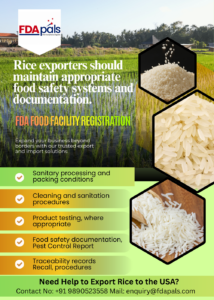
Rice exporters should maintain appropriate food safety systems and documentation.
Important areas may include:
- Sanitary processing and packing conditions
- Pest control
- Cleaning and sanitation procedures
- Supplier controls
- Product testing, where appropriate
- Traceability records
- Recall procedures
- Food safety documentation
The exact requirements can depend on the facility’s operations and the nature of the food activity.
A foreign facility should not assume that compliance with Indian food regulations automatically guarantees compliance with U.S. FDA requirements.
Step 7: Prepare the Documents Required for Shipment
A successful shipment requires coordination between the exporter, U.S. importer, freight forwarder, customs broker, and other parties.
Common export and import documents may include:
- Commercial invoice
- Packing list
- Bill of lading or airway bill
- Certificate of origin, where applicable
- Product specifications
- Certificate of analysis, where required by the buyer or importer
- FDA facility registration information, where applicable
- FDA Prior Notice confirmation information
- Customs entry documentation
- Other documents required by U.S. Customs and Border Protection or other agencies
The exact documents may vary depending on the product, shipment terms, buyer requirements, and applicable U.S. import regulations.
Step 8: Work With a U.S. Importer or Customs Broker
The U.S. importer plays an important role in the import process.
The importer is generally responsible for ensuring that imported food complies with applicable U.S. requirements.
A customs broker may assist with:
- Customs entry filing
- Import documentation
- Coordination with FDA-related entry information
- Classification and customs procedures
- Communication with government agencies
The exporter should communicate with the U.S. importer and customs broker before shipping the product.
This is especially important for first-time exporters because errors in product information, facility details, labeling, or entry documentation can cause delays.
Common Reasons Rice Shipments May Face Problems
Indian exporters should be aware of common compliance issues that may affect shipments.
These may include:
- Incorrect or Missing FDA Facility Registration
If a facility that is required to be registered has not been properly registered, the shipment may face problems during import review.
- Missing Prior Notice
Food shipments generally require Prior Notice before arrival unless an exemption applies. Missing or incorrect Prior Notice information can cause delays.
Labels that do not provide required information or contain misleading claims may create compliance concerns.
Incorrect manufacturer, shipper, importer, country-of-origin, or product information can cause inconsistencies in import documentation.
- Poor Food Safety Documentation
Facilities should maintain appropriate records and procedures related to sanitation, food safety, and traceability.
- Assuming FDA Registration Means FDA Approval
FDA facility registration does not mean that FDA has approved every product or shipment from the facility.
Compliance must be maintained across the facility, product, labeling, and shipment process.
Conclusion
Exporting basmati rice from India to the USA can provide significant business opportunities, but exporters must understand that U.S. food import compliance is an important part of the process.
 Before shipping, Indian rice exporters should evaluate:
- Whether the relevant foreign food facility must be registered with FDA
- Whether a U.S. Agent is required
- Whether FDA Prior Notice must be submitted
- Whether the product label complies with applicable U.S. requirements
- Whether food safety and facility records are properly maintained
- Whether the U.S. importer and customs broker have the correct shipment information
FDA registration alone does not guarantee entry into the United States. Successful export requires coordination between the exporter, facility, U.S. importer, customs broker, and other parties involved in the supply chain.
If you are planning to export basmati rice or other food products from India to the United States, understanding FDA food facility registration and Prior Notice requirements before your first shipment can help reduce compliance risks and avoid unnecessary delays.
Frequently Asked Questions
- Is FDA registration required to export basmati rice from India to the USA?
A foreign facility involved in manufacturing, processing, packing, or holding food for consumption in the United States may be required to register with FDA, depending on the activities and applicable requirements.
The exporter should identify the facilities involved and determine whether registration is required.
- Do I need FDA approval for basmati rice?
Ordinary basmati rice generally does not require a separate FDA product approval certificate simply to be imported into the United States.
However, the food must comply with applicable FDA requirements, including facility, safety, labeling, and import requirements.
- Is FDA Prior Notice required for rice exports to the USA?
In general, food shipments entering the United States require FDA Prior Notice unless a specific exemption applies.
Basmati rice is a food product, so exporters and importers should ensure that Prior Notice is properly submitted and confirmed before the shipment arrives.
- Who files FDA Prior Notice for a rice shipment?
Prior Notice may be submitted by an importer, exporter, customs broker, or another person with the required shipment information.
The parties involved should coordinate to ensure that the Prior Notice is accurate and submitted within the applicable timeframe.
- Does the Indian rice exporter need a U.S. Agent?
If a foreign food facility is required to register with FDA, the registration generally requires a U.S. Agent located in the United States.
The U.S. Agent acts as the communication contact between the foreign facility and FDA.
- What documents are required to export basmati rice to the USA?
Documents may include commercial invoices, packing lists, shipping documents, certificates of origin where applicable, product specifications, FDA-related information, Prior Notice details, and customs entry documentation.
The exact requirements depend on the shipment and the importer.
- Can a trader export rice without owning a rice mill?
A trading company may work with a third-party rice mill, processor, packer, or warehouse.
However, the exporter should correctly identify the facilities involved in manufacturing, processing, packing, and holding the food and determine which FDA requirements apply to each facility.
- What happens if the rice shipment does not meet FDA requirements?
FDA may examine imported food at the port of entry. Non-compliant shipments may face delays, detention, refusal of admission, or other regulatory action depending on the nature of the violation.
Correct documentation and compliance preparation before shipment can help reduce avoidable problems.