Expanding into the United States market presents enormous opportunities for manufacturers and exporters worldwide. However, entering the U.S. market also comes with strict regulatory obligations established by the U.S. Food and Drug Administration (FDA). One of the most frequently misunderstood requirements is the appointment of an FDA US Agent.
Many foreign companies assume that an importer, distributor, or customs broker automatically fulfills this role. In reality, FDA regulations specify when a US Agent is required and what responsibilities they hold. Failing to appoint a qualified US Agent can delay product registrations, interrupt FDA communications, and even impact your ability to market products in the United States.
This guide explains the US Agent requirements across different industries, including food, cosmetics, medical devices, pharmaceuticals, dietary supplements, and animal food, helping businesses understand when a US Agent is mandatory and why choosing the right regulatory partner matters.
What Is an FDA US Agent?
An FDA US Agent is a person or organization located in the United States that serves as the official communication link between the FDA and a foreign establishment.
The US Agent acts as the primary contact for FDA inquiries, inspection notices, compliance communications, and emergency situations. While the US Agent does not manufacture products or guarantee regulatory approval, they ensure that important FDA communications reach the foreign company promptly and accurately.
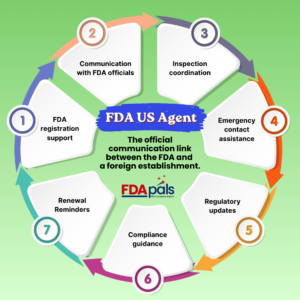 A qualified US Agent typically assists with:
- FDA registration support
- Communication with FDA officials
- Inspection coordination
- Emergency contact assistance
- Regulatory updates
- Compliance guidance
- Renewal reminders
Choosing an experienced regulatory consultant as your US Agent ensures faster responses and better compliance management throughout your product lifecycle.
Why Does FDA Require a US Agent?
Since foreign manufacturers are located outside the United States, FDA needs a reliable point of contact within the country.
The US Agent helps FDA communicate efficiently regarding:
- Product registrations
- Inspection scheduling
- Regulatory deficiencies
- Import-related questions
- Emergency situations involving public health
- Compliance notices
Without a valid US Agent, many FDA registration processes cannot be completed successfully.
US Agent Requirements by Industry
Although FDA regulates multiple product categories, US Agent requirements vary depending on the industry and applicable regulations.
| Industry | US Agent Required? | FDA Registration Required? |
| Food Facilities | Yes | FDA Food Facility Registration |
| Cosmetics | Often Required for Foreign Facilities | Cosmetic Facility Registration & Product Listing |
| Medical Devices | Yes | Establishment Registration |
| Pharmaceuticals | Yes | Drug Establishment Registration |
| Dietary Supplements | Yes (Food Regulations) | Food Facility Registration |
| Animal Food | Yes | Food Facility Registration |
| Biologics | Yes | FDA Registration |
Let’s explore each industry individually.
FDA US Agent Requirements for Food Facilities
Foreign food manufacturers exporting products to the United States must comply with the FDA Food Facility Registration requirements established under the Bioterrorism Act and strengthened through the Food Safety Modernization Act (FSMA).
Food facilities involved in manufacturing, processing, packing, or holding food intended for U.S. consumption must appoint a US Agent before completing FDA registration.
Examples include:
- Food manufacturers
- Beverage companies
- Spice exporters
- Bakery manufacturers
- Seafood processors
- Dairy manufacturers
- Frozen food companies
- Snack manufacturers
The FDA US Agent serves as the communication bridge for:
- Registration confirmations
- Biennial renewals
- FDA inspections
- Import questions
- Compliance notifications
Without an active US Agent, registration may become invalid or delayed.
US Agent Requirements for Cosmetic Companies
The Modernization of Cosmetics Regulation Act (MoCRA) has significantly strengthened FDA oversight of cosmetic products.
Foreign cosmetic manufacturers registering their facilities with FDA should appoint a knowledgeable US Agent to facilitate communication with the agency.
Companies manufacturing:
- Skin care products
- Hair care products
- Makeup
- Fragrances
- Personal care products
- Baby care products
Benefit from having an experienced US Agent who understands cosmetic regulations.
The US Agent can assist with:
- Facility registration
- Product listing
- FDA correspondence
- Regulatory updates
- Compliance questions
As cosmetic regulations continue evolving, businesses increasingly rely on regulatory experts for ongoing compliance support.
US Agent Requirements for Medical Device Manufacturers
Medical device manufacturers located outside the United States must appoint a US Agent when registering their establishments with FDA.
This applies to companies manufacturing the following:
- Surgical instruments
- Diagnostic devices
- Dental products
- Hospital equipment
- Orthopaedic implants
- Monitoring devices
- Laboratory equipment
The US Agent supports communication regarding:
- Establishment Registration
- Device Listing
- FDA inspections
- Quality System concerns
- Import communications
Medical device regulations can be highly technical, making experienced regulatory representation especially valuable.
US Agent Requirements for Pharmaceutical Companies
Foreign pharmaceutical manufacturers exporting drugs or active pharmaceutical ingredients (APIs) to the United States must comply with FDA establishment registration requirements.
Industries include:
- API manufacturers
- Finished dosage manufacturers
- Contract manufacturers
- Sterile product manufacturers
- Biotechnology companies
A US Agent assists with:
- Drug Establishment Registration
- FDA inspection communication
- GMP-related correspondence
- Compliance notifications
- Regulatory inquiries
Timely communication becomes particularly important because pharmaceutical manufacturing facilities are frequently subject to FDA inspections.
Dietary Supplement Manufacturers
Although dietary supplements have unique regulatory requirements, many facilities manufacturing supplements fall under FDA food regulations.
Manufacturers producing:
- Herbal supplements
- Vitamins
- Minerals
- Protein powders
- Nutritional products
often require:
- FDA Food Facility Registration
- A designated FDA US Agent
- Compliance with current Good Manufacturing Practices (cGMP)
The US Agent helps ensure smooth communication throughout the registration process.
Animal Food and Pet Food Manufacturers
Foreign manufacturers producing:
- Pet food
- Animal feed
- Livestock nutrition products
- Veterinary nutritional supplements
must also comply with FDA food facility regulations when exporting to the United States.
A US Agent assists with:
- Registration
- FDA communications
- Import issues
- Inspection coordination
Responsibilities of an FDA US Agent
Many companies mistakenly believe a US Agent only receives emails from FDA. In reality, their responsibilities extend much further.
A professional FDA US Agent typically provides:
FDA Communication
Acts as the official point of contact for FDA correspondence.
Inspection Coordination
Communicates inspection schedules and assists manufacturers in preparing documentation.
Emergency Contact
Responds promptly during urgent public health situations.
Registration Assistance
Supports facility registration, updates, renewals, and amendments.
Regulatory Guidance
Keeps businesses informed about changing FDA regulations.
Compliance Support
Helps companies understand regulatory obligations and avoid common compliance mistakes.
Common Misconceptions About FDA US Agents
“Our Importer Can Automatically Act as Our US Agent.”
Not necessarily. While an importer may serve as a US Agent if they agree and meet FDA requirements, the two roles are legally different.
“A US Agent Gets FDA Approval.”
False.
The FDA US Agent facilitates communication but does not approve products or registrations.
“We Only Need a US Agent Once.”
Incorrect.
The US Agent relationship should remain active throughout your FDA registration period.
“Any U.S. Address Can Be Used.”
FDA expects accurate and responsive contact information. Choosing an inexperienced representative may delay important regulatory communications.
How to Choose the Right FDA US Agent
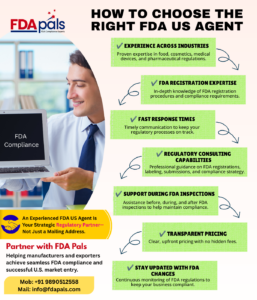 Selecting a US Agent should be based on expertise rather than cost alone.
Consider these factors:
- Experience across multiple FDA-regulated industries
- Knowledge of FDA registration procedures
- Fast response times
- Regulatory consulting capabilities
- Support during inspections
- Transparent pricing
- Strong understanding of FDA compliance updates
A knowledgeable US Agent can become a valuable long-term regulatory partner rather than simply a mailing address.
Why Work with FDA Pals?
Navigating FDA regulations can be complex, especially for companies entering the U.S. market for the first time. FDA Pals provides comprehensive FDA regulatory support to businesses worldwide.
Our services include:
- FDA US Agent Services
- FDA Food Facility Registration
- Cosmetic Facility Registration
- Cosmetic Product Listing
- Medical Device Registration
- Drug Establishment Registration
- DMF Consulting
- FDA Compliance Consulting
- Regulatory Documentation Support
- Ongoing Compliance Assistance
With industry expertise and personalized guidance, FDA Pals helps businesses meet FDA requirements efficiently and confidently.
Conclusion
An FDA US Agent plays a critical role in maintaining effective communication between foreign manufacturers and the U.S. Food and Drug Administration. Whether your business manufactures food products, cosmetics, medical devices, pharmaceuticals, dietary supplements, or animal food, understanding the applicable US Agent requirements is essential for regulatory compliance.
Rather than viewing the US Agent as merely a regulatory requirement, businesses should see this role as a strategic compliance partner. An experienced US Agent can help reduce communication delays, support FDA registrations, coordinate inspections, and keep your company informed about evolving regulatory requirements.
As FDA regulations continue to expand across industries, partnering with a trusted compliance expert can help your business enter and remain in the U.S. market with confidence.
Frequently Asked Questions (FAQs)
Q. 1) What is an FDA US Agent?
An FDA US Agent is a U.S.-based representative who serves as the official communication link between foreign establishments and the FDA.
Q. 2) Is an FDA US Agent mandatory for all industries?
No. Requirements depend on the product category and FDA regulations governing that industry. Food facilities, medical device establishments, and pharmaceutical manufacturers generally require a US Agent, while cosmetic requirements vary under MoCRA.
Q. 3) Can my importer act as my FDA US Agent?
Yes, if they agree to serve in that role and meet FDA requirements. However, many companies prefer an independent regulatory consultant to avoid conflicts of interest.
Q 4) Does a US Agent approve FDA registrations?
No. The US Agent facilitates communication but does not approve registrations or products.
Q. 5) Can I change my FDA US Agent?
Yes. FDA allows companies to update their US Agent information whenever necessary through the appropriate registration process.
Q. 6) What happens if my FDA cannot reach my US Agent?
Missed communications can delay registrations, inspections, or other regulatory actions, making it important to maintain accurate and responsive US Agent details.
Q. 7) Does FDA Pals provide FDA US Agent services?
Yes. FDA Pals offers FDA US Agent services along with end-to-end support for food, cosmetics, medical devices, pharmaceuticals, and other FDA-regulated industries.