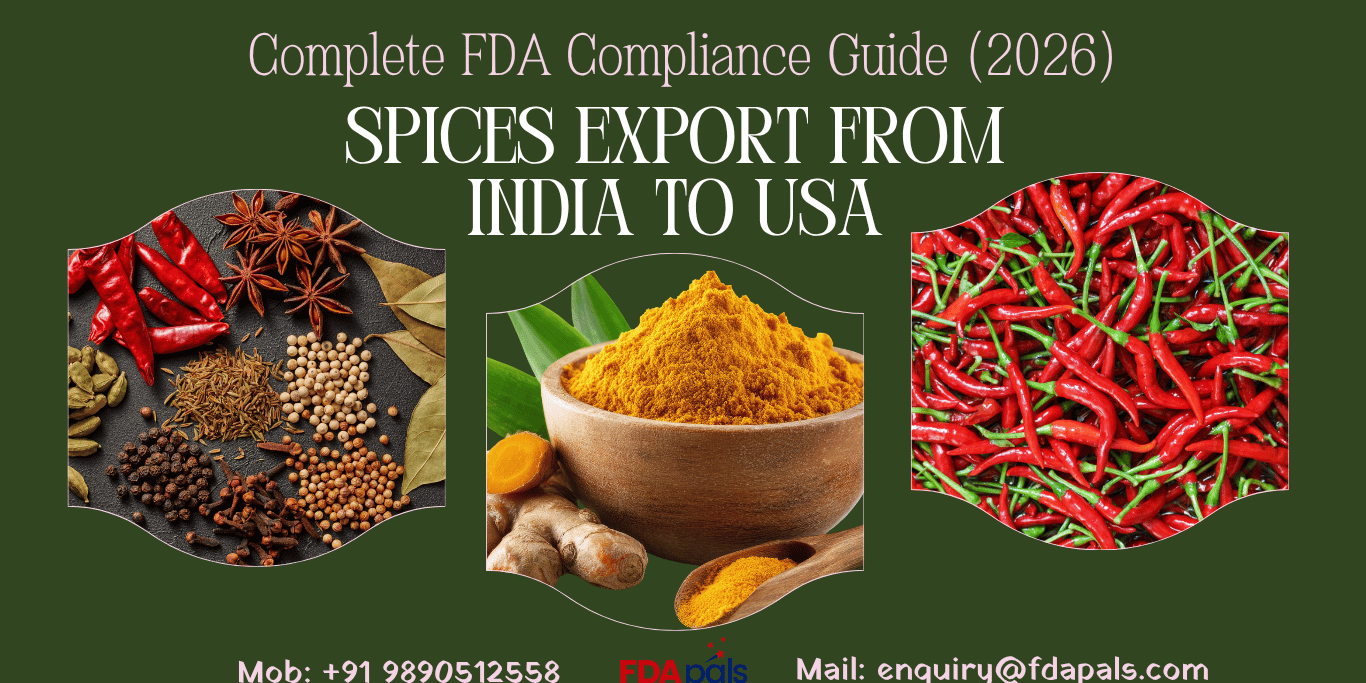
India grows and exports spices more than any other country on earth. Turmeric, cumin, black pepper, chili powder, cardamom — if it’s in a spice rack somewhere in the world, chances are a good chunk of it came from here. And the US is one of our biggest buyers.
But here’s the thing exporters often learn the hard way: growing great spices and getting them onto US shelves are two very different problems. One is agriculture. The other is regulatory paperwork, and the FDA doesn’t care how good your turmeric smells if your documentation isn’t in order.
Spices are food, plain and simple, and that puts them squarely under FDA jurisdiction. There’s a defined checklist for Spices Export from India to USA that you need to have sorted before your shipment even reaches the U.S. border — and skipping one item doesn’t just slow things down. It can get your shipment refused at the port, or worse, land you on an import alert that flags every future shipment automatically, whether it’s clean or not.
So let’s walk through what actually needs to be in place if you’re exporting spices to the US in 2026 — including a couple of rule changes that are brand new this year.
Why This Isn’t Optional
If your shipment isn’t backed by proper FDA registration and paperwork, it’s legally considered “adulterated” — a technical term, but a brutal one. It doesn’t matter how clean your product actually is. That single label is enough for the FDA and CBP to hold your container, refuse it, or send it straight back at your cost.
And in a category where India is competing hard against Vietnam, Indonesia, and a handful of Latin American exporters for the same US shelf space, this isn’t just about avoiding fines. It’s about being the supplier a US buyer can actually count on, shipment after shipment.
Step 1: FDA Food Facility Registration
For Spices Export from India to USA, any facility in India that grows, processes, blends, packs, or stores spices bound for the US needs to be registered with the FDA — this comes from the Food Safety Modernization Act and the Bioterrorism Act. Doesn’t matter if you’re a large processing plant or a smaller packing unit built specifically for export. If your product touches US soil, your facility needs to be on record.
A few things worth knowing:
- You register through FDA’s FURLS portal, and you’ll get a unique FEI number for your facility once it’s done.
- Before any of that, you need a DUNS number from Dun & Bradstreet. It usually takes a few business days for international applicants, so don’t leave it to the last minute.
- Registration isn’t a “set it and forget it” thing — it has to be renewed every even-numbered year (2026, 2028…) during a fixed window from October 1 to December 31. Miss that window and there’s no grace period. You simply lose your authorization to export until you fix it.
- Foreign facilities also can’t register without naming a US Agent — more on that next.
Honestly, the renewal deadline is where we see most exporters trip up. Not because the process is hard, but because nobody’s watching the calendar.
Step 2: Appoint a US Agent
As a foreign facility, the FDA requires you to name someone based in the US who acts as your point of contact. This person receives FDA communications on your behalf, coordinates during inspections, and steps in if a shipment gets flagged.
They don’t need to be involved in your day-to-day shipping or sales. But they do need to be responsive — FDA correspondence often comes with tight deadlines attached, and a US Agent who’s slow to respond can turn a minor issue into a real delay.
Step 3: File Prior Notice — Every Single Shipment
Registration covers your business. Prior Notice covers each shipment individually, and you need to file it every time.
Before your container arrives at a US port, Prior Notice has to be submitted electronically through FDA’s Prior Notice System Interface. This gives FDA and CBP a heads-up on what’s coming in before it actually arrives. The exact timing depends on how it’s shipped — roughly 2 hours ahead for road shipments, 4 hours for air or rail, and 8 hours for ocean freight.
The details need to line up exactly — product, manufacturer, shipper, importer. Small inconsistencies here are one of the most common reasons shipments get pulled aside for manual review at the port.
Step 4: FSVP — Technically Your Buyer’s Job, But It Affects You Directly
The Foreign Supplier Verification Program puts the compliance responsibility on the US importer, not you. Under FSVP, your US buyer has to verify that you — the foreign supplier — are producing spices to US food safety standards.
In practice, that means your buyer is going to come to you asking for:
- Documentation of your food safety systems (HACCP or Preventive Controls-based)
- Contaminant testing records
- Proof of your FDA facility registration
- Cooperation during their supplier verification audits
Exporters who already have this documentation ready sail through buyer onboarding. Exporters who don’t often lose the deal entirely to someone who was better prepared — buyers don’t have the patience to chase paperwork anymore.
The Risks That Are Specific to Spices
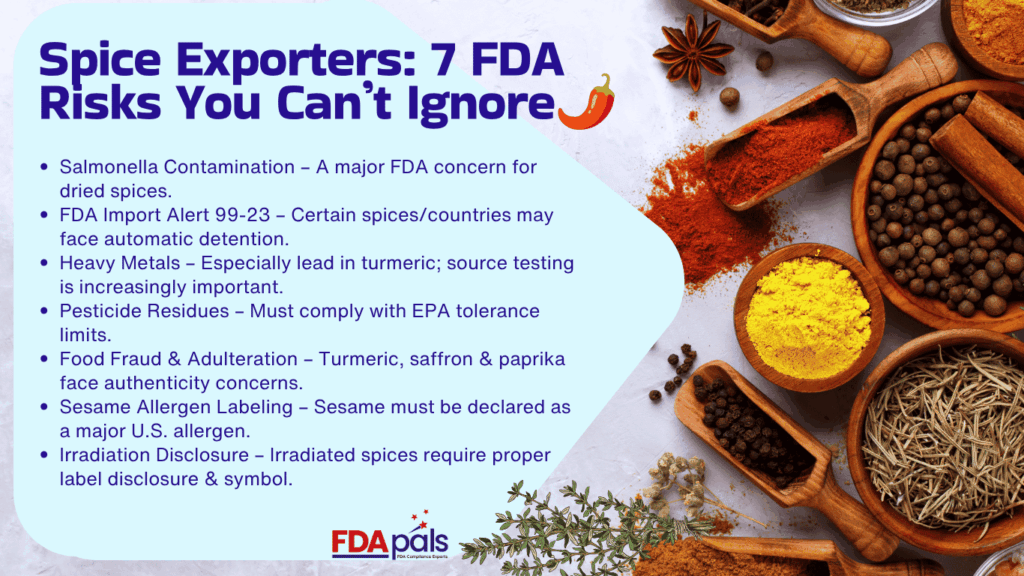 Spices carry a handful of contamination and labeling risks that the FDA watches especially closely.
Salmonella is probably the biggest one. Dried spices have a history of triggering FDA scrutiny here, and certain categories and countries have ended up on FDA Import Alert 99-23 — which lets the FDA detain shipments without even physically examining them. Once you’re on that list, every future shipment gets held automatically until you can prove you’ve fixed the problem. Getting off an import alert is slow and expensive, so this is one to take seriously from day one.
Heavy metals, especially lead, are another concern — turmeric in particular has faced increased testing tied to certain processing and coloring methods. Documented testing at source isn’t a nice-to-have anymore; it’s expected.
Pesticide residues get checked against EPA tolerance levels, and anything over the limit is an automatic refusal.
Then there’s food fraud — turmeric, saffron, and paprika are common targets for cheap fillers or unauthorized colorants, and the FDA has stepped up authenticity testing on exactly these categories.
If your blends contain sesame, you need to declare it clearly — sesame became the ninth major US allergen under the FASTER Act, and that applies even in small quantities.
And if you irradiate your spices for microbial control, which a lot of exporters do, the label needs to disclose it properly with the required symbol and statement.
What Changed in 2026 Spices Export from India to USA
Two updates are worth knowing about specifically because they’re new this year.
First, the FDA’s Food Traceability List rules kicked in this January, and herbs and spices are now on that list. That means lot-level tracking and recordkeeping is mandatory — you need to be able to trace a batch through every stage of your supply chain, not just keep a general log.
Second, new import certification requirements now apply to shipments from certain designated regions. The FDA can ask for shipment-specific certificates, certified facility lists, test records, or third-party audit reports before clearing a shipment — and these certifications have to come from either a government agency in the exporting country or an FDA-accredited third-party certifier.
Both changes are really saying the same thing: the FDA wants more proof, more traceability, and it wants it documented, not just assumed. Exporters who build these systems now are going to have a real edge over the ones scrambling to catch up when a shipment gets stopped.
Mistakes We See Again and Again
- Registering once and forgetting the renewal deadline exists
- Handing Prior Notice entirely to a customs broker without ever reviewing what’s actually being filed
- Not keeping batch-level records detailed enough for FSVP audits or the new FTL rules
- Only taking heavy metal or Salmonella testing seriously after a shipment gets detained
- Skipping allergen or irradiation disclosure on private-label blends
- Waiting until something’s stuck at the port to figure out where the gap actually was
Every one of these is avoidable. It just takes putting the process in place before you ship, not after something goes wrong.
What to Have Ready Before You Ship
Rather than discovering a gap at the port, it helps to have this sorted in advance:
- Valid FDA Food Facility Registration with a current FEI number
- US Agent designation on file
- FSSAI license and export paperwork from the Indian side
- Product specification sheets and a Certificate of Analysis per batch
- Test reports covering Salmonella, heavy metals, and pesticide residues
- Label artwork checked against 21 CFR Part 101 — statement of identity, net quantity in metric and US units, current Nutrition Facts format, full ingredient and allergen list, and clear country-of-origin marking
- Lot-level traceability records that satisfy the Food Traceability List
- Irradiation disclosure, if applicable
More and more buyers want this entire file upfront, before they’ll even finalize an order. Having it ready ahead of time saves weeks of back-and-forth later.
A Few Quick Questions Exporters Ask Us (FAQs)
Q. 1) Do Indian spice exporters need FDA registration to export spices to the USA?
Ans: Yes, in many cases, the U.S. FDA compliance process starts with Food Facility Registration. If an Indian facility manufactures, processes, packs, or holds spices intended for consumption in the USA, the facility may need to register with the FDA. However, registration alone does not mean the product is automatically approved. Exporters must also meet applicable U.S. food safety, labeling, and import requirements.
Q. 2) Which Indian spices can be exported to the USA?
Ans: A wide range of Indian spices can be exported to the U.S. market, including turmeric, cumin, coriander, red chilli, black pepper, cardamom, and spice blends such as garam masala. The specific compliance requirements can vary depending on the type of spice, how it is processed, and how it is packaged and marketed.
Q. 3) What FDA requirements should Indian spice exporters follow?
Ans: Indian exporters generally need to consider requirements related to FDA food facility registration, food safety, preventive controls, labeling, ingredient declarations, and import procedures. Depending on the product and facility, additional requirements may apply. It is important to review the requirements before shipping rather than treating FDA registration as the only compliance step.
Q. 4) Is FDA registration enough to clear spices at the U.S. border?
Ans: Not necessarily. FDA facility registration is only one part of the compliance process. Shipments may also need proper Prior Notice, compliant labeling, appropriate documentation, and adherence to U.S. food safety regulations. The FDA can examine imported food shipments, so exporters should ensure that their products and paperwork are compliant before dispatch.
Q. 5) What labeling requirements apply to Indian spices exported to the USA?
Ans: Spice products sold in the USA generally need labeling that follows applicable U.S. requirements. Depending on the product, the label may need information such as the product identity, net quantity, ingredient statement, allergen information where applicable, and the name and address of the responsible business. Labels should be reviewed carefully before printing because even small mistakes can create compliance or shipment issues.
Q. 6) What are the common FDA compliance challenges for Indian spice exporters?
Ans: Common challenges include incorrect or incomplete labeling, inadequate food safety controls, facility registration issues, documentation errors, contamination concerns, and misunderstanding U.S. import requirements. Many of these problems can be avoided by preparing compliance documentation in advance and checking the requirements applicable to the specific spice and manufacturing process.
Q. 7) I only export occasionally — do I still need FDA registration?
Ans: Yes. Registration is tied to your facility, not how often you ship. Even one export requires active registration and a US Agent on file.
Q. 8) Isn’t FSSAI enough?
Ans: No. FSSAI is domestic Indian food safety compliance, and it’s useful supporting documentation — but it doesn’t replace FDA registration, Prior Notice, or FSVP. Those are separate US requirements entirely.
Q. 9) What actually happens if I land on an Import Alert?
Ans: Shipments get detained without examination until you can show corrective action — usually test results plus documentation. It’s slow, and it usually needs someone who knows the process to get you off it.
Q. 10) Does one registration cover all my spice products?
Ans: It covers one facility and whatever food categories that facility handles. If you run more than one processing or packing unit, each generally needs its own registration.
How FDApals Can Help
We work with Indian spice manufacturers and exporters on exactly this — FDA Food Facility Registration and renewal, US Agent services, Prior Notice coordination, and helping you put together the documentation your US buyers will ask for under FSVP. Thirty years in regulatory compliance has taught us that the exporters who succeed long-term aren’t the ones with the best product alone — they’re the ones whose paperwork never gives a buyer a reason to worry.
If you’re getting ready to export spices to the US, or a recent shipment ran into trouble, get in touch. We’ll help you get registered, get compliant, and stay that way.