Launching a cosmetic, food, medical device, drug, or other regulated product in India can create strong commercial opportunities. However, market entry is not only about product quality, branding, distribution, and sales. Regulatory readiness is equally important.
For many startups and importers, compliance with the Central Drugs Standard Control Organization (CDSCO) can become a complex and time-consuming responsibility. Applications, technical documents, product classifications, labels, authorisations, registrations, and follow-up responses must be handled correctly. Even a small documentation gap can lead to queries, delays, additional costs, or disruption to launch plans.
This is why many businesses choose to outsource CDSCO compliance to experienced regulatory consultants. Outsourcing does not remove the company’s responsibility for compliance. Instead, it gives the business structured expert support to manage the process more efficiently and reduce avoidable regulatory risk.
For imported cosmetics, CDSCO regulates import through a registration system under the Drugs and Cosmetics Act, 1940 and the Cosmetics Rules, 2020. Products, variants, pack sizes, and manufacturing premises may need to be included before import into India.
What Does CDSCO Compliance Mean?
CDSCO is India’s central regulatory authority for products regulated under the Drugs and Cosmetics Act and related rules. Depending on the product category and business activity, compliance may involve registrations, licences, import permissions, documentation review, labeling assessment, quality-related information, and post-approval obligations.
For startups and importers, CDSCO compliance is often connected with questions such as:
- Does our product fall under CDSCO regulation?
- Is the product classified correctly?
- Which registration or licence is required?
- Can an authorised Indian agent submit the application?
- Are our labels compliant for the Indian market?
- Which documents must be legalised, notarised, or apostilled?
- How should we respond if CDSCO raises a query?
- What changes require a new filing, endorsement, or regulatory assessment?
The answer is not always straightforward. Requirements can differ based on the product type, manufacturing location, intended claims, product composition, and route to market.
For cosmetic imports, an online application for an Import Registration Certificate is made through the SUGAM portal in Form COS-1. The applicant may be the manufacturer, authorised agent, importer, or an Indian subsidiary authorised by the manufacturer.
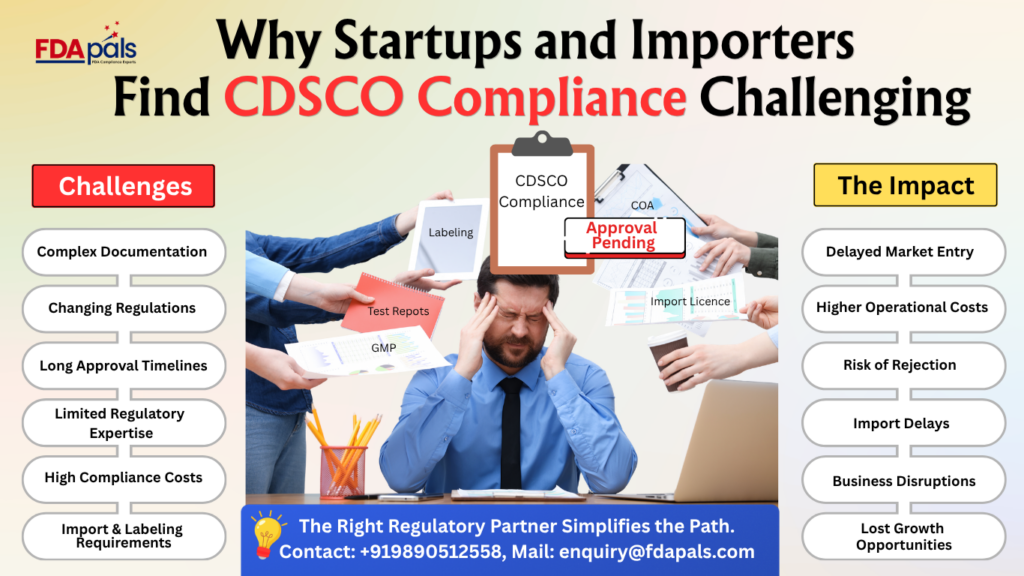
Why Startups and Importers Find CDSCO Compliance Challenging
- Limited In-House Regulatory Expertise
Early-stage companies often have small teams focused on product development, marketing, sales, investor discussions, and supply chain planning. Hiring a full-time regulatory specialist may not be practical at the beginning.
Importers face a different challenge. They may understand their overseas product portfolio well but may not fully understand India-specific documentation, labeling, registration, or authorised-agent requirements.
A specialist compliance partner helps fill this knowledge gap without requiring the business to build a large internal regulatory department from day one.
- Documentation Can Be Detailed and Time-Sensitive
Regulatory applications are only as strong as the documents supporting them. Depending on the category, a business may need product details, manufacturing information, authorisation letters, labels, ingredient or composition information, safety-related documents, certificates, declarations, and proof of overseas approvals.
For imported cosmetics, CDSCO guidance highlights registration of the cosmetic along with its pack sizes, variants, and manufacturing premises before import.
When documents are incomplete, inconsistent, expired, or not properly authenticated, the application process can slow down significantly.
- Product Labels Need Indian Regulatory Review
A label that works in another country may not automatically be suitable for India. Imported products may need changes to align with local labeling rules, declarations, claims, and product information requirements.
Cosmetics must not carry claims that are false or misleading. CDSCO also requires compliance with applicable quality and safety standards under the Cosmetics Rules, 2020.
A pre-submission label review can identify potential concerns before products are printed, shipped, or listed for sale.
- Delays Can Affect Commercial Launch Plans
For a startup, a delayed regulatory approval can affect distributor commitments, marketplace launches, marketing campaigns, warehousing plans, and revenue projections.
For an importer, delays may result in inventory being held longer than expected, missed seasonal demand, and pressure from overseas brand owners.
Outsourcing helps businesses create a realistic regulatory timeline and prepare submissions in a more organised way.
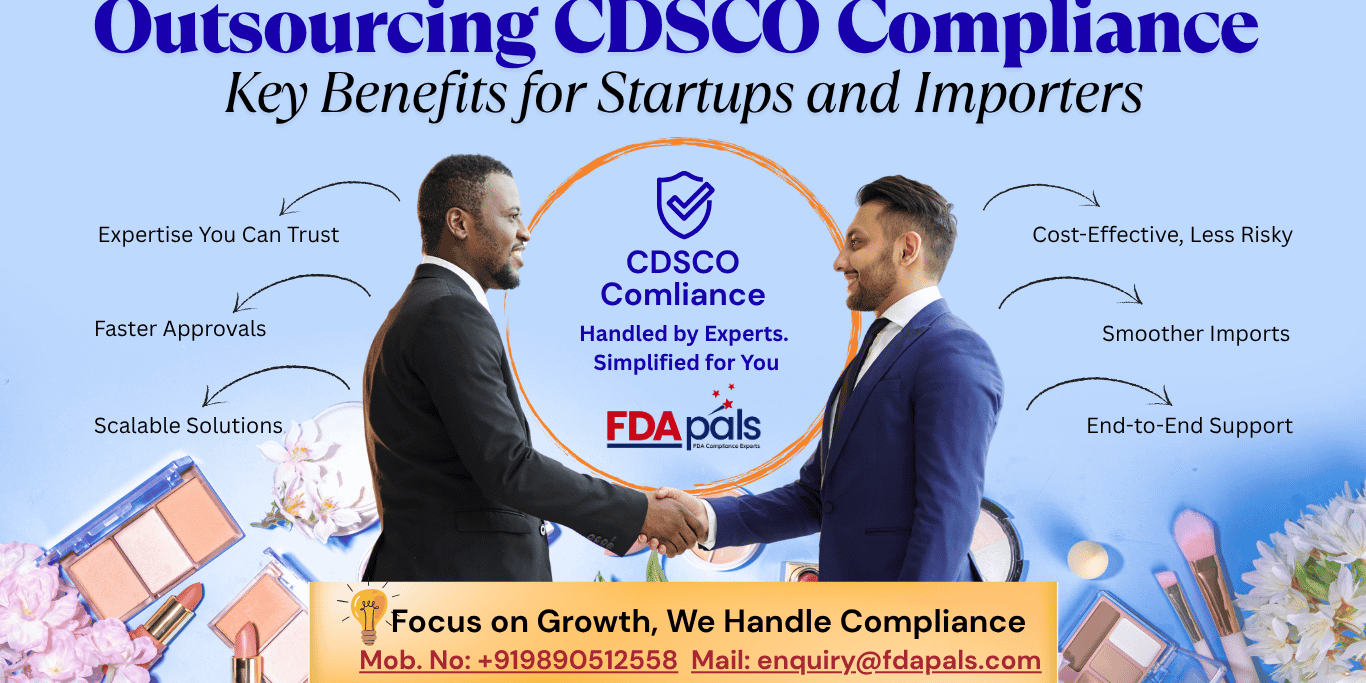
Major Benefits of Outsourcing CDSCO Compliance
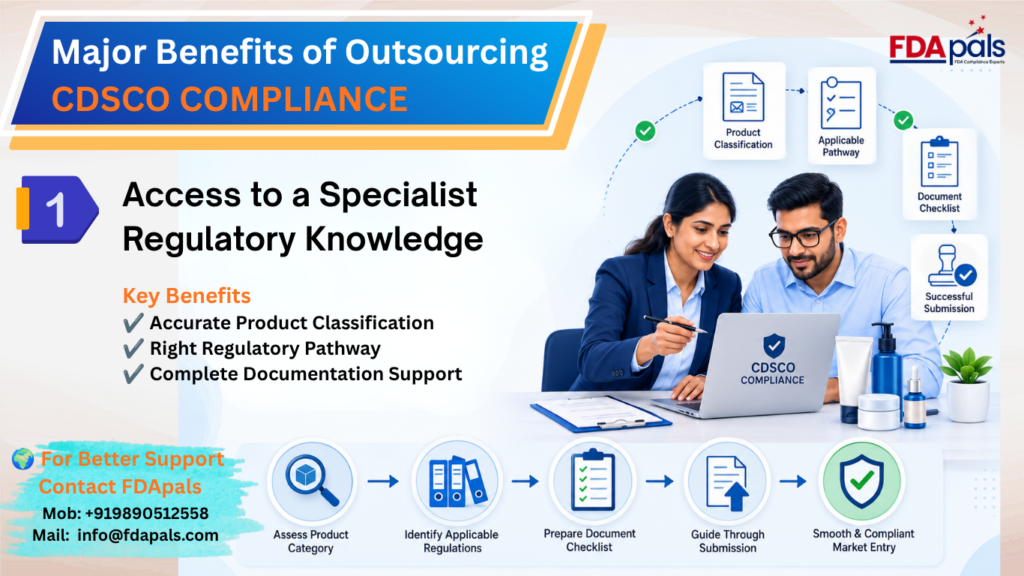
- Access to Specialist Regulatory Knowledge
The main advantage of outsourcing is access to professionals who work regularly with regulatory documentation and CDSCO processes.
An experienced consultant can help assess the product category, identify the applicable pathway, prepare a document checklist, and guide the business through submission requirements. This reduces the chance of making decisions based on assumptions or incomplete online information.
For startups entering regulated markets for the first time, this expert direction can be particularly valuable.
- Faster and Better-Organised Documentation
A regulatory consultant typically begins with a document gap assessment. This involves reviewing what is available, identifying missing documents, checking consistency across records, and creating a structured filing plan.
This process can help businesses avoid common issues such as:
- Mismatch between product name and label
- Incorrect manufacturing site details
- Missing authorisation documents
- Incomplete product lists
- Incorrect pack-size or variant details
- Unsupported marketing claims
- Inconsistent ingredient or composition information
- Unclear responsibility between importer and overseas manufacturer
A well-prepared dossier does not guarantee approval, but it can reduce avoidable back-and-forth during review.
- Lower Risk of Costly Rework
Compliance errors are often expensive because they create rework. A business may need to revise labels, collect fresh legalised documents, delay shipment, amend product information, or repeat parts of the application process.
Outsourcing helps identify regulatory gaps earlier, when corrections are usually easier and less costly.
For example, if a cosmetic label is reviewed before final printing, the company can correct missing declarations or problematic claims before large packaging quantities are produced.
- Better Support for Imported Products
Foreign manufacturers and Indian importers often need to coordinate across different time zones, languages, document formats, and regulatory expectations.
A local regulatory partner can act as a bridge between the overseas manufacturer and the Indian market. They can explain which documents are required, provide formats for authorisations and declarations, review product lists, and coordinate the submission process.
The Cosmetics Rules, 2020 provide for an authorised agent to act as an official representative for registration purposes. The authorised agent can also remain responsible for compliance in relation to imported cosmetics, including after withdrawal of the power of attorney for products already imported.
This makes the choice of a knowledgeable Indian compliance partner important.
- Improved Focus on Core Business Activities
Startups need to focus on activities that build the business: product innovation, customer acquisition, brand building, fundraising, channel partnerships, and operational growth.
Importers need to focus on supplier management, forecasting, distribution, sales, and customer service.
When internal teams spend too much time trying to understand regulatory forms, rules, and documentation requirements, other important work can suffer. Outsourcing allows the business to retain control while delegating technical execution to specialists.
- Stronger Compliance Planning Before Market Entry
Good compliance is not only about filing an application. It begins much earlier.
A consultant can help businesses plan regulatory requirements before they finalise product claims, packaging, shipment schedules, or distributor agreements. This supports a more realistic market-entry strategy.
A pre-launch compliance plan may include:
- Product classification review
- Ingredient or composition assessment
- Label compliance review
- Documentation checklist
- Authorised agent support
- Application preparation
- Submission and query-response support
- Post-registration compliance planning
This structured approach can make regulatory work more predictable.
- Support During CDSCO Queries and Follow-Ups
Receiving a regulatory query does not always mean that the application will fail. However, the response must be accurate, complete, and submitted within the required timeline.
Consultants can help interpret the query, coordinate with the manufacturer, prepare a response package, and ensure that the answer aligns with the original application.
This is especially helpful for importers who depend on overseas teams to provide technical data or revised documents.
- Scalable Support as the Business Grows
A startup may initially need support for one product line. Later, it may add new variants, new pack sizes, additional manufacturing sites, or a wider product portfolio.
Outsourced regulatory support can scale with the business. Instead of hiring a full internal team immediately, the company can use consulting support based on current needs.
This can be a practical model for businesses managing budgets carefully while still taking compliance seriously.
When Should a Startup or Importer Outsource CDSCO Compliance?
Outsourcing is especially useful when:
- You are launching a regulated product in India for the first time.
- You are importing cosmetics, medical devices, drugs, or other CDSCO-regulated products.
- Your overseas manufacturer needs Indian regulatory guidance.
- You do not have an in-house regulatory affairs team.
- You need help reviewing labels and product claims.
- Your documentation is spread across multiple suppliers or countries.
- You have received a CDSCO query and need structured support.
- You are planning multiple products, variants, or pack sizes.
- You want to reduce the risk of delayed launch timelines.
How to Choose the Right CDSCO Compliance Consultant
Not every consultant offers the same depth of support. Before outsourcing, businesses should assess whether the consultant understands their product category and commercial goals.
Look for a partner that can provide:
Product-Specific Experience
The consultant should understand the regulatory requirements relevant to your product category. Cosmetic registration support is different from medical device or drug compliance support.
Clear Scope of Work
Ask what is included: document review, label review, application preparation, portal submission, query responses, authorised agent support, and post-approval guidance.
Transparent Documentation Process
A reliable consultant should provide a checklist, explain document requirements clearly, and maintain organised communication with your team.
Practical Commercial Understanding
Regulatory compliance should support business growth, not create unnecessary complexity. The right consultant should help you understand risks while also offering workable solutions.
Ongoing Support
Compliance does not always end after registration. Choose a partner that can assist with future changes, renewals or retention requirements, new products, and regulatory updates.
Under the Cosmetics Rules, 2020, an Import Registration Certificate in Form COS-2 remains valid in perpetuity subject to payment of the applicable retention fee.
Outsourcing Does Not Mean Losing Control
Some businesses worry that outsourcing compliance means giving up control. In reality, the best outsourcing model is collaborative.
The company remains responsible for product quality, manufacturing information, commercial decisions, and the accuracy of documents supplied. The consultant provides regulatory interpretation, process management, document coordination, and filing support.
The strongest results come when the business, manufacturer, importer, and regulatory consultant work together with clear responsibilities.
How FDA Pals Can Help
FDA Pals supports startups, overseas manufacturers, brand owners, and importers with practical regulatory guidance for entering and operating in the Indian market.
Our CDSCO compliance support can help with:
- Cosmetic registration strategy
- Import registration documentation
- Ingredient compliance review
- Cosmetic label compliance assessment
- Authorised Indian agent support
- Product and variant documentation review
- CDSCO application preparation
- Query response coordination
- Post-registration compliance guidance
Whether you are launching one imported cosmetic product or building a larger India portfolio, early regulatory planning can reduce avoidable delays and help your business move forward with greater confidence.
Conclusion
Outsourcing CDSCO compliance is not simply an administrative decision. It is a strategic choice for startups and importers that want to enter the Indian market with better preparation.
By working with experienced regulatory professionals, businesses can improve documentation quality, reduce avoidable errors, manage regulatory timelines more effectively, and keep internal teams focused on growth.
For importers and startups, compliance should be treated as part of market-entry planning—not as a last-minute task before shipment or launch.
Frequently Asked Questions: Outsourcing CDSCO Compliance
- What does outsourcing CDSCO compliance mean?
Outsourcing CDSCO compliance means working with a regulatory consulting partner to manage product registration, documentation, labeling review, application preparation, and regulatory communication related to CDSCO requirements. It helps startups, importers, and foreign manufacturers handle compliance more efficiently without building a full in-house regulatory team.
- Why should startups outsource CDSCO compliance?
Startups often have limited internal resources and may not have dedicated regulatory professionals. Outsourcing CDSCO compliance helps them access expert guidance, reduce documentation errors, avoid unnecessary launch delays, and focus on business growth, branding, product development, and sales.
- Can importers apply for CDSCO cosmetic registration?
Yes. An importer, manufacturer, authorised Indian agent, or Indian subsidiary authorised by the overseas manufacturer may apply for cosmetic import registration in India. The right applicant structure depends on the product, manufacturer arrangement, and regulatory documentation available.
- What services are included in CDSCO compliance outsourcing?
CDSCO compliance outsourcing may include product classification review, document checklist preparation, cosmetic ingredient compliance review, label assessment, authorised agent support, application preparation, SUGAM portal submission, CDSCO query responses, and post-registration compliance guidance.
- Does outsourcing CDSCO compliance guarantee approval?
No consultant can guarantee CDSCO approval because final approval is always decided by the regulatory authority. However, professional CDSCO regulatory support can improve document quality, reduce avoidable mistakes, and help ensure that applications are prepared according to applicable requirements.
- How does outsourcing help reduce registration delays?
A CDSCO compliance consultant reviews documents before submission, identifies missing information, checks label details, and coordinates with manufacturers or importers for corrections. This reduces the risk of incomplete applications, repeated queries, incorrect product details, and avoidable delays.
- Is label compliance important for imported cosmetics in India?
Yes. Imported cosmetic labels must meet applicable Indian labeling requirements before products are sold or distributed. Labels should include accurate product information and avoid misleading claims. A label compliance review before printing or import can help reduce regulatory and commercial risks.
- Can a foreign cosmetic manufacturer appoint an Indian authorised agent?
Yes. Foreign cosmetic manufacturers can appoint an authorised Indian agent to support the cosmetic registration process and act as a local regulatory representative. The authorised agent can help coordinate documentation, registration applications, communication, and compliance-related responsibilities in India.
- When should a company hire a CDSCO compliance consultant?
A company should consider hiring a CDSCO compliance consultant before finalising product labels, placing import orders, planning launch dates, or submitting applications. Early support is especially useful for first-time importers, startups, foreign brands, and businesses launching multiple cosmetic products or variants.
- How can FDA Pals help with CDSCO compliance?
FDA Pals helps startups, importers, and international cosmetic brands with CDSCO cosmetic registration, ingredient compliance review, label compliance assessment, documentation support, authorised Indian agent services, application filing, and post-registration guidance.