If you run a food, beverage, or dietary supplement business that touches the U.S. market, there’s a date circled on your compliance calendar that you really don’t want to miss: December 31, 2026. That’s the last day of this year’s FDA Food Facility Registration renewal window, and if your facility misses it, the consequences aren’t a slap on the wrist — they can mean stalled shipments, blocked imports, and products legally treated as adulterated.
The good news? FDA Food Facility Registration Renewal itself is a fairly simple process once you know what’s involved. The bad news? Every renewal cycle, thousands of facilities get tripped up by outdated contact details, expired identifiers, or simply forgetting the window exists at all. This blog walks you through everything — what renewal actually is, who needs to do it, what information you’ll need, common mistakes to avoid, and answers to the questions we hear most often from clients at FDA Pals.
What Is FDA Food Facility Registration Renewal, Exactly?
Back in 2002, the U.S. passed the Public Health Security and Bioterrorism Preparedness and Response Act, which required food facilities to register with the FDA so the agency could quickly trace the source of a foodborne illness outbreak or respond to a potential bioterrorism threat. When the FDA Food Safety Modernization Act (FSMA) came along in 2011, it added a crucial twist: registrations wouldn’t last forever. Instead, every facility would need to renew its registration every two years, during even-numbered years, between October 1 and December 31.
So renewal isn’t a formality — it’s the FDA’s way of keeping its database of the food supply chain current. Facilities open and close, ownership changes hands, contact people move on to new jobs, and product lines shift. FDA Food Facility Registration Renewal forces a refresh of that information so the agency always has an accurate picture of who’s manufacturing, processing, packing, or holding food destined for American tables.
Who Actually Needs to Renew?
In general, if your facility manufactures, processes, packs, or holds food, beverages, or dietary supplements intended for human or animal consumption in the United States, you’re required to register — and therefore to renew. This applies whether your facility is located inside the U.S. or anywhere else in the world.
That covers a wide range of businesses:
- Packaged food and snack manufacturers
- Beverage producers and bottlers
- Dietary supplement companies
- Co-packers, warehouses, and cold storage facilities that hold food
- Ingredient suppliers and processors
- Foreign exporters shipping food products into the U.S.
There are exemptions written into FDA regulations for certain activities and facility types — for example, some farms, restaurants, and retail food establishments fall outside the registration requirement. But “I think we’re probably exempt” is a risky assumption to build a compliance strategy on. If you’re not sure where your facility stands, it’s worth getting a straight answer before the window closes rather than after.
What You’ll Need to Renew
Renewal happens through the FDA’s online portal, and you’ll need an active FDA Industry Systems (FIS) account to access it. Once you’re in, be ready to review and confirm:
- Your facility’s legal name, physical address, and mailing address
- Trade names the facility operates under
- Owner, operator, and emergency contact information
- The types of activities performed at the facility (manufacturing, processing, packing, holding)
- Applicable food product categories
- A Unique Facility Identifier (UFI) — currently, the only accepted UFI is a DUNS number issued free of charge by Dun & Bradstreet
- For foreign facilities, current and valid U.S. Agent details
That last point trips up more businesses than you’d expect. Your U.S. Agent is the FDA’s point of contact for your facility if there’s ever a question, inspection notice, or emergency — and if that agent’s information is outdated, incorrect, or unreachable, your renewal can be rejected outright.
Why the Deadline Actually Matters
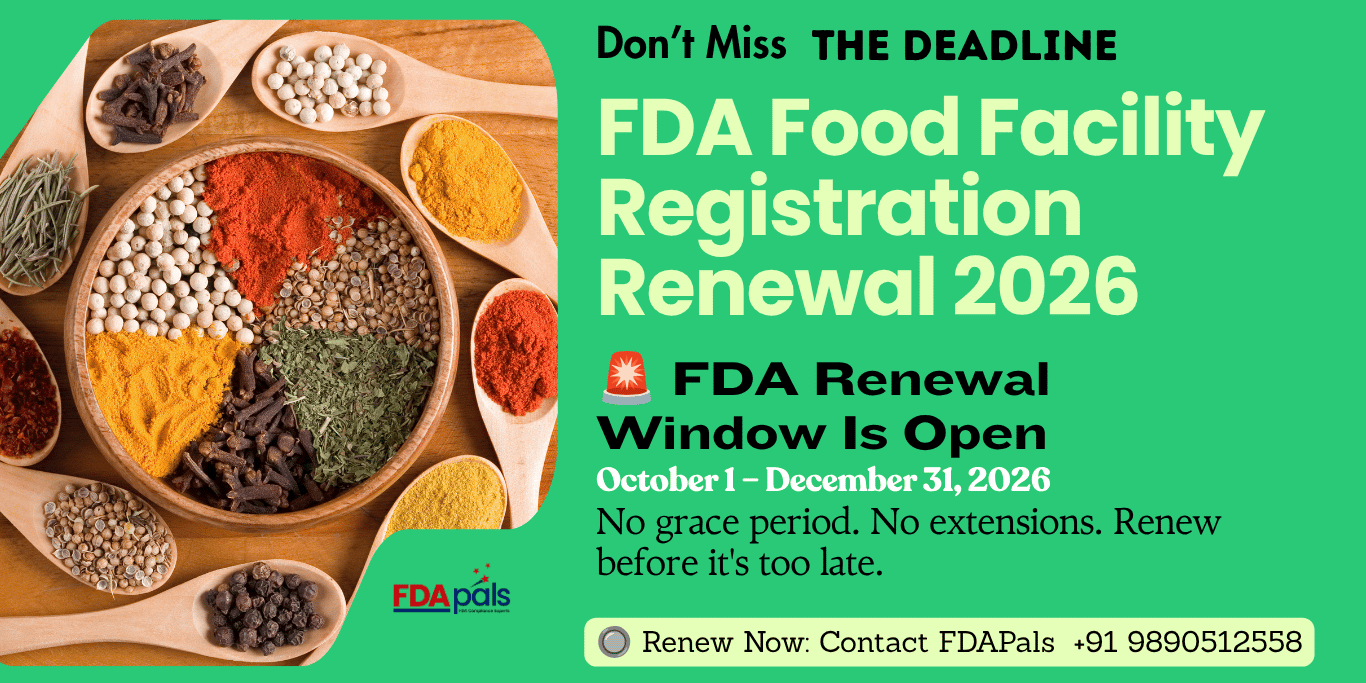
Here’s the part that catches people off guard: there’s no grace period. If your registration isn’t renewed by December 31, 2026, the FDA doesn’t pause it or send a gentle reminder — it simply expires. And an expired registration isn’t something you can quietly reactivate. You’ll have to submit a brand-new registration from scratch, which takes longer to process than a FDA Food Facility Registration Renewal and can leave you scrambling while shipments are stuck in limbo.
Practically speaking, an expired registration means your food is considered adulterated under FDA rules. That opens the door to:
- Shipments being detained or refused entry at the U.S. border
- Products held, and in some cases destroyed
- Increased scrutiny on future shipments, even after you re-register
- Lost time, lost contracts, and lost revenue while you sort it out
For a process that takes most facilities well under an hour to complete online, that’s a steep price to pay for procrastination.
Common Mistakes That Delay or Derail Renewal
Most renewal problems aren’t dramatic — they’re small oversights that snowball. The ones we see most often include:
- Registering the corporate headquarters instead of the actual manufacturing facility. The FDA wants the address where food is actually made, packed, or held — not necessarily where your finance team sits.
- An outdated or mismatched DUNS number. Your UFI needs to match your facility’s exact legal entity name; small discrepancies can cause rejections.
- Letting the U.S. Agent designation lapse. If your agent has changed roles, left the company, or is simply unreachable, foreign facilities can’t complete renewal.
- Assuming last cycle’s information is still accurate. Product categories, ownership, and contacts change more often than businesses realize — and renewal is the moment the FDA expects those updates.
- Waiting until the last week of December. Portal issues, missing documentation, or an unreachable U.S. Agent are all fixable problems — if you have time to fix them.
A Simple Way to Think About the Timeline for FDA Food Facility Registration Renewal
- October 1, 2026 — The renewal window opens. You can log into FDA Industry Systems and begin the process as soon as this date hits.
- October–November 2026 — The sweet spot for most facilities. Enough runway to fix any UFI, contact, or agent issues without pressure.
- December 31, 2026 — Hard deadline. No extensions, no exceptions.
If you’re the kind of business that likes to check a box and move on, aim to complete renewal in October. It removes the risk entirely and frees up your December for, well, actual holidays.
How FDA Pals Helps With Your 2026 Renewal
FDA Food Facility Registration Renewal sounds simple on paper, but small details — a mismatched DUNS number, a U.S. Agent who’s changed roles, an old address still on file — are exactly what cause rejections and delays. At FDA Pals, we take that guesswork off your plate. Our team reviews your existing registration line by line, confirms your UFI and facility details are accurate and properly matched, and makes sure your U.S. Agent information is current and FDA-compliant before anything gets submitted. We handle the renewal filing directly through FDA Industry Systems on your behalf, track the confirmation, and keep a record on file so you’re covered if questions ever come up down the line. Instead of watching the calendar and hoping nothing slips through the cracks, you get a dedicated point of contact who makes sure your facility stays active, compliant, and shipment-ready — without the last-minute scramble.
Frequently Asked Questions
1. What is the FDA Food Facility Registration renewal period for 2026?
Ans: The renewal window runs from October 1, 2026, through December 31, 2026. This applies to both domestic and foreign facilities that are required to maintain an active FDA food facility registration.
2. How often do I need to renew my FDA food facility registration?
Ans: Renewal is required every two years, during every even-numbered year (2024, 2026, 2028, and so on). It’s not a one-time registration — it’s an ongoing obligation for as long as your facility is active.
3. What happens if I miss the December 31 deadline?
Ans: Your registration expires. There’s no grace period, and an expired registration can’t simply be reinstated — you’ll need to file a brand-new registration, which takes longer to process than renewal and can result in shipment holds or refusals in the meantime.
4. Do foreign facilities need to renew too?
Ans: Yes. Any foreign facility that manufactures, processes, packs, or holds food for consumption in the United States must register and renew, just like domestic facilities. Foreign facilities also need a valid, reachable U.S. Agent on file to complete the process. Read Full Blog here: https://fdapals.com/us-fda/food-facility-registration-services/who-need/
5. What is a Unique Facility Identifier (UFI), and do I need one?
Ans: Yes, every registration and renewal requires a UFI. Currently, the only accepted UFI is a DUNS number, which you can obtain free of charge through Dun & Bradstreet. If your DUNS number is outdated or doesn’t exactly match your facility’s legal name, resolve that before you start your renewal.
6. Is there a fee to renew my FDA food facility registration?
Ans: The FDA itself does not charge a fee to register or renew a food facility. If you choose to work with a compliance firm or U.S. Agent service to manage the process on your behalf, that’s typically where any cost comes in.
7. My facility’s information hasn’t changed — do I still need to renew?
Ans: Yes. FDA Food Facility Registration Renewal isn’t just for facilities with updates; it’s a required confirmation for every registered facility, whether anything has changed or not. Skipping it because “nothing’s different” still results in an expired registration.
8. Can I renew my registration before October 1?
Ans: No — the FDA opens the renewal portal on October 1 of each renewal year, and submissions can’t be processed before that date. Use the weeks leading up to it to gather your information so you’re ready to submit as soon as the window opens.
9. What’s the difference between registration and Prior Notice for imports?
Ans: Food facility registration establishes your facility’s ongoing status with the FDA. Prior Notice is a separate, shipment-specific requirement — it must be filed before each individual food shipment arrives in the U.S. A lapsed registration can affect your ability to file valid Prior Notice, so the two are closely connected.
Final Thoughts
FDA Food Facility Registration renewal isn’t complicated, but it is unforgiving of deadlines. The window is generous — three full months — but the consequences of missing it are disproportionately painful for how little effort it takes to get done. Mark October 1 as your start date, double-check your DUNS number and U.S. Agent details early, and treat December 31 as a deadline with zero flexibility.
If you’d rather have someone double-check the details for you, that’s exactly what we’re here for at FDA Pals. Reach out before the window closes, and let’s make sure your facility sails through renewal without a hitch.