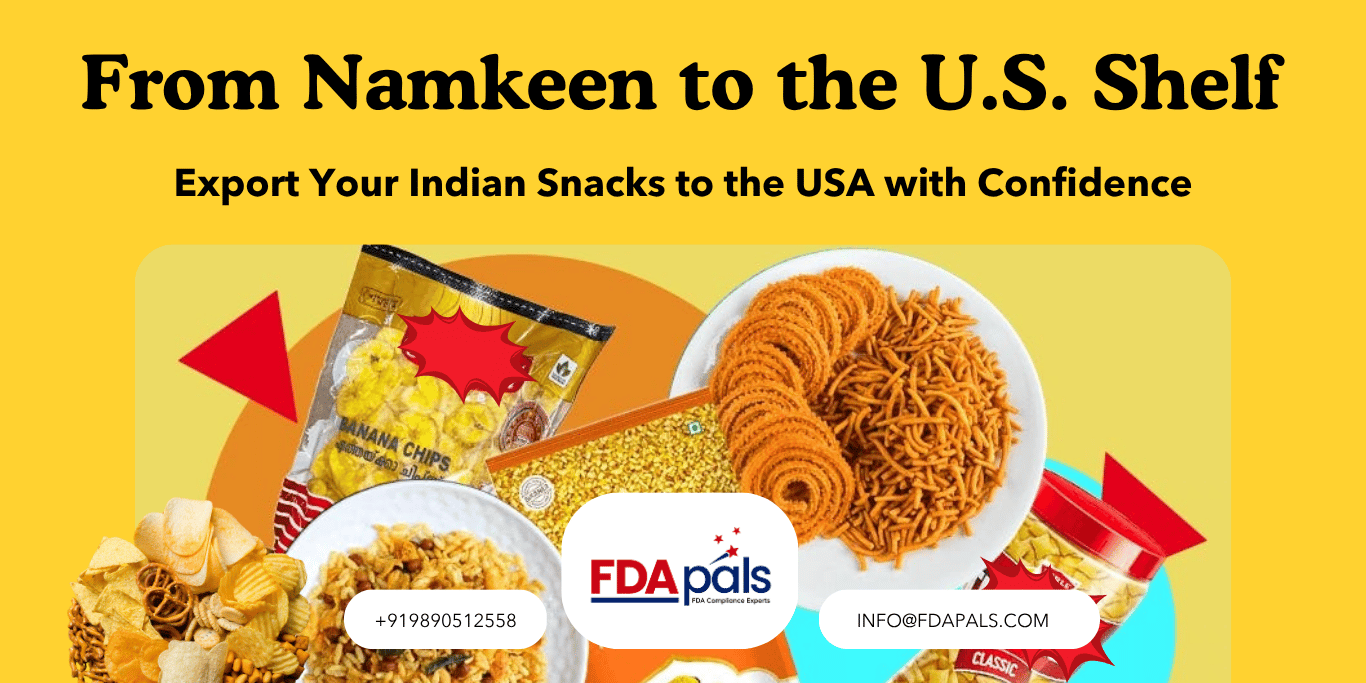
Walk into an Indian supermarket and you will find an incredible variety of snacks—spicy namkeen, crunchy bhujia, banana chips, murukku, khakhra, roasted chana, makhana, mixtures and much more.
These traditional Indian snacks are no longer limited to the Indian market. With the growing demand for Indian foods, more manufacturers and exporters are exploring Indian snacks export to USA opportunities through Indian grocery stores, supermarkets, specialty food retailers and online marketplaces.
But before sending that first commercial shipment, one question deserves serious attention:
Is your snack actually ready for the U.S. market from a regulatory point of view?
This is where FDA Registration for Snacks becomes important.
However, FDA compliance is not simply about getting a registration number. For most conventional packaged snacks, U.S. market entry involves several areas, including FDA food facility registration, ingredients, food safety, labeling, allergens, Nutrition Facts and import requirements.
Let’s look at the process from the perspective of an Indian snack manufacturer preparing for the U.S. market.
exporting pickle products to the USA.
⌛Your Snack Is Ready. Is Your Business Ready?
Imagine you manufacture a popular bhujia in India.
Your product is:
- FSSAI compliant
- Properly packed
- Successfully sold in India
- Popular with customers
- Ready for export
Then a distributor from the United States places an order.
It sounds like the next step should simply be manufacturing and shipping.
But this is where FDA requirements for Indian food products become important.
The U.S. market has its own food safety and labeling requirements. A package that is acceptable for sale in India does not automatically mean that the same package satisfies applicable U.S. requirements.
The manufacturing facility may also have FDA registration obligations.
Therefore, FDA Registration for Snacks should be viewed as one part of a broader compliance process rather than as a single certificate.
🗒️Think of FDA Registration for Snacks as a Journey
Instead of thinking about FDA compliance as one document, think about it as a journey:
Indian manufacturing facility
↓
FDA food facility registration, where applicable
↓
Ingredient and formulation review
↓
↓
Allergen and Nutrition Facts review
↓
Applicable food safety / FSMA requirements
↓
Prior Notice and import procedures
↓
U.S. importer / distributor
↓
U.S. consumer
A problem at any one of these stages can create unnecessary delays, relabeling expenses or problems at import.
This is why businesses planning food export from India to USA should start regulatory preparation before the shipment is manufactured.
⌛Which Indian Snacks Are Covered?
The word “snacks” includes a huge range of Indian food products.
Some common products involved in Indian snacks export to USA include:
| Snack Category | Examples |
|---|---|
| Namkeen | Aloo bhujia, sev, mixtures |
| Fried snacks | Murukku, chakli, boondi |
| Chips | Banana chips, potato chips |
| Flat snacks | Khakhra |
| Roasted snacks | Chana, makhana, roasted grains |
| Nut-based snacks | Spiced nuts, roasted peanuts |
| Traditional mixtures | Dal mixture, farsan-style snacks |
| Extruded snacks | Corn- and grain-based snacks |
The exact FDA requirements for snacks can vary depending on the ingredients, formulation, manufacturing process, packaging and claims made for the product.
That is why there is no single checklist that works identically for every Indian snack.
👉Start With FDA Food Facility Registration for Snacks
One of the first questions an Indian snack manufacturer should ask is whether its facility is required to register with FDA.
Facilities that manufacture, process, pack or hold food for consumption in the United States may be subject to FDA food facility registration requirements, unless an exemption applies. FDA registration requirements can apply to foreign facilities as well as domestic facilities.
For Indian manufacturers, this makes FDA food facility registration for snacks an important starting point when preparing for the U.S. market.
The focus should be on the facility and its activities, rather than asking whether “namkeen has FDA approval.”
FDA Registration Is Not the Same as FDA Product Approval
This is an important distinction.
Conventional food products are generally not individually “FDA approved” before import. FDA states that it does not approve, certify or license individual food importers, products, labels or shipments before importation. Imported foods must instead comply with applicable U.S. requirements.
Therefore, businesses should be cautious when they see advertisements offering a “100% FDA-approved food certificate.”
FDA Registration for Snacks is about applicable facility registration—not a blanket FDA approval of the snack.
👉Your Indian Label May Not Be Your U.S. Label
This is one of the most important areas for Indian food exporters.
You may already have an attractive package for your namkeen, bhujia or banana chips.
But before printing thousands of packages for the U.S. market, the label should be checked against applicable
FDA food labeling requirements.
Depending on the product, the U.S. label may need to address:
- Product identity
- Net quantity
- Ingredient declaration
- Nutrition Facts
- Major food allergens
- Manufacturer, packer or distributor information
- Applicable claims
- Other required statements
FDA states that imported foods must be safe, sanitary and labeled according to U.S. requirements.
For example,
Suppose your Indian package says:
“Wheat Khakhra – Traditional Indian Snack.”
The product name may be appropriate, but that is only one part of the package.
The complete label still needs to be reviewed for applicable U.S. requirements.
The same applies to flavored banana chips, spicy namkeen or a mixed snack containing several ingredients.
The attractive front panel is only one part of a compliant food label.
👉Ingredients Deserve a Closer Look
Indian snacks can have surprisingly complicated formulations.
A typical namkeen mixture may contain:
Gram flour + edible oil + peanuts + spices + salt + flavoring ingredients + additives
Each component should be considered when evaluating the FDA requirements for Indian food products.
An ingredient that is permitted for use in India should not automatically be assumed to satisfy every applicable U.S. requirement.
Particular attention may be required for:
- Food additives
- Colors
- Flavoring substances
- Preservatives
- Sweeteners
- Processing aids
- Specialty ingredients
A formulation review before production for the U.S. market can help identify potential problems before thousands of labels are printed.
This is particularly useful for businesses starting Indian food export to USA for the first time.
👉Allergens Can Make a Big Difference
Allergen compliance deserves special attention when preparing FDA Registration for Snacks and U.S. food labels.
Think about the ingredients commonly found in Indian snacks:
Peanuts. Wheat. Sesame. Milk. Tree nuts. Soy.
These ingredients can appear directly in a recipe or as part of another ingredient.
The United States recognizes nine major food allergens:
- Milk
- Eggs
- Fish
- Crustacean shellfish
- Tree nuts
- Peanuts
- Wheat
- Soybeans
- Sesame
Sesame became the ninth major food allergen under U.S. federal law, effective January 1, 2023.
For Indian snack manufacturers, this is particularly relevant because sesame, peanuts, wheat, milk and tree nuts are common in traditional recipes.
For example:
Khakhra
Wheat may be a major allergen consideration.
Peanut Mixture
Peanuts need appropriate allergen consideration.
Sesame Snack
Sesame needs to be properly addressed under U.S. allergen labeling requirements.
Dairy-Based Snack
Milk may require appropriate allergen declaration.
A proper FDA food label review should therefore consider the complete formulation rather than looking only at the product name.
👉Nutrition Facts Is Another Important Checkpoint
Indian and U.S. food labels are not necessarily interchangeable.
Packaged foods marketed in the United States may require a Nutrition Facts label in the applicable format.
This can be particularly important for products such as:
- Banana chips
- Namkeen
- Bhujia
- Roasted snacks
- Snack mixtures
- Flavored nuts
- Fried snacks
Nutrition information should ideally be addressed before the U.S. packaging is finalized.
For a company working on FDA Registration for Snacks, regulatory review at the packaging stage can prevent the situation where thousands of printed packages need to be redesigned.
👉What About Food Safety and FSMA?
FDA compliance does not stop with registration and labeling.
The Food Safety Modernization Act (FSMA) focuses significantly on preventing food safety problems.
Depending on the facility and its activities, applicable requirements may involve areas such as:
- Hazard analysis
- Preventive controls
- Food safety plans
- Sanitation
- Supply-chain controls
- Records
- Verification activities
Not every requirement applies in exactly the same way to every snack manufacturer.
Therefore, businesses should evaluate the requirements applicable to their particular facility, products and activities rather than assuming that one generic FSMA checklist applies to everyone.
This is an important part of understanding the broader FDA requirements for snacks.
👉Don’t Forget Prior Notice Before Shipment
Your product may be ready at the factory, but compliance does not end there.
For applicable food shipments, FDA must receive Prior Notice before food is offered for import into the United States. Prior Notice allows FDA to review shipment information and help target inspections or examinations.
This means businesses involved in Indian snacks export to USA should coordinate with their importer, customs broker or other responsible parties to ensure applicable import procedures are handled correctly.
FDA may inspect imported food at U.S. ports of entry, and non-compliant shipments can be detained.
So the compliance journey is not simply:
Factory → FDA registration
It is:
Factory → Registration → Product compliance → Label → Food safety → Shipment → U.S. entry
Snack-by-Snack: What Should You Check?
The general regulatory framework may be similar, but individual products should still be reviewed separately.
✅FDA Registration for Namkeen
Namkeen can contain multiple ingredients, oils, spices, additives and allergens.
For FDA registration for namkeen, the facility’s registration requirements should be evaluated along with the product’s formulation, labeling, allergens and applicable food safety requirements.
Key focus areas:
- Facility registration
- Ingredients
- Additives
- Allergens
- Nutrition Facts
- U.S. label compliance
✅FDA Registration for Bhujia
Bhujia may contain gram flour, edible oils, spices and other ingredients depending on the recipe.
For FDA registration for bhujia, exporters should look beyond registration and review the complete product compliance picture.
Key focus areas:
- Facility registration
- Ingredient declaration
- Allergen review
- Nutrition labeling
- Food safety
- Import requirements
✅FDA Registration for Banana Chips
Banana chips may appear to be a simple product, but the ingredients can include cooking oil, salt, seasoning, flavors or other additives.
When evaluating FDA registration for banana chips, the manufacturer should consider both the facility and the finished product.
Key focus areas:
- Ingredients
- Cooking oil
- Seasonings
- Nutrition Facts
- Labeling
- Applicable food safety requirements
✅FDA Registration for Murukku
Murukku and similar snacks can contain rice flour, pulses, spices, salt and edible oils.
The exact recipe determines the regulatory review required.
For FDA registration for murukku, manufacturers should assess the facility registration requirements as well as ingredients, allergens and labeling.
✅FDA Registration for Khakhra
Khakhra is particularly interesting from a labeling perspective because wheat is commonly used.
When preparing FDA registration for khakhra, the manufacturer should pay close attention to:
- Wheat declaration
- Ingredient list
- Allergen labeling
- Nutrition Facts
- Net quantity
- Product identity
- Applicable food safety requirements
✅FDA Registration for Roasted Snacks
Roasted chana, makhana, peanuts, and roasted nuts are increasingly popular in health-focused and specialty food markets.
For FDA registration for roasted snacks, the product formulation and allergen profile should be reviewed carefully.
Peanuts and tree nuts, for example, can be major allergens under U.S. law.
The 7-Point Pre-Export Check
Before sending your Indian snack to a U.S. distributor, ask these seven questions:
01 — Is the facility required to register with FDA?🔎
Check whether the manufacturing, processing, packing or holding facility is subject to food facility registration requirements.
02 — Does the foreign facility have the required U.S. Agent?🔎
A foreign facility subject to registration requirements must designate a U.S. Agent who meets FDA requirements.
03 — Have the ingredients been reviewed?🔎
Do not assume an Indian formulation automatically meets U.S. requirements.
04 — Has the U.S. label been reviewed?🔎
Check the complete package, not just the front panel.
05 — Have allergens been assessed?🔎
Pay particular attention to peanuts, wheat, sesame, milk, soy and tree nuts.
06 — Have applicable food safety requirements been evaluated?🔎
Determine which FSMA and other food safety provisions apply to your operation.
07 — Is the shipment documentation ready?🔎
Applicable Prior Notice and import procedures should be addressed before the shipment arrives in the United States.
🚫One Mistake Indian Snack Exporters Should Avoid
There is a common assumption:
“I already have FSSAI registration, so I am ready to export.”
FSSAI compliance is important for the Indian market, but U.S. food regulatory requirements are a separate consideration.
Another common assumption is:
“I have an FDA registration number, so my product is FDA approved.”
That is not how conventional food imports generally work.
FDA explains that it does not pre-approve individual food products, labels or shipments before importation. Imported foods must comply with applicable U.S. requirements.
Therefore, FDA Registration for Snacks should be treated as one part of a broader compliance strategy.
FDA Registration for Snacks Is Only One Piece of the Puzzle
For an Indian snack manufacturer, entering the U.S. market should not be viewed as a race to obtain one certificate.
A better approach is:
Facility → Formula → Ingredients → Label → Food Safety → Import
This approach helps exporters identify potential compliance issues before the product reaches the U.S. border.
It can also reduce the risk of expensive relabeling, unnecessary packaging changes and shipment delays.
For companies planning food export from India to USA, early regulatory review can make the export process much smoother.
🎯Ready to Take Your Indian Snacks to the USA?
Whether you manufacture namkeen, bhujia, banana chips, murukku, khakhra, roasted chana, makhana, nuts or other packaged snacks, entering the U.S. market requires proper regulatory preparation.
At FDA Pals, we help Indian food manufacturers and exporters understand applicable U.S. food regulatory requirements.
Our support can include:
FDA Food Facility Registration
U.S. Agent Services
Food Label Review
Nutrition Facts Label Review
Ingredient & Allergen Review
U.S. Food Regulatory Guidance
Don’t wait until your shipment is ready to leave India.
exporting pickle products to the USA.
❓FAQs
Q. 1) Do Indian snack manufacturers need FDA registration to export to the USA?
A facility that manufactures, processes, packs or holds food intended for consumption in the United States may be required to register with FDA, unless an applicable exemption applies.
Q. 2) What is FDA Registration for Snacks?
FDA Registration for Snacks generally refers to the applicable FDA food facility registration requirements for facilities involved in manufacturing, processing, packing or holding food intended for consumption in the United States. It does not mean that FDA has individually approved the snack.
Q. 3) Is namkeen FDA approved?
Conventional namkeen is generally not individually “FDA approved” before import. The facility and food product must comply with applicable U.S. requirements.
Q. 4) Does banana chips require FDA registration?
The facility manufacturing, processing, packing or holding banana chips for U.S. consumption may be subject to FDA food facility registration requirements, unless an exemption applies.
Q. 5) Can I use my Indian food label in the USA?
Not automatically. The label should be reviewed against applicable FDA food labeling requirements before the product is marketed in the United States.
Q. 6) Are peanuts and sesame major allergens in the USA?
Yes. Peanuts and sesame are among the nine major food allergens recognized under U.S. federal law.
Q. 7) Does FDA registration guarantee that my shipment will enter the USA?
No. Facility registration does not guarantee entry. Imported foods must meet applicable U.S. requirements and may be subject to FDA review or inspection.
Q. 8) How often does FDA food facility registration need renewal?
Facilities subject to FDA registration generally have biennial renewal obligations under the applicable FDA requirements.