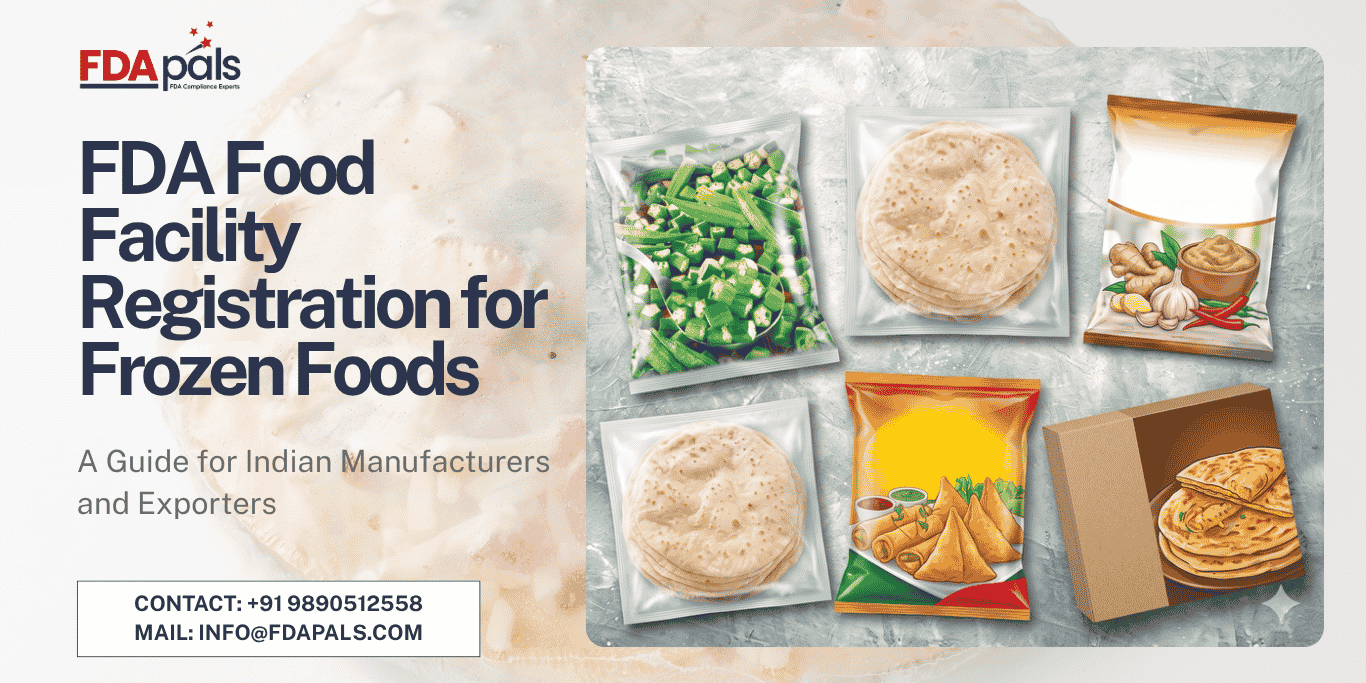
The demand for convenient, ready-to-cook and ready-to-eat frozen foods continues to create opportunities for food manufacturers and exporters targeting the United States. Products such as frozen vegetables, frozen chapati, frozen paratha and frozen snacks are popular options for consumers seeking convenient meal solutions.
For Indian manufacturers planning to export these products to the USA, understanding the U.S. Food and Drug Administration (FDA) requirements is an important step in preparing for market entry.
One of the key compliance requirements is FDA Food Facility Registration, which may apply to foreign facilities involved in manufacturing, processing, packing or holding food intended for consumption in the United States.
At FDApals, we assist food businesses with FDA Food Facility Registration and related regulatory support to help them understand the registration process and prepare the necessary information.
Which Frozen Food Products May Require FDA Food Facility Registration?
FDA Food Facility Registration requirements depend primarily on the activities performed at the facility and whether an exemption applies, rather than simply on the product being frozen.
Businesses manufacturing or processing the following products for export to the USA should assess their registration obligations.
1. Frozen Vegetables
Frozen vegetables are widely used in household cooking, restaurants, food-service operations and ready-meal manufacturing.
Common examples include:
- Frozen peas
- Frozen sweet corn
- Frozen carrots and beans
- Frozen mixed vegetables
- Frozen cauliflower and broccoli
- Other individually quick-frozen (IQF) vegetables
Facilities that process, freeze, package or hold these products for the U.S. market should assess whether FDA Food Facility Registration is required.
Manufacturers should also evaluate applicable food safety controls, product-specific requirements, labeling and import documentation.
2. Frozen Chapati
Frozen chapati is a convenient flatbread product supplied to Indian grocery stores, supermarkets, food-service businesses and distributors.
Manufacturers exporting frozen chapati to the USA should assess the applicable FDA requirements for their manufacturing and packaging facilities.
Important considerations may include:
- Facility registration eligibility and requirements
- Ingredients and food safety controls
- Packaging and storage conditions
- Applicable U.S. food labeling requirements
- Import documentation and shipment-related obligations
The applicable requirements depend on the product formulation, manufacturing process and business activities.
3. Frozen Paratha
Frozen paratha is another product category with potential demand among consumers looking for convenient Indian food options.
Products may include plain paratha, layered paratha, stuffed paratha and other varieties.
Manufacturers and exporters should evaluate their FDA compliance requirements based on the specific product and facility operations. For example, parathas containing vegetables, paneer, meat or other fillings may require additional assessment of ingredient-specific and product-specific regulatory considerations.
Important: Do not assume that all frozen paratha products follow identical requirements. The ingredients, processing methods and intended use can affect the regulatory assessment.
4. Frozen Snacks
Frozen snacks include a broad range of products supplied to retail customers, restaurants and food-service distributors.
Examples include:
- Frozen samosas
- Frozen spring rolls
- Frozen cutlets
- Frozen kachori
- Frozen potato snacks
- Frozen vegetable snacks
- Other ready-to-fry or ready-to-cook snacks
Manufacturers exporting frozen snacks should review their facility registration obligations and assess the food safety and import requirements applicable to their individual products.
Products containing meat, poultry, dairy or other regulated ingredients may need additional regulatory review, including consideration of requirements administered by other U.S. agencies where applicable.
What Is FDA Food Facility Registration?
FDA Food Facility Registration is a regulatory requirement established under the U.S. Federal Food, Drug, and Cosmetic Act, as amended by the Public Health Security and Bioterrorism Preparedness and Response Act.
Unless an exemption applies, facilities that manufacture, process, pack or hold food intended for consumption in the United States must register with the FDA before beginning the activities covered by the registration requirement.
This requirement can apply to qualifying facilities located outside the USA, including facilities in India that manufacture frozen food for export to the U.S. market.
Registration is associated with the facility and its activities. It should not be confused with product approval or a certification that a product has been individually approved by the FDA.
Key FDA Requirements for Frozen Food Manufacturers and Exporters
Before exporting frozen vegetables, chapati, paratha or snacks to the USA, businesses should evaluate the following areas.
1. FDA Food Facility Registration
Determine whether the manufacturing, processing, packing or holding facility must register with the FDA.
The registration should accurately reflect the facility’s details and applicable activities.
2. U.S. Agent for Foreign Facilities
A foreign food facility subject to FDA registration must designate a U.S. agent who meets the applicable FDA requirements.
The U.S. agent serves as a communication link between the FDA and the foreign facility. Businesses should ensure that the designated agent’s details are accurate and that the arrangement meets regulatory requirements.
3. Unique Facility Identifier (UFI)
Facilities must provide a unique facility identifier accepted by the FDA as part of the registration process.
The FDA currently recognizes the Dun & Bradstreet Data Universal Numbering System (D-U-N-S) number as an acceptable UFI. Exporters should verify that the identifier and facility information are accurate before submission.
4. Food Safety and Preventive Controls
Food Facility Registration does not replace applicable food safety obligations.
Depending on the facility, product and activities, businesses may need to assess requirements under the FDA’s Current Good Manufacturing Practice, Hazard Analysis, and Risk-Based Preventive Controls for Human Food regulations.
Applicable exemptions and modified requirements should be assessed individually.
5. Food Labeling and Import Requirements
Frozen food products entering the U.S. market must meet applicable U.S. food labeling and import requirements.
Depending on the product, businesses may need to review ingredient declarations, allergen labeling, nutrition labeling, applicable exemptions and other mandatory label information.
FDA Prior Notice is also generally required for imported food shipments unless an exemption applies. The importer and exporter should coordinate to ensure the relevant shipment information is submitted correctly and on time.
FDA Food Facility Registration Renewal in 2026
Food facilities required to register with the FDA must renew their registrations during the biennial renewal period, which runs from October 1 through December 31 of every even-numbered year.
The 2026 renewal period runs from October 1 to December 31, 2026.
Frozen food manufacturers and exporters with existing registrations should check their registration status and complete the required renewal within the applicable period.
Failing to renew a registration by the deadline can result in the registration being considered expired and removed from the registration account.
Businesses should also distinguish between updating registration information and completing the required biennial renewal. An update outside the renewal period does not eliminate the obligation to renew during the applicable renewal period.
Common Mistakes Frozen Food Exporters Should Avoid
When preparing to export frozen foods to the USA, businesses should avoid the following mistakes:
- Assuming that registering one facility automatically covers every separate manufacturing facility.
- Providing incorrect facility details or an inaccurate UFI.
- Failing to designate a qualifying U.S. agent where required.
- Treating FDA Food Facility Registration as product approval.
- Assuming registration alone guarantees that a shipment will be admitted into the USA.
- Overlooking applicable food safety, labeling or Prior Notice requirements.
- Missing the biennial registration renewal deadline.
- Failing to assess additional requirements for products containing specially regulated ingredients.
Careful preparation can help businesses identify compliance gaps before shipment and reduce avoidable administrative delays.
How FDApals Can Help with FDA Food Facility Registration
FDApals supports food businesses seeking to understand and complete the FDA Food Facility Registration process for the U.S. market.
Our support can help manufacturers and exporters of frozen vegetables, frozen chapati, frozen paratha and frozen snacks navigate the applicable registration steps.
Depending on the client’s requirements, support may include:
- Reviewing the facility’s registration requirements.
- Assisting with the preparation of registration information.
- Providing guidance on the U.S. agent requirement for foreign facilities.
- Helping identify information required for registration and renewal.
- Providing guidance on related FDA food compliance considerations.
Whether you are registering a new facility or reviewing an existing registration, it is important to assess the requirements applicable to your specific facility and products.
Frequently Asked Questions (FAQs)
1. Is FDA Food Facility Registration required for frozen food exports from India to the USA?
FDA Food Facility Registration is generally required for foreign facilities that manufacture, process, pack or hold food intended for consumption in the USA, unless an applicable exemption applies. Indian frozen food manufacturers should assess their facility’s activities and regulatory status.
2. Do frozen vegetables require FDA registration?
A facility that manufactures, processes, packs or holds frozen vegetables for the U.S. market may need FDA Food Facility Registration. The requirement depends on the facility’s activities and whether an exemption applies.
3. Do frozen chapati and paratha manufacturers need FDA registration?
Facilities manufacturing, processing, packing or holding frozen chapati and paratha intended for the U.S. market should evaluate their registration obligations. Additional product-specific requirements may depend on the ingredients and manufacturing process.
4. Do frozen snack exporters need FDA Food Facility Registration?
Frozen snack manufacturers and other facilities handling these products may be required to register with the FDA. Products containing meat, poultry or other specially regulated ingredients may also require assessment of additional agency requirements.
5. Is FDA Food Facility Registration the same as FDA product approval?
No. Food Facility Registration registers an eligible facility; it is not an individual product approval or a guarantee that a product or shipment complies with all U.S. import requirements.
6. Is a U.S. agent required for an Indian food facility?
A foreign facility required to register with the FDA must designate a U.S. agent who satisfies the applicable requirements. The U.S. agent acts as a communication link between the FDA and the foreign facility.
7. When must FDA Food Facility Registration be renewed?
Required registrations must be renewed every two years during the October 1–December 31 renewal period in even-numbered years. For 2026, the renewal deadline is December 31, 2026.
8. Can FDApals help with FDA Food Facility Registration for frozen foods?
FDApals provides assistance with FDA Food Facility Registration and related regulatory guidance for food businesses preparing to enter the U.S. market. Contact our team to discuss your facility, product category and registration requirements.
Get Support for FDA Food Facility Registration
Planning to export frozen vegetables, frozen chapati, frozen paratha or frozen snacks to the United States?
Make sure your facility’s registration obligations and related food compliance requirements are assessed before exporting.
Contact FDApals for assistance with FDA Food Facility Registration and guidance on your U.S. market entry requirements.
Website: https://fdapals.com/
Email: info@fdapals.com
Phone: +91 9890512558
Disclaimer: This article is intended for general informational purposes and does not constitute legal or regulatory advice. Requirements depend on the facility, product formulation, processing activities and applicable exemptions. Consult the current FDA regulations and relevant authorities for requirements applicable to your business.