Introduction
India’s haircare and personal care industry has witnessed growing demand for hair colouring products, including permanent hair dyes, semi-permanent colours, ammonia-free hair colours, herbal hair dyes, and professional salon colouring products.
International cosmetic brands, manufacturers, importers, and distributors looking to introduce hair dye products into the Indian market must understand the applicable regulatory requirements before importing or manufacturing these products.
In India, hair dye products are generally regulated as cosmetics under the Drugs and Cosmetics Act, 1940, and the Cosmetics Rules, 2020. The Central Drugs Standard Control Organisation (CDSCO) regulates the import of cosmetics, while State Licensing Authorities regulate their domestic manufacture.
Hair Dye Registration in India involves more than obtaining a cosmetic import registration certificate. Businesses must also assess the ingredients used in the formulation, applicable Bureau of Indian Standards (BIS) requirements, product safety, packaging, labelling, and mandatory warning statements.
A particularly important development is the CDSCO circular dated 10 June 2026, which specifically reiterates compliance requirements for imported and manufactured hair-colour cosmetic products.
This guide explains the regulatory framework, ingredient requirements, documentation, registration process, safety considerations, and labelling requirements for hair dye products in India.
What Is Hair Dye Registration in India?
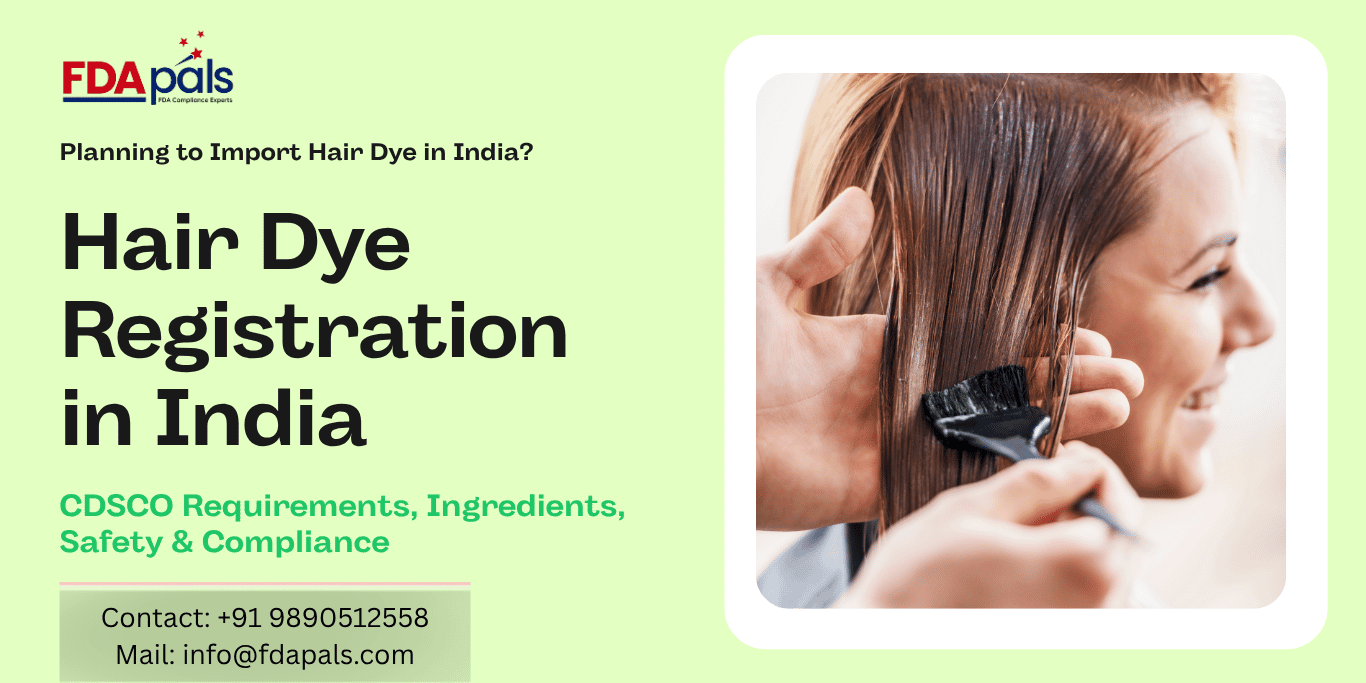
Hair dye registration in India refers to the regulatory approval and compliance process applicable to hair colouring products under the Indian cosmetic regulatory framework.
Hair dyes are cosmetic products intended to change, enhance, restore, or modify the natural or existing colour of hair.
Depending on their formulation and intended use, hair colouring products may include:
- Permanent hair dyes
- Semi-permanent hair colours
- Temporary hair colour products
- Ammonia-free hair dyes
- Cream-based hair colours
- Liquid hair colouring formulations
- Powder-based hair dyes
- Herbal hair colouring products
- Professional salon hair colour products
Businesses planning to import hair dye products into India must obtain the applicable CDSCO Import Registration Certificate before commercial import.
Domestic manufacturers must obtain the applicable manufacturing licence from the relevant State Licensing Authority.
The regulatory requirements depend on whether the product is imported or manufactured in India, its formulation, intended use, ingredients, and applicable cosmetic standards.
Which Authority Regulates Hair Dye Products in India?
Hair dye products are regulated under the Drugs and Cosmetics Act, 1940, and the Cosmetics Rules, 2020.
The regulatory responsibilities are divided between central and state authorities.
1. Central Drugs Standard Control Organisation (CDSCO)
CDSCO, under the Ministry of Health and Family Welfare, Government of India, regulates the import registration of cosmetic products.
The Drugs Controller General (India), functioning as the Central Licensing Authority, is responsible for granting Import Registration Certificates for imported cosmetics.
2. State Licensing Authority
The respective State Licensing Authority regulates the domestic manufacture of cosmetic products in India.
Manufacturers intending to produce hair dye products for sale or distribution must obtain the applicable manufacturing licence under the Cosmetics Rules, 2020.
3. Bureau of Indian Standards (BIS)
BIS standards play an important role in determining the permissible and restricted ingredients, quality, and safety requirements applicable to hair colour products.
The relevant standards include:
- IS 4707 (Part 1): Classification of cosmetic raw materials and adjuncts, including the applicable list of generally recognised as safe (GRAS) colourants.
- IS 4707 (Part 2): Classification of cosmetic raw materials and adjuncts, including ingredients generally not recognised as safe (GNRAS) and restricted ingredients.
- IS 8481: Applicable requirements and specifications relating to hair dyes.
Manufacturers and importers should assess their product formulations against the applicable standards and current regulatory requirements.
Latest CDSCO Update on Hair Colour Cosmetic Products – June 2026
On 10 June 2026, CDSCO issued a circular titled:
“Submission of Compliance for Imported / Manufactured Hair Color Cosmetics Products as per Cosmetics Rules, 2020 and applicable BIS Standards.”
The circular specifically addresses compliance requirements for hair colour cosmetic products intended to alter, enhance, or restore hair colour through dyeing and colouring ingredients.
According to the circular, imported and domestically manufactured hair colour products must comply with:
- IS 4707 (Part 1) and IS 4707 (Part 2).
- IS 8481.
- Ingredient declaration requirements.
- Restrictions applicable to hair dye substances.
- Directions for use.
- Mandatory caution and warning statements.
- Preliminary patch test instructions.
- Applicable labelling requirements under Rules 34 and 37 of the Cosmetics Rules, 2020.
The circular also clarifies that changes or revisions to product labels, product composition, and product quality specifications must be reported to the Central or State Licensing Authority, as applicable, under the relevant provisions of Rules 15(2) and 26(k).
This update makes formulation assessment, ingredient compliance, and label review particularly important for hair dye manufacturers and importers.
Businesses should review their existing products and documentation to ensure compliance with these requirements.
What Are the Ingredient Requirements for Hair Dye Products in India?
Ingredient compliance is one of the most important aspects of hair dye registration and regulatory assessment.
Hair colouring products may contain different types of colouring agents, chemical intermediates, developers, preservatives, and other functional ingredients.
However, not every ingredient used internationally can automatically be considered acceptable for use in India.
Manufacturers and importers must assess their formulations against the applicable Indian cosmetic standards.
1. Colouring Agents and Pigments
Colouring agents are responsible for imparting the desired shade to the hair.
Their use must comply with the applicable requirements under IS 4707 (Part 1) and Part 2.
Manufacturers should verify:
- Whether the colourant is permitted for the intended cosmetic use.
- Whether any restrictions apply to its concentration or application.
- Whether the ingredient has specific purity or quality requirements.
- Whether the formulation complies with applicable Indian standards.
2. Para-Phenylenediamine (PPD)
Para-phenylenediamine (PPD) is a commonly used ingredient in certain oxidative hair dye formulations.
It helps produce long-lasting hair colour through a chemical reaction during the colouring process.
However, PPD is associated with allergic contact dermatitis and may cause skin irritation or allergic reactions in sensitive individuals.
Therefore, manufacturers should carefully assess its use against the applicable Indian standards and restrictions.
Products containing PPD must also comply with the specific warning and preliminary patch test labelling requirements under Rule 37 of the Cosmetics Rules, 2020.
3. Ammonia and Alkalising Agents
Ammonia and other alkalinizing agents may be used in permanent hair colour formulations to help prepare the hair for the colouring process.
Their concentration and use should be assessed in accordance with the product formulation, safety considerations, and applicable quality standards.
Ammonia-free hair colour products should also undergo ingredient and safety assessment. The absence of ammonia does not automatically establish regulatory compliance.
4. Oxidizing Agents
Certain hair dye systems use oxidizing agents, such as hydrogen peroxide, as part of the colour development process.
Manufacturers should ensure that the ingredients and their intended concentrations comply with the applicable requirements.
The complete formulation, rather than individual ingredients in isolation, should be reviewed for regulatory and safety compliance.
5. Herbal and Plant-Based Ingredients
Herbal hair dyes may contain plant-derived colouring ingredients such as henna and indigo.
Although these products are marketed as natural or herbal alternatives, they must still comply with applicable cosmetic quality, safety, and ingredient requirements.
Manufacturers should also assess the complete formulation, including any additional chemical colouring agents, preservatives, or fragrances.
A product should not be considered compliant merely because it is labelled as natural, herbal, or chemical-free.
What Are the Safety Requirements for Hair Dye Products?
Hair dye products are applied directly to the hair and may come into contact with the scalp and surrounding skin.
Therefore, safety assessment is an important part of regulatory compliance.
Manufacturers and importers should consider the following factors.
1. Ingredient Safety Assessment
All ingredients should be reviewed against the applicable BIS standards and Indian cosmetic regulations.
Restricted or unsuitable ingredients should not be used beyond the permitted conditions.
2. Product Quality
Hair dye products must meet the applicable quality and safety specifications under Rule 39 of the Cosmetics Rules, 2020.
Relevant product specifications and supporting quality information should be maintained.
3. Preliminary Patch Test Instructions
Hair dye formulations containing PPD or other dyes, colours, and pigments are subject to specific patch test instructions under Rule 37.
The prescribed preliminary test is intended to help identify possible hypersensitivity reactions before application.
The instructions require applying a small quantity of the prepared hair dye to a small area behind the ear or on the inner forearm, observing the area for 24 hours, and checking for irritation or inflammation.
The test should be carried out before each application as prescribed in the rules.
4. Warning Against Use on Eyebrows and Eyelashes
Hair dyes containing PPD or other dyes, colours, and pigments must carry the prescribed warning against use on eyelashes and eyebrows.
The warning is important because misuse of these products around the eyes may cause severe inflammation and even blindness.
5. Appropriate Directions for Use
Manufacturers should provide clear directions for preparation and application, including any precautions necessary for safe use.
Consumers should be able to understand how to prepare the product, how to conduct the preliminary test, and how to follow the prescribed safety instructions.
What Are the Labelling Requirements for Hair Dye Products in India?
Labelling is a critical part of hair dye compliance.
Under the Cosmetics Rules, 2020, hair dyes containing PPD or other dyes, colours, and pigments must carry specific warning statements and patch test instructions.
1. Mandatory Caution Statement
Rule 37 prescribes a specific caution statement for hair dyes containing PPD or other dyes, colours, and pigments.
The warning must appear in English and local languages on both the inner and outer labels.
The prescribed caution states:
“CAUTION.— This product contains ingredients which may cause skin irritation in certain cases and so a preliminary test according to the accompanying directions should first be made. This product should not be used for dyeing the eyelashes or eyebrows; as such a use may cause blindness.”
The exact prescribed wording should be followed rather than replaced with a shortened marketing statement.
2. Patch Test Instructions
Each package must also contain the prescribed instructions for conducting a preliminary skin test.
The instructions must explain:
- Cleaning a small area of skin behind the ear or on the inner forearm.
- Applying a small quantity of the prepared hair dye.
- Allowing the preparation to dry.
- Washing the area gently after 24 hours.
- Checking for signs of irritation or inflammation.
- Conducting the test before every application.
The prescribed instructions should be reproduced in English and local languages as required under Rule 37.
3. Ingredient Declaration
Hair dye labels should include the required ingredient information in accordance with Rule 34 and other applicable requirements.
The declared ingredients should accurately reflect the product formulation.
4. Manufacturer and Product Details
Applicable cosmetic labelling particulars should be included, such as:
- Name of the cosmetic product.
- Manufacturer’s name and address.
- Batch or lot identification.
- Manufacturing licence details, where applicable.
- Net contents.
- Use-before or expiry-related information, as applicable.
- Country of origin for imported products.
- Other mandatory declarations under the applicable rules.
5. Imported Cosmetic Labelling
Imported hair dye products must comply with the applicable Indian labelling requirements.
Under Rule 34, imported cosmetics must also bear the applicable registration certificate number and the name and address of the registration certificate holder for marketing the product in India.
Where India-specific labelling is required, the rules provide for such labelling to be affixed to the unit pack at bonded warehouses in the prescribed circumstances.
What Is the Process for Hair Dye Registration in India?
The regulatory process differs depending on whether the product is imported or manufactured domestically.
A. Hair Dye Registration for Imported Products
International manufacturers and Indian importers planning to introduce hair dye products into India must follow the applicable CDSCO cosmetic import registration process.
Step 1: Identify the Product Category
Determine whether the proposed product is a permanent hair dye, semi-permanent hair colour, temporary colour, herbal hair dye, or another hair colouring formulation.
Review its intended use, composition, and product claims.
Step 2: Review the Formulation
Assess the complete ingredient composition against IS 4707 (Part 1), IS 4707 (Part 2), IS 8481, and other applicable regulatory requirements.
Pay particular attention to PPD, colourants, restricted ingredients, and other functional ingredients.
Step 3: Review Product Safety and Labelling
Check the product specifications, quality information, warning statements, patch test instructions, and ingredient declarations.
Ensure that the proposed labels comply with Rules 34 and 37, as applicable.
Step 4: Prepare Manufacturer Documentation
Collect the relevant manufacturer authorisation, manufacturing site details, Free Sale Certificate or other applicable evidence, product information, and supporting documents.
Step 5: Submit Form COS-1
Submit the application for an Import Registration Certificate in Form COS-1 through the CDSCO SUGAM portal.
The application may be made by the manufacturer, its authorised agent, an importer in India, or a manufacturer-authorised subsidiary in India, as provided under Rule 12.
Step 6: Upload Documents and Pay Applicable Fees
Upload the required documentation according to the applicable CDSCO checklist and complete the prescribed fee payment.
Step 7: Regulatory Review
CDSCO reviews the application and supporting documentation.
If discrepancies or additional information are required, the applicant may need to submit clarifications or revised documents.
Step 8: Obtain Form COS-2
Following satisfactory regulatory review and approval, the Central Licensing Authority issues the Import Registration Certificate in Form COS-2.
Step 9: Complete Import Compliance
Before commercial import and distribution, ensure that the products meet the applicable registration, quality, labelling, and import requirements.
B. Hair Dye Manufacturing Licence in India
Businesses planning to manufacture hair dye products within India must obtain the applicable manufacturing licence from the State Licensing Authority.
Under the Cosmetics Rules, 2020, the manufacturing licence process generally involves:
Step 1: Identify the Manufacturing Requirements
Determine the product category, proposed manufacturing activities, formulation, and applicable quality standards.
Step 2: Prepare Manufacturing Premises
Ensure that the manufacturing premises, equipment, technical personnel, and facilities comply with the applicable requirements under the Cosmetics Rules, 2020.
Step 3: Prepare Technical Documentation
Prepare product formulation details, manufacturing information, quality specifications, and other supporting documents.
Step 4: Apply for the Manufacturing Licence
Submit the applicable application to the State Licensing Authority through the prescribed process.
For manufacturing cosmetics for sale or distribution, the relevant licence is issued in Form COS-8. A loan licence, where applicable, is issued in Form COS-9.
Step 5: Regulatory Review and Inspection
The State Licensing Authority reviews the application and may conduct the required inspection or seek additional information.
Step 6: Obtain the Manufacturing Licence
Once the applicable requirements are fulfilled and the application is approved, the manufacturer receives the relevant licence.
Manufacturers must continue to comply with applicable GMP, product quality, ingredient, and labelling requirements.
Documents Required for Hair Dye Registration in India
The documents required depend on whether the hair dye product is being imported or manufactured domestically.
For imported hair dye products, commonly required documents and information include:
1. Manufacturer Authorisation
An authorisation letter from the overseas manufacturer appointing an eligible Indian applicant or authorised representative, where applicable.
2. Free Sale Certificate
A Free Sale Certificate or other applicable evidence from the country of origin, as required under the relevant CDSCO checklist.
3. Product Details
- Product name and brand.
- Product category.
- Hair colour shades and variants.
- Pack sizes.
- Intended use.
- Product formulation details.
4. Ingredient Composition
Complete formulation information, including colouring agents, preservatives, functional ingredients, and other relevant components.
5. Manufacturing Site Details
The name and complete address of the actual manufacturing premises.
6. Product Labels and Packaging
Copies of the proposed inner and outer labels, product packaging, warning statements, ingredient declarations, and directions for use.
7. Quality and Safety Documentation
Relevant product specifications, quality information, applicable test reports, and supporting safety documentation, as required.
8. Application and Fee Documents
Prescribed application details, applicable fee payment acknowledgement, and other documents specified in the CDSCO checklist.
For domestically manufactured hair dyes, the applicant must prepare the documents required by the relevant State Licensing Authority for the manufacturing licence application.
Common Compliance Challenges for Hair Dye Manufacturers and Importers
Hair dye manufacturers and importers may face regulatory challenges when product formulations, technical documents, or labels do not meet applicable Indian requirements.
Some common issues include:
1. Use of Restricted Ingredients
Certain ingredients may be restricted or unsuitable for particular cosmetic applications. Formulations should be reviewed against the applicable BIS standards.
2. Incomplete Ingredient Declaration
Differences between the actual formulation and the ingredients declared on product labels may result in compliance issues.
3. Missing Patch Test Instructions
Failure to include the prescribed preliminary test instructions and warning statements can create labelling non-compliance.
4. Incorrect Product Information
Inconsistent product names, shades, formulations, and manufacturing details across the application and supporting documents may result in regulatory queries.
5. Non-Compliant Packaging and Labelling
Imported products may require India-specific label modifications to meet applicable requirements.
6. Failure to Report Product Changes
Changes to product composition, labels, and quality specifications must be reported to the relevant authority in accordance with the applicable provisions of the Cosmetics Rules, 2020.
7. Inadequate Manufacturer Documentation
Missing or improperly prepared authorisation documents, manufacturing information, and other supporting records may delay the application review.
A structured regulatory assessment before application submission can help identify these issues and improve documentation readiness.
How FDApals Can Help with Hair Dye Registration in India
International cosmetic manufacturers, Indian importers, and domestic hair colour manufacturers must understand the applicable Indian regulatory requirements before launching their products.
FDApals provides regulatory affairs support to businesses seeking assistance with cosmetic registration, import compliance, and regulatory documentation in India.
Depending on the project scope, our services may include:
- Regulatory Assessment: Reviewing hair dye products and identifying applicable Indian cosmetic regulatory requirements.
- Ingredient Compliance Review: Assessing product formulations against applicable BIS standards and ingredient restrictions.
- Documentation Review: Reviewing manufacturer authorisation, Free Sale documentation, product details, and other supporting documents.
- Product and Variant Assessment: Evaluating hair colour shades, formulations, pack sizes, and manufacturing premises.
- Application Preparation: Supporting the preparation of Form COS-1 and related registration documentation for imported cosmetics.
- Labelling Compliance: Reviewing product labels, ingredient declarations, mandatory warnings, and patch test instructions.
- Regulatory Query Support: Assisting with responses to regulatory discrepancies and clarification requests.
Our regulatory support helps businesses understand the applicable compliance requirements and prepare their hair colour products for the Indian market.
Frequently Asked Questions (FAQs)
1. Is hair dye registration mandatory in India?
Imported hair dye products classified as cosmetics generally require CDSCO import registration before commercial import into India. Domestic manufacturers must obtain the applicable manufacturing licence from the State Licensing Authority.
2. Which authority regulates hair dye products in India?
CDSCO regulates cosmetic imports, while the respective State Licensing Authorities regulate domestic cosmetic manufacturing under the Cosmetics Rules, 2020.
3. Which BIS standards apply to hair dye products in India?
The CDSCO circular dated 10 June 2026 specifically refers to IS 4707 (Part 1), IS 4707 (Part 2), and IS 8481 for hair colour cosmetic products.
4. Is PPD allowed in hair dye products in India?
PPD is subject to applicable ingredient requirements and restrictions. Manufacturers and importers must assess its use against the relevant BIS standards and Indian cosmetic regulations. Products containing PPD must also comply with the specific warning and patch test
5. Is a patch test mandatory for hair dye products?
Rule 37 of the Cosmetics Rules, 2020 prescribes preliminary test instructions for hair dyes containing PPD or other dyes, colours, and pigments. The instructions must be included with the product as specified under the rule.
6. What warning statements are required on hair dye labels?
Hair dyes covered by Rule 37 must carry the prescribed caution statement warning about possible skin irritation and prohibiting use for dyeing eyelashes or eyebrows because of the risk of blindness. The statement must appear in English and local languages on both inner and outer labels.
7. Which forms are required for imported hair dye registration?
Form COS-1 is used to apply for an Import Registration Certificate, while Form COS-2 is issued following regulatory approval.
8. Which licence is required for manufacturing hair dye in India?
A cosmetic manufacturing licence in Form COS-8 is generally required. Where applicable, a loan licence in Form COS-9 may be obtained under the Cosmetics Rules, 2020.
9. Are herbal hair dyes exempt from cosmetic regulations?
No. Herbal or plant-based hair dyes are not automatically exempt from cosmetic regulatory requirements. Their classification, ingredients, quality, and intended use must be assessed under the applicable Indian regulations.
10. Can an imported hair dye product be sold in India without CDSCO registration?
Imported hair dye products classified as cosmetics generally cannot be commercially imported without the applicable Import Registration Certificate, subject to any specific exemption under the rules.
11. What is the latest CDSCO update for hair colour products?
On 10 June 2026, CDSCO issued a circular reiterating compliance with IS 4707 (Parts 1 and 2), IS 8481, and the applicable ingredient, safety, warning, patch test, and labelling requirements for imported and manufactured hair colour products.
12. Can FDApals help with hair dye registration in India?
Yes. FDApals provides regulatory affairs assistance for cosmetic registration, documentation preparation, ingredient compliance assessment, and import compliance support, depending on the project requirements.
Conclusion
Hair dye registration in India is an important regulatory consideration for international cosmetic manufacturers, Indian importers, distributors, and domestic hair colour manufacturers.
Under the Drugs and Cosmetics Act, 1940, and the Cosmetics Rules, 2020, hair dye products must comply with the applicable ingredient, quality, safety, registration, and labelling requirements.
The CDSCO circular dated 10 June 2026 further highlights the importance of complying with IS 4707 (Part 1 and Part 2), IS 8481, and the prescribed warning and patch test instructions.
Businesses should carefully review their product formulations, manufacturing details, supporting documentation, and labels before importing or manufacturing hair dye products in India.