

Introduction
Obtaining approval from the Central Drugs Standard Control Organization (CDSCO) is a major milestone for pharmaceutical, medical device, and cosmetic companies operating in India. However, regulatory compliance does not end once approval is granted. As businesses grow and products evolve, companies often need to update manufacturing processes, packaging, suppliers, or other approved details. These updates are known as Post Approval Changes (PACs) or variations.
Managing these changes correctly is essential to maintain regulatory compliance and ensure uninterrupted business operations. Filing the required variations with CDSCO at the right time helps companies avoid compliance issues, delays in product distribution, and potential regulatory actions.
In this guide, we explain what CDSCO Post Approval Changes are, when they should be filed, and how businesses can handle them efficiently without diving into complex regulatory language.
What Are CDSCO Post Approval Changes?
A Post Approval Change refers to any modification made to an approved product or its associated information after receiving authorization from CDSCO.
No product remains exactly the same throughout its lifecycle. Manufacturers may upgrade facilities, improve packaging, change suppliers, or optimize production methods. While these changes may benefit the business, they can also affect the information originally approved by the regulatory authority.
To ensure transparency and continued cosmetics compliance, companies must inform CDSCO and seek approval whenever required before implementing certain changes.
Post Approval Changes help regulators maintain updated records while ensuring that products available in the market continue to meet safety and quality standards.
Why Are Post Approval Changes Important?
Many businesses mistakenly believe that once a product is approved, they are free to make changes whenever necessary. In reality, unauthorized modifications can create compliance risks and may lead to regulatory complications.
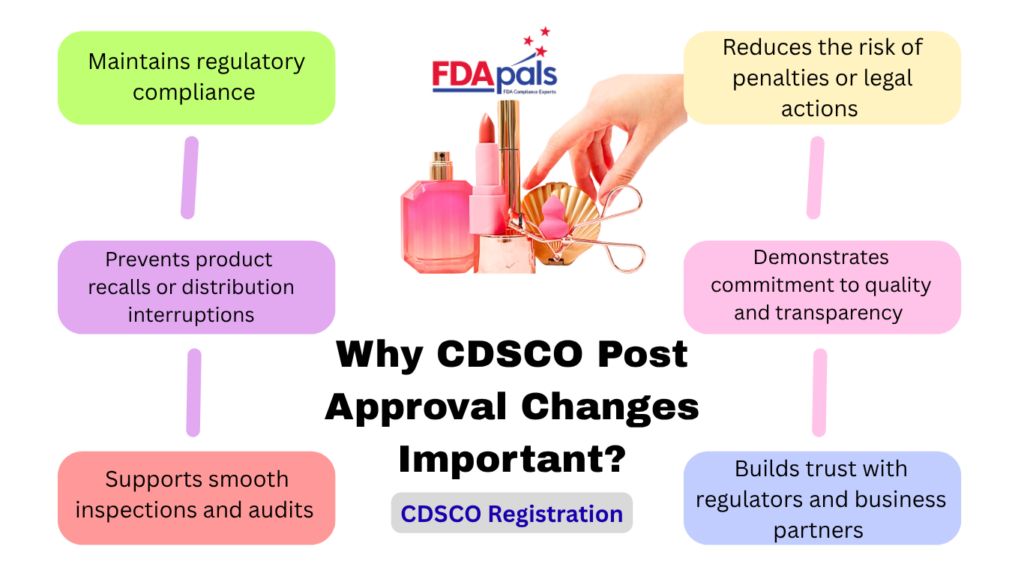
Properly managing Post Approval Changes offers several advantages:
- Maintains regulatory compliance
- Prevents product recalls or distribution interruptions
- Demonstrates commitment to quality and transparency
- Supports smooth inspections and audits
- Builds trust with regulators and business partners
- Reduces the risk of penalties or legal actions
In today’s competitive healthcare market, regulatory compliance is an essential part of maintaining business continuity.
Common Situations That Require Filing Variations
Several business decisions may trigger the need for a Post Approval Change submission.
Some common examples include:
Change in Manufacturing Facility
Companies may relocate production to a new site or add an additional manufacturing location to increase capacity.
Since manufacturing details form part of the original approval, such changes often require regulatory review.
Change in Product Packaging
Businesses frequently redesign packaging for branding or marketing purposes.
Even simple packaging updates may require notification or approval if they affect product information, instructions, or labeling.
Change in Product Label
Labels may be updated to include revised warnings, storage instructions, importer details, or company branding.
Before introducing updated labels into the market, companies should verify whether regulatory approval is necessary.
Change in Raw Material Supplier
Businesses often switch suppliers due to pricing, quality improvements, or supply chain issues.
Regulators may require documentation to ensure that product quality remains consistent despite the supplier change.
Change in Product Composition
If ingredients or components are modified, companies should carefully assess regulatory obligations before marketing the revised product.
Such changes often receive closer scrutiny because they may impact product performance or safety.
Shelf Life Extension
Manufacturers may wish to extend a product’s shelf life based on additional stability studies or accumulated data.
Appropriate documentation should be submitted before implementing such changes.
When Should Companies File Variations?
One of the most common questions businesses ask is
“Should we file before or after implementing the change?”
The answer depends on the nature of the change.
Certain modifications require prior approval before implementation, while others may only require notification to CDSCO. Some minor administrative updates may involve simplified procedures.
Instead of making assumptions, companies should evaluate every proposed change from a regulatory perspective before proceeding.
Taking proactive action is always safer than correcting compliance issues later.
Signs That a Regulatory Review May Be Needed
If your company is planning any of the following, it is advisable to assess whether a variation filing is required:
 Changing packaging artwork
- Revising product labels
- Modifying product specifications
- Changing suppliers
- Updating company ownership information
- Revising storage conditions
- Extending expiry dates
- Introducing manufacturing process improvements
- Updating testing arrangements
- Updating manufacturing details
 Changing packaging artwork
Early regulatory assessment helps prevent costly business disruptions.
How to File CDSCO Post Approval Variations
Although the exact documentation may differ depending on the nature of the change, the overall filing process generally follows a structured approach.
Step 1: Identify the Proposed Change
Clearly define what is changing and why the change is being introduced.
Having complete internal documentation simplifies the regulatory assessment process.
Step 2: Evaluate Regulatory Impact
Determine whether the proposed modification affects information included in the original approval.
This evaluation helps establish whether prior approval, notification, or supporting documentation is required.
Step 3: Prepare Supporting Documents
A comprehensive submission typically includes explanations, supporting evidence, updated records, and any other relevant documents demonstrating that the change will not negatively affect product quality or compliance.
Well-prepared documentation reduces the likelihood of regulatory queries.
Step 4: Submit the Variation Application
Once documentation is complete, the variation request is submitted to CDSCO through the applicable regulatory process.
Accurate submissions improve review efficiency and minimize unnecessary delays.
Step 5: Respond to Regulatory Queries
During review, CDSCO may request clarification or additional information.
Prompt and complete responses help keep the approval process moving smoothly.
Step 6: Implement the Approved Change
After receiving the necessary approval or completing the required regulatory process, companies can implement the approved change while maintaining proper documentation for future inspections.
Common Mistakes Companies Should Avoid
Many regulatory delays occur because of avoidable mistakes rather than the complexity of the process itself.
Some common errors include:
- Implementing changes before obtaining necessary approval
- Assuming all changes are minor
- Submitting incomplete documentation
- Delaying variation filings
- Failing to maintain proper internal records
- Ignoring packaging or labeling updates
- Responding slowly to regulatory queries
Avoiding these mistakes can significantly reduce compliance risks.
Benefits of Proper Post Approval Change Management
Businesses that establish a structured regulatory change management system often experience smoother operations and stronger compliance outcomes.
Some key benefits include:
- Faster regulatory approvals
- Reduced compliance risks
- Better inspection readiness
- Improved operational efficiency
- Fewer market disruptions
- Stronger customer confidence
- Enhanced business reputation
- Easier expansion into new markets
Rather than viewing regulatory filings as an administrative burden, successful companies treat them as part of a long-term quality strategy.
Why Professional Regulatory Support Can Make a Difference
Preparing a variation submission requires careful planning, documentation, and regulatory understanding. Even a small omission can lead to additional queries or delays.
Working with experienced regulatory consultants can help businesses:
- Assess whether a change requires filing
- Prepare complete documentation
- Reduce approval timelines
- Minimize compliance risks
- Manage regulator communications
- Maintain uninterrupted product availability
For companies handling multiple products or frequent updates, expert guidance can save both time and resources.
Conclusion
Business growth often brings change, but every change should be managed responsibly from a regulatory perspective. CDSCO Post Approval Changes ensure that approved products continue to comply with regulatory expectations while allowing manufacturers and importers to improve and expand their operations.
By identifying changes early, evaluating regulatory requirements, and filing variations when needed, companies can avoid unnecessary delays and maintain market continuity. A proactive compliance strategy not only protects your business but also strengthens confidence among regulators, partners, and customers.
Frequently Asked Questions (FAQs)
- What are CDSCO Post Approval Changes?
CDSCO Post Approval Changes (PACs) refer to any modifications made to a drug, medical device, or cosmetic product after it has received regulatory approval from the Central Drugs Standard Control Organization (CDSCO). These changes may involve manufacturing facilities, product labeling, packaging, suppliers, or other approved details. Filing the required variation with CDSCO helps ensure continued regulatory compliance and allows businesses to implement changes without disrupting product availability in the Indian market.
- When should a company file a CDSCO Post Approval Variation?
A company should file a CDSCO Post Approval Variation whenever it plans to make changes that could affect the information submitted during the original approval process. Common examples include changes in manufacturing location, product composition, labeling, packaging, or key suppliers. Filing the variation before implementing the change, when required, helps maintain compliance and prevents regulatory issues, delays, or potential enforcement actions.
- Why are CDSCO Post Approval Changes important?
CDSCO Post Approval Changes are important because they ensure that approved products continue to meet regulatory requirements even after modifications are made. Properly managing these changes demonstrates transparency, maintains product quality, and reduces compliance risks. It also helps companies avoid penalties, product recalls, and interruptions in distribution while building trust with regulators and business partners.
- What types of changes commonly require a CDSCO variation filing?
Several business or operational updates may require a CDSCO variation filing. These include changes to manufacturing facilities, packaging design, product labels, raw material suppliers, shelf life, storage conditions, testing laboratories, and product specifications. Before implementing any modification, companies should evaluate whether regulatory approval or notification is necessary to remain compliant with CDSCO requirements.
- Can a company implement changes before receiving CDSCO approval?
It depends on the nature of the proposed change. Some variations require prior approval from CDSCO before implementation, while others may only require notification or documentation updates. Implementing significant changes without following the appropriate regulatory process may lead to compliance issues or delays. Companies should assess regulatory requirements before making any approved product modifications.
- What documents are generally required for CDSCO Post Approval Changes?
The documentation required for CDSCO Post Approval Changes varies depending on the type of variation. In general, companies may need to submit a cover letter, justification for the change, updated product information, supporting reports, revised labels or packaging, and other relevant documents demonstrating that the modification will not affect product quality or compliance. Well-prepared documentation helps streamline the review process.
- How long does the CDSCO Post Approval Change process take?
The timeline for a CDSCO Post Approval Change depends on the complexity of the variation, the completeness of the submitted documentation, and the need for additional clarifications during the review process. Submitting accurate and well-organized applications can help reduce delays and improve the chances of a smoother approval process.
- Do labeling and packaging updates require CDSCO Post Approval filing?
Many labeling and packaging updates may require regulatory review, especially if they involve changes to mandatory information, warnings, product claims, importer details, or instructions for use. Even when changes appear minor, companies should evaluate whether a CDSCO Post Approval Variation or notification is required before introducing updated packaging into the market.
- What happens if a company does not report required Post Approval Changes to CDSCO?
Failing to report required Post Approval Changes may result in regulatory non-compliance, inspection observations, delays in product distribution, or other enforcement actions. It can also affect a company’s reputation and create challenges during audits or future regulatory submissions. Maintaining a proactive approach to variation filing helps minimize these risks and supports long-term business continuity.
- How can regulatory consultants help with CDSCO Post Approval Changes?
Regulatory consultants can assist companies by evaluating whether a proposed change requires a variation filing, preparing the necessary documentation, managing submissions, and responding to regulatory queries. Their expertise helps reduce compliance risks, avoid unnecessary delays, and ensure that Post Approval Changes are handled efficiently in line with CDSCO expectations. Businesses with frequent product updates often benefit from professional regulatory support to maintain smooth operations and market access.