
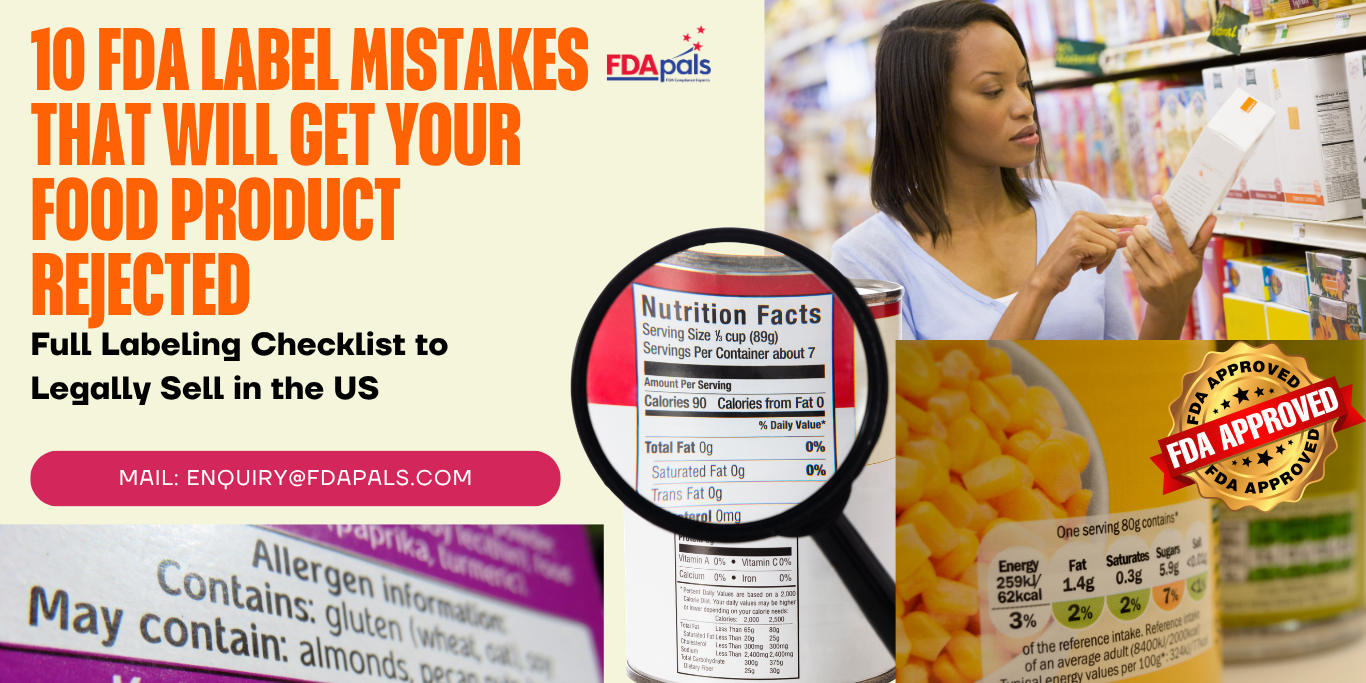
Are you looking to ship or market your foods and food products within the United States? It’s crucial to note that your product label is not only for marketing purposes; it is mandatory and legally required. A slight error on your product label could result in your goods being detained or even denied at the port of entry. Contact FDA food facility registration services provider to avoid the common FDA label mistake that gets your food product rejected.
The U.S. Food and Drug Administration (FDA) has strict food labeling regulations to ensure consumers receive accurate, clear, and non-misleading information about the food they purchase. Whether you’re a manufacturer, exporter, or private label brand, understanding these requirements is essential.
In this blog, we, FDApals, will look into the complete FDA food labeling requirements and the full checklist to legally sell your food facility in the US market. We guide you, explaining each required element in detail so you can stay compliant and avoid costly mistakes.
Top 10 FDA Label Mistakes That Will Get Your Food Product Rejected: –
1. Statement of Identity (Product Name)
The statement of identity tells the consumer exactly what the product is. This is typically the product name, such as “Strawberry Jam,” “Potato Chips,” or “Almond Milk.”
Key Requirements:
- Must appear on the Principal Display Panel (PDP)—the front of the package
- Should be clear, prominent, and easy to read
- Must use the common or usual name of the food
❌ Common Mistakes:
- Using vague or marketing-heavy names instead of the actual product identity
- Making the name too small or hard to read
👉 For example, calling a product “Nature Delight” without specifying it’s a granola bar can lead to compliance issues.
2. Net Quantity of Contents
This element tells consumers how much food is inside the package.
Key Requirements:
- Must be displayed in:
- U.S. customary units (ounces, pounds)
- Metric units (grams, kilograms, milliliters)
- Placed on the lower 30% of the front panel
- Must be accurate and not misleading
Example:
“Net Wt. 8 oz (227 g)”
❌ Common Mistakes:
- Using only metric units (common for exporters)
- Incorrect placement or font size.
- Inconsistent weight due to poor filling controls/Wrong net quantity (weight/volume)
3. Nutrition Facts Panel
The Nutrition Facts label is one of the most detailed and strictly regulated parts of your packaging.
Key Requirements:
✅ Must follow the standard FDA format
- Include:
- Serving size
- Calories
- Total fat, saturated fat, trans fat
- Cholesterol, sodium
- Total carbohydrates, dietary fiber, total sugars, added sugars
- Protein
- Key vitamins and minerals
Why It Matters:
The FDA updated its labeling rules under the Food Safety Modernization Act to improve transparency and public health awareness.
- Incorrect serving size calculations
- Missing “Added Sugars.”
- Using outdated label formats
👉 Even small formatting errors (like font size or line thickness) can result in non-compliance.
❌ Common Mistakes:
- Incorrect Nutrition Facts Panel
- Wrong format or outdated design
- Missing serving size or calories
- Incorrect font size/layout
- Not following U.S. Food and Drug Administration rules
4. Ingredient List
The ingredient list provides transparency about what’s inside your product.
Key Requirements:
- List all ingredients in descending order by weight
- Use common or usual names (e.g., “sugar” instead of “sucrose”)
- Include sub-ingredients for compound ingredients
Example:
“Ingredients: Wheat flour, sugar, vegetable oil (palm oil, sunflower oil), cocoa powder…”
❌ Common Mistakes:
- Improper Ingredient Listing
- Ingredients not in descending order
- Using non-standard or vague names
- Missing sub-ingredients or additives
👉 This section is closely scrutinized during inspections.
5. Allergen Declaration
Allergen labeling is critical for consumer safety and strictly enforced in the U.S.
Key Requirements:
You must declare major allergens such as:
- Milk, Eggs, Fish, Shellfish
- Tree nuts, Peanuts
- Wheat, Soy, Sesame
This requirement comes under the Food Allergen Labeling and Consumer Protection Act.
How to Declare:
- Either within the ingredient list
- Or in a separate statement like
“Contains: Milk, Soy”
❌ Common Mistakes:
- Missing or not mentioning a major allergen
- Using unclear terms (e.g., “nuts” instead of “almonds”)
- Not updating labels when formulations change
- Hidden allergens in ingredients
6. Name and Address of Responsible Party
This identifies who is responsible for the product.
Key Requirements:
- Include:
- Company name
- City, state, and ZIP code
- Must be a U.S. address for imported products (or include importer details)
❌ Common Mistakes:
Missing Manufacturer Details
- No company name or address
- Incomplete contact details
- Not mentioning the importer (for foreign brands)
👉 If your business is not listed in a public directory, a full street address is required.
7. Country of Origin
For imported products, country of origin labeling is mandatory.
Key Requirements:
- Must clearly state the origin, e.g.,
“Product of India” - Should be easy to find and read
Why It Matters:
This is enforced by U.S. customs and helps ensure transparency for consumers.
❌ Common Mistakes:
- Omitting origin information
- Hiding it in small or unreadable text
8. Lot / Batch / Code Number
While not always consumer-facing, this is essential for traceability.
Key Requirements:
- Helps identify production batches
- Critical for recalls and quality control
Common Mistakes:
- Not including any batch coding
- Using codes that are difficult to trace internally
👉 This is especially important under preventive control systems encouraged by the Food Safety Modernization Act.
9. Date Marking (If Applicable)
Date labels help indicate product freshness and shelf life.
Key Points:
- Not federally required for all foods
- Common formats:
- “Best Before.”
- “Use By”
- “Expiration Date”
❌ Common Mistakes:
- Using unclear formats
- Not aligning with actual shelf-life studies
👉 While not always mandatory, it’s highly recommended for consumer trust.
10. Special Labeling Claims (If Used)
If your product includes claims, they must meet strict definitions.
Examples:
- “Gluten-Free”
- “Low Fat”
- “Sugar-Free”
- “Organic” (regulated by the USDA Organic Program)
Key Requirements:
- Claims must be truthful and verifiable
- Must meet FDA or USDA standards
❌ Common Mistakes:
- Using claims without scientific backing
- Misusing terms like “Natural” or “Healthy”
👉 Misleading claims can result in your product being classified as misbranded.
Click to get your free labeling requirement checklist.
🚫 What Happens If You Get It Wrong?
Failure to comply with FDA labeling requirements can result in:
- Detention of goods at U.S. ports
- Refusal of entry
- Product recalls
- Financial losses due to relabeling or destruction
For exporters, labeling mistakes are one of the top reasons shipments are rejected.
Final Thoughts: Your Label Is Your Passport to the U.S. Market
Think of your food label as a compliance checklist, not just a design element. Every detail—from font size to ingredient order—plays a role in determining whether your product meets all regulatory standards that can legally be sold in the United States.
The good news? Once you understand the requirements set by the U.S. Food and Drug Administration, compliance becomes a structured and manageable process.
Before shipping your product:
✔ Double-check every label element
✔ Verify formatting and placement
✔ Ensure all claims are substantiated
A well-designed, compliant label doesn’t just help you avoid rejection—it builds trust, credibility, and long-term success in the U.S. market.
💡 Pro Tip
If you’re exporting for the first time, consider getting your label reviewed by an FDA compliance expert. A small upfront investment can save you from major losses and delays later.
FAQ
Q. 1) What happens if my food label is rejected by the FDA?
Ans: Your product may be denied entry into the U.S. market, delayed, or even recalled if already distributed.
Q. 2) Is FDA approval required for food labels?
Ans: The FDA does not pre-approve labels, but they must comply with all regulations. Non-compliance can lead to enforcement actions.
Q. 3) Can I use “natural” or “organic” on my label?
Ans: Yes, but only if your product meets specific criteria. Misuse can result in penalties.
Q. 4) How often do FDA labeling rules change?
Ans: FDA regulations are updated periodically, so it’s important to stay current with the latest guidelines.
Q. 5) Should I hire a consultant for FDA labeling?
Ans: If you’re new to the U.S. market, working with an expert can help you avoid costly mistakes and ensure faster compliance.
Other Services (Quick Links)
- ✅ FDA Food Label Compliance Services
- ✅ Nutrition Facts Panel Creation (FDA Format)
- ✅ Ingredient & Allergen Review
- ✅ FDA Food Facility Registration
- ✅ U.S. Agent Services (for Foreign Companies)
- ✅ FSSAI to FDA Transition Support
- ✅ Import Documentation & Compliance
- ✅ Product Label Audit & Correction
- ✅ Claims Verification (Organic, Natural, Sugar-Free)
- ✅ Regulatory Consulting for U.S. Market Entry
- ✅ Packaging & Label Design as per FDA Guidelines
- ✅ Shelf-Life & Stability Guidance
- ✅ Food Product Compliance Check for Amazon/Export
- ✅ Free Labelling Requirement Checklist
- ✅ Free FDA food facility registration Checklist