The baby-care market in India is growing rapidly, with parents becoming increasingly conscious about the products they use on their children’s delicate skin. From baby lotions and creams to shampoos, oils, wipes and other personal-care products, demand for baby cosmetics continues to increase.
But if you are a manufacturer, importer, brand owner or distributor planning to introduce baby cosmetic products in the Indian market, there is one important question you cannot ignore:
Do you need Baby Cosmetics Registration in India?
The answer depends on how the product is manufactured and marketed in India.
For imported cosmetic products, registration with the Central Drugs Standard Control Organization (CDSCO) is an important regulatory requirement before the products can be imported into India. Cosmetics manufactured in India are regulated through a licensing system under the applicable Cosmetics Rules, with the manufacturing licence handled by the State Licensing Authority.
Because baby products are intended for a particularly sensitive consumer group, regulatory compliance, product safety, ingredient suitability and labeling deserve careful attention.
This guide explains the basics of Baby Cosmetics Registration India, the registration process, documents, labeling requirements and common compliance issues.
What Is Baby Cosmetics Registration in India?
There is no separate registration certificate called a “Baby Cosmetics Registration Certificate” simply because a product is intended for babies.
Instead, baby-care products that fall within the legal definition of a cosmetic are regulated under India’s cosmetics framework.
Under the Drugs and Cosmetics Act, a cosmetic generally includes articles intended for cleansing, beautifying, promoting attractiveness or altering appearance, including products applied to the human body.
Examples of products that may fall within the cosmetics category include:
- Baby lotions
- Baby creams
- Baby body washes
- Baby shampoos
- Baby oils
- Baby powders
- Baby soaps
- Baby moisturizers
- Certain baby wipes and cleansing products
- Other products intended for cosmetic use
However, classification should always be evaluated based on the product’s ingredients, intended use, claims and presentation.
This is particularly important when a product makes therapeutic or medicinal claims. A product marketed as treating a disease, infection or medical condition may raise a different regulatory question than a conventional cosmetic.
Who Regulates Baby Cosmetics in India?
India follows different regulatory pathways depending on whether the cosmetic is manufactured domestically or imported.
For Imported Baby Cosmetics
Imported cosmetics are regulated by the CDSCO, under the Central Licensing Authority.
The Cosmetics Rules, 2020 provide that a cosmetic cannot be imported into India unless it has been registered according to the applicable requirements. The application for an imported cosmetic is submitted online in Form COS-1, and the Import Registration Certificate is issued in Form COS-2 when approved.
CDSCO also states that a cosmetic intended for import must be registered along with details such as the pack size, variants and manufacturing premises.
For Baby Cosmetics Manufactured in India
If you are manufacturing baby cosmetics in India, the regulatory pathway is different.
Manufacture of cosmetics is regulated through a licensing system administered by the relevant State Licensing Authority. Under the Cosmetics Rules, 2020, a manufacturing licence is granted in Form COS-8, while a loan licence is granted in Form COS-9.
Therefore, before starting the regulatory process, determine whether your business is:
Importing the finished cosmetic → CDSCO registration
or
Manufacturing the cosmetic in India → State cosmetic manufacturing licence
This distinction can save considerable time and prevent submission under the wrong regulatory route.
Why Is Compliance Especially Important for Baby Cosmetics?
Baby skin is often treated with greater care by consumers because parents are naturally concerned about ingredients, quality and safety.
For a brand, this means regulatory compliance is not merely paperwork.
A product may have attractive packaging and strong marketing potential, but it still needs to satisfy applicable regulatory requirements before entering the market.
For imported products, CDSCO requires cosmetics to comply with applicable quality and safety requirements. The Cosmetics Rules also restrict false or misleading claims.
Therefore, companies should review:
- Product composition
- Ingredient information
- Product category
- Intended use
- Product claims
- Manufacturing site
- Packaging
- Label information
- Safety and quality documentation
- Free Sale Certificate and other supporting documents, where applicable
A strong regulatory review at the beginning can reduce the risk of questions, delays or compliance problems later.
Documents Required for Baby Cosmetics Registration in India
The exact documentation can vary depending on the product, manufacturer, country of origin and application circumstances.
For imported cosmetics, the CDSCO application is submitted online through the applicable system, and the manufacturer’s authorization and supporting documentation form an important part of the application.
Commonly required documents may include:
1. Manufacturer Authorization
The foreign manufacturer generally needs to authorize the Indian applicant/agent or other eligible entity to act for the registration process.
CDSCO’s current guidance specifies requirements relating to authentication of the authorization and details of the manufacturer, manufacturing premises, authorized Indian agent, cosmetic products and manufacturing sites.
2. Product Details
Information about the baby cosmetic should be prepared carefully, including:
- Product name
- Product category
- Variant
- Pack size
- Intended use
- Ingredient information
- Manufacturing site
- Brand details
3. Free Sale Certificate
A Free Sale Certificate or equivalent supporting documentation may be required depending on the application and country of origin.
The documentation should be consistent with the product information submitted in the application.
4. Product and Manufacturing Information
Details concerning the product and manufacturing facility may be required to establish the identity and regulatory status of the cosmetic.
5. Label and Packaging Information
Labels should be reviewed before submission rather than after the registration process.
Any mismatch between the submitted product information and the final commercial packaging can create unnecessary compliance issues.
6. Supporting Regulatory Documents
Depending on the product and application, additional documents, declarations, certificates or supporting information may be requested.
CDSCO’s guidance document provides a detailed framework for submitting applications through Form COS-1 and identifies documentation requirements for the import registration process.
Baby Cosmetics Registration Process in India
The registration process for imported baby cosmetics can broadly be understood in the following steps.
Step 1: Determine Product Classification
First, establish whether the product qualifies as a cosmetic under Indian regulations.
Review its:
- Ingredients
- Intended purpose
- Product claims
- Method of use
- Labeling and presentation
This is one of the most important stages because the regulatory pathway depends on proper classification.
Step 2: Review the Product Formula
The formulation should be reviewed against applicable Indian cosmetic requirements and standards.
For baby products, companies should pay particular attention to the suitability of ingredients, product safety and applicable restrictions.
Step 3: Review Manufacturer and Product Documents
Collect the manufacturer’s authorization, product information, manufacturing-site details, Free Sale Certificate and other required supporting documents.
All documents should be consistent.
Step 4: Prepare the CDSCO Application
For imported cosmetics, the application is submitted online in Form COS-1 through the CDSCO online system/SUGAM process. CDSCO’s current guidance specifically confirms online submission through the SUGAM portal.
Step 5: Upload the Required Documents
The applicable checklist documents are uploaded electronically as part of the application.
The documents should be properly organized and the product information should match across the application, certificates, authorization documents and labels.
Step 6: Regulatory Review
The application is reviewed by the designated regulatory officials.
If the application is satisfactory, it can proceed toward approval by the Licensing Authority.
If discrepancies are identified, the applicant may receive queries requiring clarification or additional compliance.
Step 7: Registration Approval
Once the application satisfies the applicable requirements, the Import Registration Certificate is issued in Form COS-2.
The Cosmetics Rules, 2020 provide that the registration certificate remains valid in perpetuity, subject to payment of the applicable retention fee.
Baby Cosmetics Labeling Requirements
Regulatory compliance does not end with obtaining registration.
The product label is one of the most visible parts of regulatory compliance and should be reviewed carefully before commercialization.
Depending on the product and applicable requirements, labels may need information such as:
- Product name
- Manufacturer details
- Importer details, where applicable
- Net contents
- Batch or lot information
- Manufacturing information
- Use directions
- Applicable warnings or precautions
- Ingredient information
- Other mandatory declarations
The exact labeling requirements should be evaluated according to the applicable provisions and product category.
Be Careful With Baby-Care Claims
This is an area where marketing teams sometimes create regulatory problems without realizing it.
Statements such as:
“Safe for babies”
“Gentle on baby’s skin”
“Dermatologically tested”
“Natural baby care”
or stronger claims relating to treatment, prevention or cure should be supported appropriately and reviewed for regulatory compliance.
CDSCO states that a cosmetic must not make claims that are false or misleading to the intended user.
For this reason, regulatory review should ideally take place before the packaging is finalized.
Common Mistakes in Baby Cosmetics Registration
Many registration problems are not caused by complicated regulations. They happen because basic information does not match.
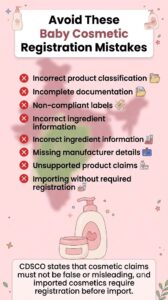 Here are some common issues businesses should avoid:
1. Incorrect Product Classification
A company may assume that every baby-care product is automatically a cosmetic.
However, classification should be based on the product’s intended use, claims and other characteristics.
2. Inconsistent Documents
The product name, manufacturer name, manufacturing address, pack size or variant may differ between documents.
Even small inconsistencies can result in regulatory queries.
3. Ignoring Label Compliance
Some businesses prepare registration documents first and think about labels later.
It is better to review the proposed label during the regulatory preparation stage.
4. Unsupported Claims
Marketing claims should not go beyond what can be appropriately supported and what is permitted for a cosmetic.
5. Assuming Registration Covers Every Variant
CDSCO indicates that imported cosmetics are registered with details including pack size and variants.
Therefore, businesses should understand exactly what products, variants and manufacturing premises are covered by their registration.
6. Treating Imported and Domestic Manufacturing as the Same
Imported cosmetics and cosmetics manufactured in India follow different regulatory pathways.
Understanding this distinction at the beginning can prevent an unnecessary regulatory detour.
How FDA Pals Can Help With Baby Cosmetics Registration India
For an international cosmetic manufacturer or an Indian importer, navigating regulatory requirements can become time-consuming, particularly when several products, variants or manufacturing sites are involved.
FDA Pals provides regulatory support to businesses looking to bring baby cosmetic products into the Indian market.
Our support can include:
- Product regulatory assessment
- Cosmetic classification support
- Documentation review
- CDSCO registration guidance
- Form COS-1 application support
- Manufacturer authorization review
- Label and packaging compliance review
- Product and variant documentation
- Query response support
- Regulatory compliance guidance
Our objective is simple: to help businesses understand the regulatory requirements clearly and prepare their applications correctly from the beginning.
Frequently Asked Questions About Baby Cosmetics Registration India
1. Is Baby Cosmetics Registration mandatory in India?
For imported cosmetics falling under the applicable cosmetic definition, registration is required before import into India under the Cosmetics Rules, 2020. Domestic manufacturing follows the applicable cosmetic manufacturing licensing requirements.
2. Does CDSCO regulate imported baby cosmetics?
Yes. Imported cosmetics are regulated through the Central Licensing Authority under CDSCO, while cosmetic manufacturing in India is regulated through the applicable State Licensing Authority.
3. What form is used for imported cosmetic registration?
An application for registration of an imported cosmetic is made online in Form COS-1. The Import Registration Certificate is issued in Form COS-2 when approved.
4. Do baby lotion and baby shampoo require registration if imported?
If the products fall within the definition of cosmetics and are intended for import into India, they are subject to the applicable cosmetic import registration requirements.
5. Is a separate registration required for every baby cosmetic?
The regulatory treatment depends on the products, variants, pack sizes and manufacturing premises covered by the application. These details should be reviewed before submission rather than assuming that one registration automatically covers every product.
6. Can a foreign manufacturer apply for cosmetic registration?
The Cosmetics Rules permit an application to be made by the manufacturer itself or through an authorized agent/importer in India or an appropriately authorized Indian subsidiary, as applicable.
7. How long is the cosmetic registration valid?
Under the Cosmetics Rules, 2020, the Registration Certificate in Form COS-2 remains valid in perpetuity, subject to payment of the applicable retention fee.
Final Thoughts
Launching a baby-care brand in India can be an exciting business opportunity, but regulatory compliance should be part of the launch strategy from day one.
For imported baby cosmetics, Baby Cosmetics Registration India is an important regulatory step before the products enter the Indian market. From product classification and formulation review to documentation, labeling and CDSCO submission, every part of the application should be prepared carefully.
A well-prepared regulatory submission does more than help with registration. It gives your business a stronger foundation for entering the Indian market with confidence.
If you are planning to import baby cosmetics into India or launch an international baby-care brand in the Indian market, FDA Pals can help you understand the applicable regulatory pathway and prepare your cosmetic registration documentation.